Skip to main content Skip to main navigation
heart-solid My Visit Donate
Home Smithsonian Institution IK development site for ODI
Press Enter to activate a submenu, down arrow to access the items and Escape to close the submenu.
    • Overview
    • Museums and Zoo
    • Entry and Guidelines
    • Museum Maps
    • Dine and Shop
    • Accessibility
    • Visiting with Kids
    • Group Visits
    • Overview
    • Exhibitions
    • Online Events
    • All Events
    • IMAX & Planetarium
    • Overview
    • Topics
    • Collections
    • Research Resources
    • Stories
    • Podcasts
    • Overview
    • For Caregivers
    • For Educators
    • For Students
    • For Academics
    • For Lifelong Learners
    • Overview
    • Become a Member
    • Renew Membership
    • Make a Gift
    • Volunteer
    • Overview
    • Our Organization
    • Our Leadership
    • Reports and Plans
    • Newsdesk
heart-solid My Visit Donate
  1. Home
  2. forward-slash
  3. About
  4. forward-slash
  5. Newsdesk
  6. forward-slash
  7. Photos and Video
  8. forward-slash
  9. Idiacanthus 1b

About

  • Overview
  • Our Organization
    • Board of Regents
    • Museums and Zoo
    • Research Centers
    • Cultural Centers
    • Education Centers
    • General Counsel
    • Office of Human Resources
    • Office of Equal Opportunity
    • Office of Sponsored Projects
    • Office of Protection Services
  • Our Leadership
  • Reports and Plans
    • Annual Reports
    • Strategic Plan
    • Smithsonian Dashboard
  • Newsdesk
    • News Releases
    • Media Contacts
    • Photos and Video
    • Media Kits
    • Fact Sheets
    • Visitor Stats
    • Secretary and Admin Bios
    • Filming Requests

Idiacanthus 1b

Media Photo/Video

July 16, 2020

Karen Osborn, Smithsonian

download Download karen_-_idiacanthus_1450747-8-2_sm.jpg

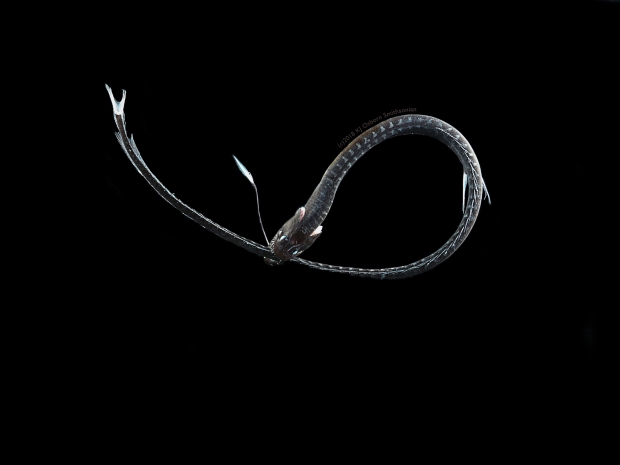
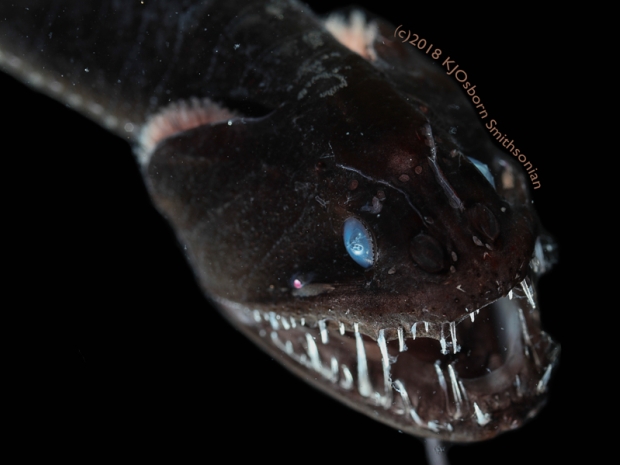
The ultra-black Pacific blackdragon (Idiacanthus antrostomus), the second-blackest fish studied by the research team. These fish have a bioluminescent lure that they use to attract prey, and if not for their ultra-black skin and transparent, anti-reflective teeth, the reflection of their lure would scare prey away. The Pacific blackdragon also has light-producing organs below their eyes that scientists expect might be used as a searchlight to spot prey.

In the July 16 issue of the journal Current Biology, a team of scientists led by Smithsonian’s National Museum of Natural History research zoologist Karen Osborn and Duke University biologist Sönke Johnsen report on how a unique arrangement of pigment-packed granules enables some fish to absorb nearly all of the light that hits their skin, so that as little as 0.05% of that light is reflected back.

Tags
Research News

Tags

  • Research News

Related Media

Deep-sea ultra black fish

Image

document

Anoplogaster 1b

07.16.2020
Deep-sea ultra black fish

Image

document

Idiacanthus 1a

07.16.2020
Idiacanthus

Image

document

Idiacanthus 1c

07.16.2020

Related Content

  • Scientists Discover How Deep-Sea, Ultra-Black Fish Disappear

    Deep in the ocean, where sunlight barely reaches, Smithsonian scientists and a team of collaborators have discovered one of the blackest materials known: the skin of certain fish.

    • July 16, 2020
    • News Release
    • Natural History Museum
    • Research News
arrow-up Back to top
Home
  • Facebook facebook
  • Instagram instagram
  • LinkedIn linkedin
  • YouTube youtube

  • Contact Us
  • Get Involved
  • Shop Online
  • Job Opportunities
  • Equal Opportunity
  • Inspector General
  • Records Requests
  • Accessibility
  • Host Your Event
  • Press Room
  • Privacy
  • Terms of Use