
Cosmetics and Personal Care Products
Baby Products
This section includes products such as baby powders and shampoos. The text below provides some historical context and shows how we can use these products to explore aspects of American history, for example, product safety concerns and monitoring. To skip the text and go directly to the objects, CLICK HERE
For the past century, baby hygiene products have been commonly stocked by American druggists. Baby powder was marketed by Johnson & Johnson in 1894 and by Mennen in 1898, and baby products expanded to include baby shampoos, oils, lotions, and creams. These products are marketed to address the particular daily hygiene needs of infants: mainly the need to clean tender skin without irritating it, to prevent skin irritations caused by moisture, and to treat diaper rash.
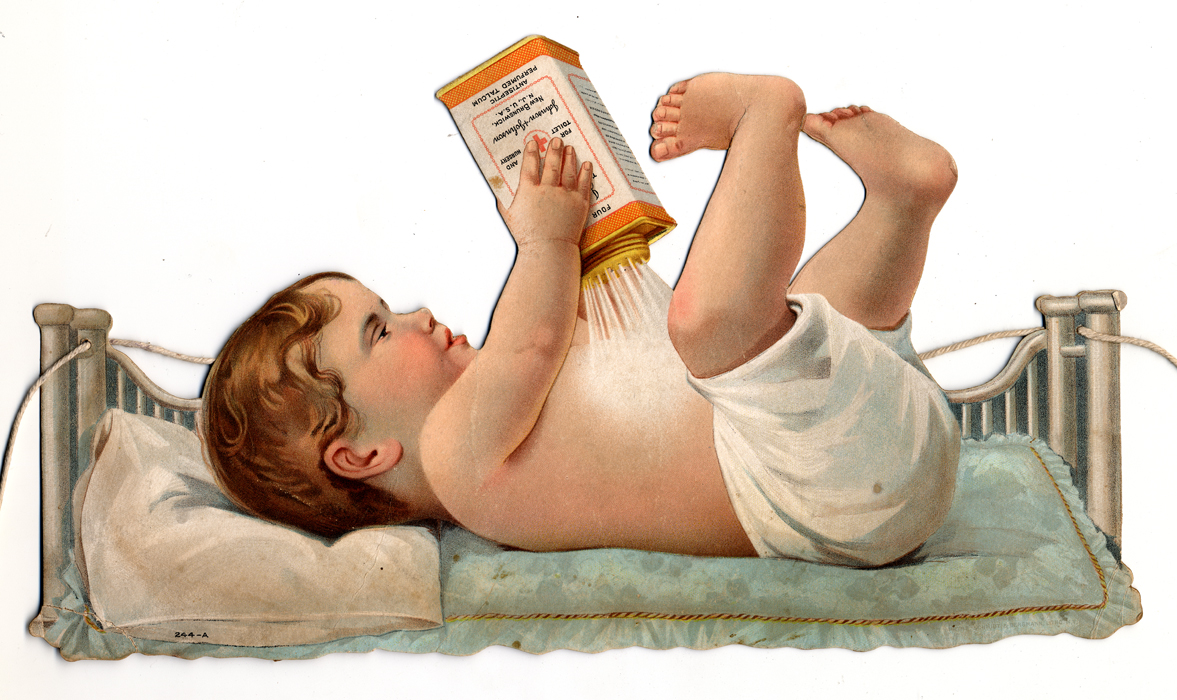 |
| Johnson's Baby Powder advertisement, Warshaw Collection of Business Americana, Archives Center, National Museum of American History, Smithsonian Institution |
Baby hygiene products reflect American concerns about personal care product safety, as well as the ways medical expertise has been invoked to endorse hygiene and infant care practices and products. Marketing for baby products consistently addresses parents’ safety concerns by focusing on a product’s gentleness, purity, and general safety. The baby hygiene product industry arose during a time in American history when proper baby care practices were changing. Traditionally, mothers and grandmothers had been the source of authority for proper baby care practices; they developed and passed down baby care techniques and recipes for homemade products. During the mid-nineteenth century, doctors began to replace mothers as the source of authority. Doctors created manuals to educate mothers about what they believed were the most current, scientifically-supported baby care practices and products. Mothers were encouraged to participate in “scientific motherhood”—to seek scientific and medical counsel on how to care for their children.
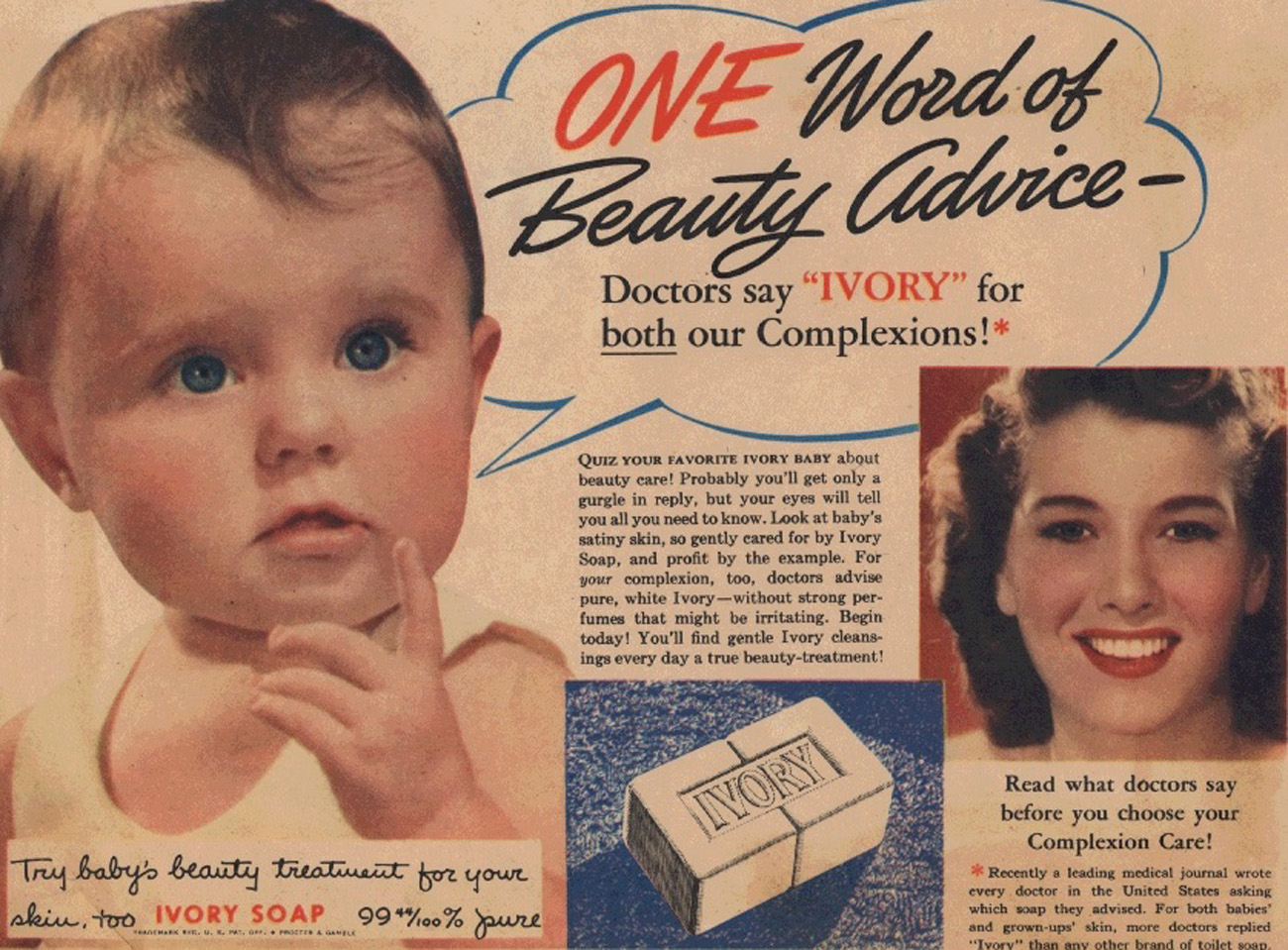 |
| Ivory Soap advertisement, 1941: "Doctors say 'Ivory'" and "99 44/100% Pure." Ivory Soap Advertising Collection, Archives Center, National Museum of American History, Smithsonian Institution |
Ivory Soap, introduced by Proctor and Gamble in 1879, is perhaps the most famous product to address these parental concerns. The brand’s long-running advertising campaigns have claimed that the soap is “99 44/100% Pure” and that more doctors advise the use of Ivory than any other soap.
The Ivory company reinforced their product’s medical credentials through promotional “how-to” manuals for new mothers, such as the 1941 “Bathing Your Baby the Right Way.”
The manual focuses on safe ways to handle and hold a baby, safety measures to be taken against germs and infection, and safe products to use for baby hygiene. The manual states that the instructions “given in this booklet are the same methods preferred by doctors and nurses everywhere.” These general instructions are paired with the claim that the Ivory brand is the safest soap for tender baby skin, and suggestions for other ways mothers should use Ivory to care for their babies. The manual exemplifies how the baby product industry increasingly linked product consumption with modern medical opinion and scientific research.
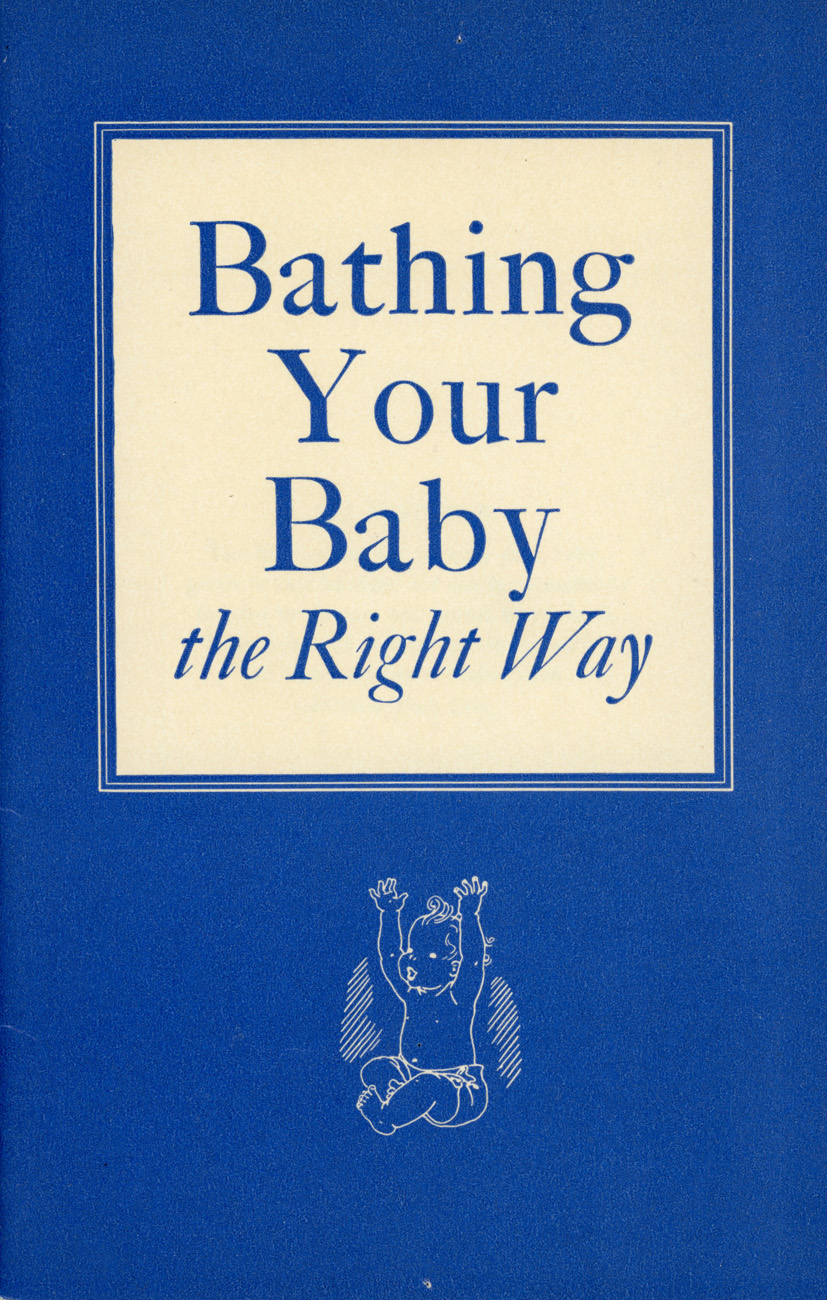 |
| 1941 -“Bathing Your Baby the Right Way” |
Many adults choose baby products for their own use, assuming that the products are also extremely gentle, and perhaps safer, on adult bodies. Products such as Mennen Borated Talc or Johnson & Johnson’s Toilet and Baby Powder have included adult uses on packaging—as a shaving powder, a foot powder, a toilet powder, for sunburn, prickly heat, and to remove all odor of perspiration.
However, assumptions and scientific evidence about cosmetic ingredients and product safety have changed over time, and the safety of some traditional cosmetic ingredients used in baby products has come into question.
For example, in the 1960s and 1970s, some talcum powders, from which baby powder has traditionally been made, were found to be contaminated with asbestos, a known carcinogen. The FDA says that all talc sold in the United States must be safe for consumer use, and therefore free of asbestos. However, there is no agency responsible for monitoring or ensuring that this is actually the case—cosmetic companies are solely responsible for their claims that their products are safe and asbestos-free. Some researchers contend that cosmetic products containing talc still test positive for asbestos.
Even if it is free of asbestos, talc is still dangerous to breathe in repeatedly. Addressing public perceptions about product safety, some companies began offering baby powder made of corn starch, as an alternative to talc. The American Academy of Pediatrics currently recommends against using baby powder on babies, especially talc-based powders and to a lesser degree cornstarch powders, because of the danger of respiratory irritation or injury. However, many baby products and myriad adult cosmetic products are still made with talc, and recent research has raised safety concerns about adult usage of talcum powders. At this time, studies are inconclusive and contradictory regarding possible links between the use of talc on the genitals and ovarian and uterine cancers.
Baby shampoos, lotions, and powders have also come under examination as potential sources of phthalates, triclosan, formaldehyde, and parabens. Some companies have responded to consumer concerns about these substances by removing or gradually phasing out their use in baby products. Some researchers contend that the focus on providing products that are “gentle” in the short term has distracted us from considering whether those products might contain substances that could be harmful in the longer term.
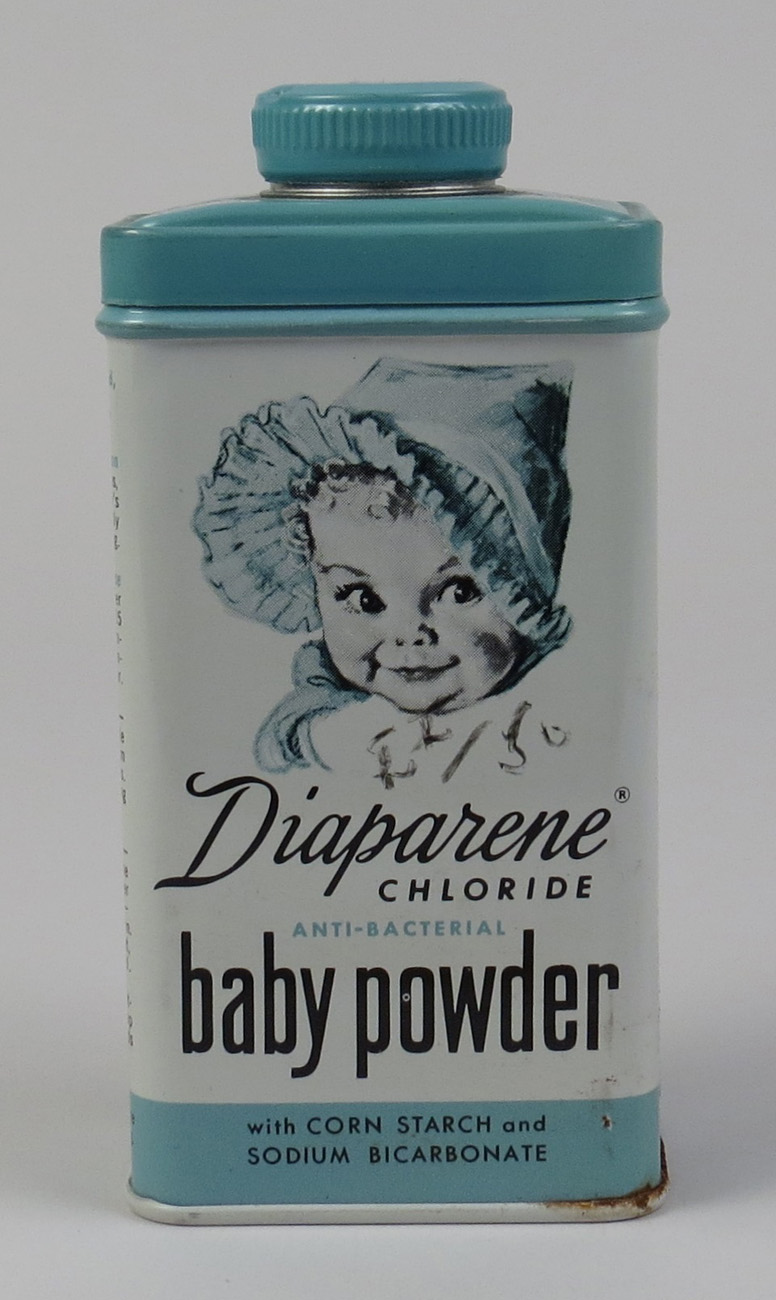 | 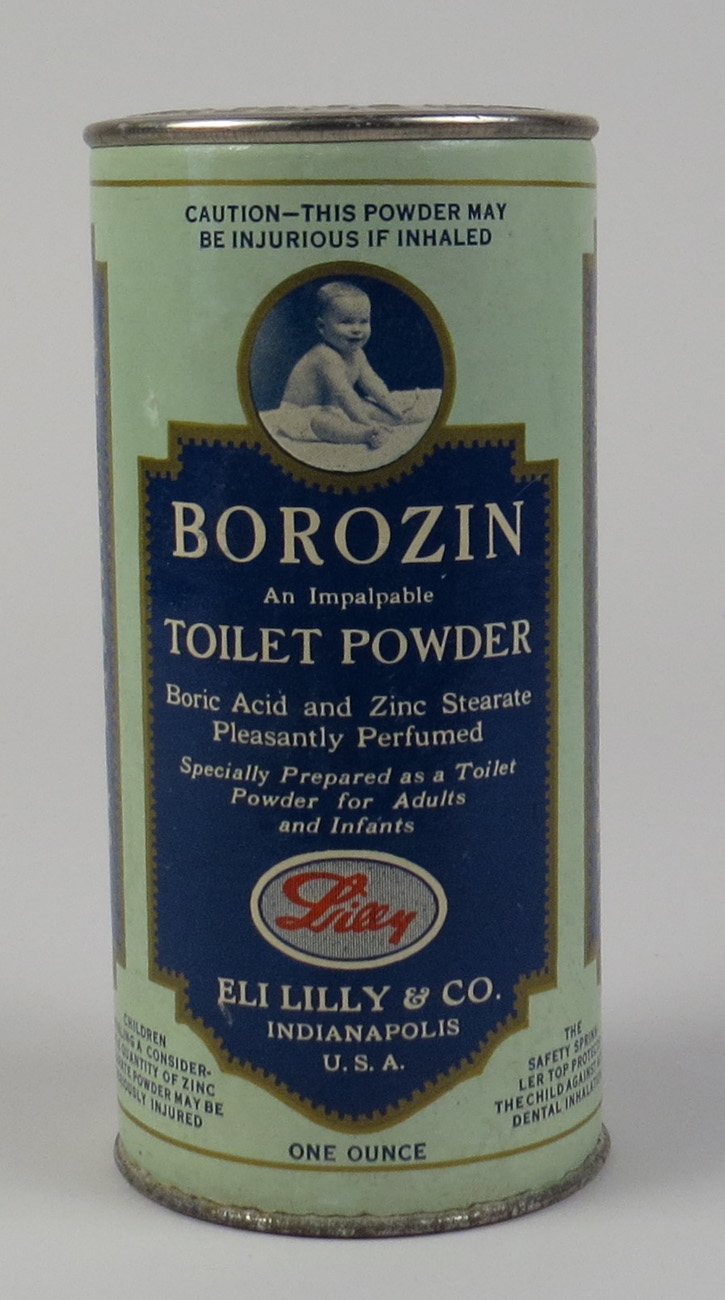 | 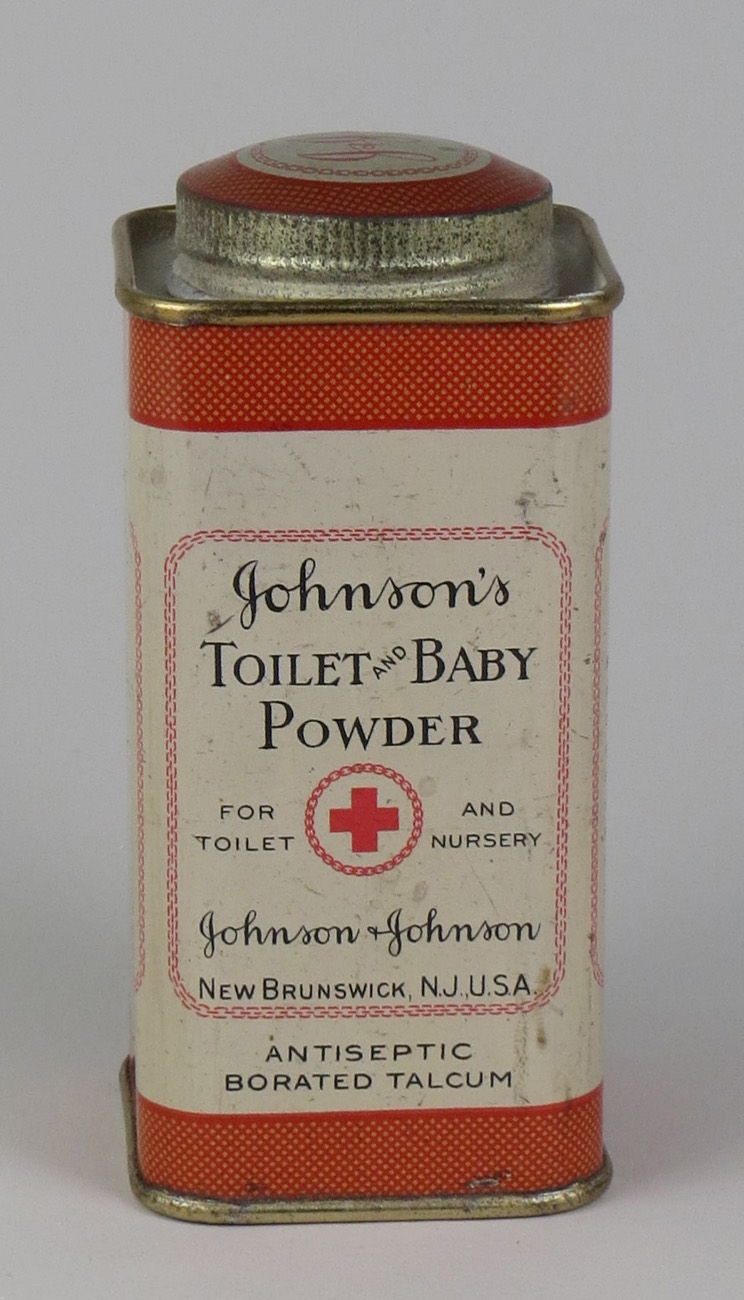 |
| Diaparene, corn starch and sodium bicarbonate | Borozin Toilet Powder, boric acid and zinc stearate | Johnson's Toilet and Baby Powder, borated talcum |
Bibliography ~ see the Bibliography Section for a full list of the references used in the making if this Object Group. However, the Baby Products section relied on the following references:
Apple, Rima D. Perfect Motherhood: Science and Childrearing in America. New Brunswick, N.J: Rutgers University Press 2006.
Center for Food Safety and Applied Nutrition. “Ingredients - Phthalates.” WebContent. Accessed May 6, 2016. https://www.fda.gov/Cosmetics/ProductsIngredients/Ingredients/ucm128250.htm.
Gordon, Ronald E, Sean Fitzgerald, and James Millette. “Asbestos in Commercial Cosmetic Talcum Powder as a Cause of Mesothelioma in Women.” International Journal of Occupational and Environmental Health 20, no. 4 (October 2014): 318–32. doi:10.1179/2049396714Y.0000000081.
Kay, Jane. “Johnson & Johnson Removes Some Chemicals from Baby Shampoo, Other Products.” Scientific American. Accessed May 6, 2016. https://www.scientificamerican.com/article/johnson-and-johnson-removes-some-chemicals-from-baby-shampoo-other-products/.
Lemus, Cheryl. “Save Your Baby, Save Ten Percent: National Baby Week, The Infants’ Department, and the Modern Pregnant Woman, 1905-1925.” Journal of Women’s History 25, no. 3 (2013): 165–87. doi:10.1353/jowh.2013.0031.
Rohl, Arthur N., and Arthur M. Langer. “Identification and Quantitation of Asbestos in Talc.” Environmental Health Perspectives 9 (December 1974): 95–109.
Sathyanarayana, Sheela, Catherine J. Karr, Paula Lozano, Elizabeth Brown, Antonia M. Calafat, Fan Liu, and Shanna H. Swan. “Baby Care Products: Possible Sources of Infant Phthalate Exposure.” Pediatrics 121, no. 2 (February 1, 2008): e260–e268. doi:10.1542/peds.2006-3766.
“Study: Cosmetic Talc Products Carry Asbestos Peril - Seattlepi.com.” Accessed May 9, 2016. https://www.seattlepi.com/national/article/Study-Cosmetic-talc-products-carry-asbestos-peril-5861858.php.