
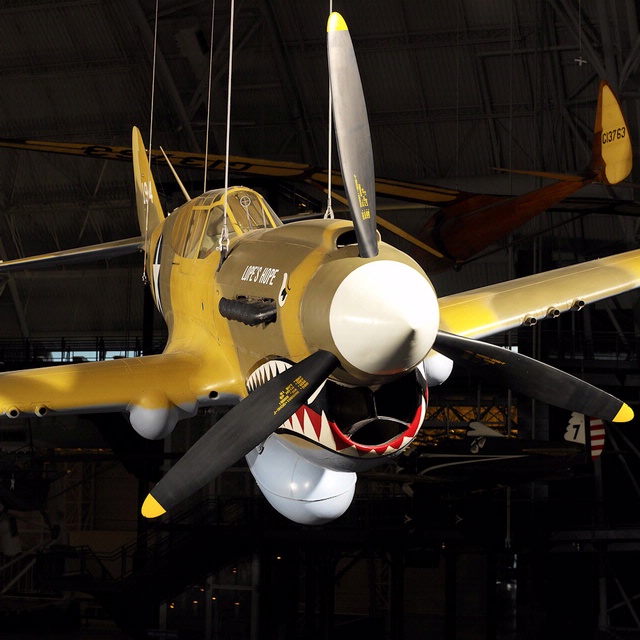
Object Details
Manufacturer
Bell Aircraft Corp.
Physical Description
All-metal, single-seat, two engine monoplane with shoulder-mounted wing.
Wing Span 1,490 cm (586 in.), Length 1,180 cm (465 in.), Height 380 cm ( 150 in. ), Weight 3,320 kg (7,319 lb)
Summary
The XP-59A is the first American jet aircraft. It did not see combat but it did give the U. S. Army Air Forces (AAF) and the U. S. Navy valuable experience with jet aircraft technology and helped pave the way to more advanced designs. The United States was slow to enter the field of jet propulsion. Political and military leaders wisely chose to forego rushing jet airplanes into service and concentrated instead on mass-producing and fielding more conventional designs that could contribute more quickly to the war effort. Britain's Gloster Meteor fighter served briefly at war's end and the Japanese flew the Nakajima Kikka twice (see NASM collection).
The Germans lead the world in jet-propelled airplanes and the Messerschmitt Me 262 jet fighter and the Arado Ar 234 jet bomber (see NASM collection for these aircraft) both reached operational status. Other types also flew but the technology was so new that it had no measurable effect on the war.
America's first XP-59A, AAF serial number 42-108784, is preserved at the National Air and Space Museum. Shortly the jet's first flight, the Army recognized the need to have an observer on board to record flight test data. They converted the gun bays forward of the pilot to accommodate the observer, cutting a 20-inch hole in the upper skin and mounting a seat, small windscreen, and instrument panel in this rather cramped, open cavity. Flight tests resumed on October 30, 1942, and for the remainder of its AAF career, the aircraft flew in that configuration.
In February 1944, an AAF engineer assigned to the Airacomet project originated the idea of saving America's first jet aircraft for museum display. In August, the Army Air Forces notified Bell that they planned to store the airframe at Muroc and the original engines at Wright Field, Ohio, until they could determine final disposition. The airplane had amassed only 59 hours and 55 minutes of flying time. On April 18, 1945, the Smithsonian asked for the aircraft. Before opening the new National Air and Space Museum in 1976, the staff restored the plane to its original configuration and removed the observer's open cockpit. Befitting its history, the first Airacomet now hangs in the Milestones of Flight gallery.
Long Description
The XP-59A is the first American jet aircraft. It did not see combat but it did give the U. S. Army Air Forces (AAF) and the U. S. Navy valuable experience with jet aircraft technology and helped pave the way to more advanced designs. The United States was slow to enter the field of jet propulsion. Political and military leaders wisely chose to forego rushing jet airplanes into service and concentrated instead on mass-producing and fielding more conventional designs that could contribute more quickly to the war effort. Britain's Gloster Meteor fighter served briefly at war's end and the Japanese flew the Nakajima Kikka twice. The Germans lead the world in jet-propelled airplanes and the Messerschmitt Me 262 jet fighter and the Arado Ar 234 jet bomber both reached operational status. Other types also flew but the technology was so new that it had no measurable effect on the war.
By the mid-1930s, U. S. propulsion engineers were seriously considering the possible applications of jet turbine engines to the airplane. War accelerated efforts to design and fly jet aircraft. On February 25, 1941, General Henry H. "Hap" Arnold, Deputy Chief of Staff for Air (later commanding general of the AAF), wrote to Dr. Vannevar Bush, chairman of the National Advisory Committee for Aeronautics (NACA), asking him to form a special group to consider jet aircraft propulsion. Bush complied the following month and the "Special Committee on Jet Propulsion" included representatives from the Army Air Corps, Navy Bureau of Aeronautics, National Bureau of Standards, Johns Hopkins University, Massachusetts Institute of Technology, and the three U. S. manufacturers of various industrial turbines and turbo-superchargers for reciprocating aircraft engines, Allis Chalmers, Westinghouse, and General Electric.
In April 1941, Arnold was briefed on the Gloster E.28/39 jet-propelled test airplane and he watched the airplane fly in England. A W.1X turbojet engine designed by Frank Whittle powered the E.28/39. Arnold returned to the U. S. in May and briefed members of the AAF Engineering Division at Wright Field, Ohio, and the U. S. State Department. Efforts began to exchange information on this technology and on July 22, 1941, British and American officials met to discuss it. On September 4, officials of the U. S. government, the Army Air Forces, and the General Electric company met and decided that the United States must begin at once to construct 15 jet turbine aircraft engines (copies of a new Whittle engine, the W.2B) and three jet airplanes. The Whittle engine was not overly powerful so the group chose a twin-engine configuration for the new jet. General Electric was selected to build the engines because the firm was already familiar with the Gloster aircraft and the Whittle engine. Several factors influenced the group's decision to select the Bell Aircraft Corporation to build the new fighter.
At that time, Bell was not as busy developing and producing aircraft as other manufacturers. Their location near the General Electric plant was thought a boon to the vital exchange of information between airframe and engine developers. The group also considered Larry Bell's enthusiasm and reputation for making unorthodox designs fly. On September 5, Arnold informed Bell that his company would undertake the new project. A contract was awarded on September 30. AAF leaders and Bell officials chose the designation XP-59A as a good cover for the true nature of this work because the designation originally referred to a piston engine fighter project proposed earlier by Bell. General Electric used a similar ruse. At that time, the company built aircraft engine superchargers with model designations 'A' through 'F.' 'I' seemed to fit this pattern. 'A' signified the first of a series so General Electric and the AAF designated the first American jet airplane engine the Type I-A.
During September 1941, Larry Bell and his Chief Engineer, Harland M. Poyer, assembled a team and began to design the first American jet airplane. The team was guided only by theory. General Electric would not finish and begin testing the first engine until March 1942 so Bell could only guess at the performance characteristics. In fact, neither the W.1X engine shipped from England in October 1941 nor General Electric's own versions could generate the power levels initially predicted. Extreme secrecy and great urgency also hampered the project. For security reasons and to get the airplane flying as quickly as possible, General Arnold had at first forbidden use of wind tunnels to test and optimize the design. Later he relented but only allowed the group to use the low-speed tunnel at Wright Field, Ohio.
On September 19, Bell shipped the first XP-59A to a remote base in California, Muroc Dry Lake, for the initial flight trials. To maintain secrecy, Bell mounted a dummy propeller on the nose and threw a tarpaulin over the fuselage to disguise the Airacomet as just another new piston engine aircraft. Mechanics removed the "propeller" before flight and reinstalled it after the airplane landed. On October 1, 1942, Bell test pilot Robert M. Stanley took the XP-59A into the air for the first time. During this initial flight, Stanley kept the landing gear fully extended and flew no higher than 7.6 m (25 ft). Later that day, he made three more flights and reached heights of 30 m (100 ft). The flight envelope expanded further the next day after four more flights at altitudes as high as 3,048 m (10,000 ft).
Two General Electric Type I-A centrifugal-flow jet engines drove the unrefined XP-59A airframe to a maximum speed of only 628 kph (390 mph). A number of enemy and Allied piston engine fighters exceeded this velocity so in March 1942, the Bell Company received a follow-on contract for 13 YP-59A test and evaluation aircraft. More powerful General Electric I-16 (J31) turbojet engines powered these and all subsequent production Airacomets. The first of 13 YP-59As arrived for flight-testing at Muroc in June 1943. One of these aircraft set a new unofficial altitude record of 14,512 m (47,600 ft). Although Bell proposed that the Army Air Forces should acquire 300 P-59 production fighter aircraft, the Army decided to order only 100. Despite the altitude record, the P-59 was clearly outclassed by contemporary piston engine fighters such as the North American P-51 Mustang, Republic P-47 Thunderbolt, and Lockheed P-38 Lightning (see NASM collection for these aircraft).
Eventually, Bell completed only 50 production Airacomets-20 P-59As and 30 P-59Bs. Each was armed with one 37-mm M-4 cannon and 44 rounds of ammunition, and three .50 cal. machine guns and 200 rounds per gun. The P-59Bs were assigned to the 412th Fighter Group to familiarize AAF pilots with the handling and performance characteristics of jet aircraft. The P-59 aircraft could fly at a maximum speed of 658 kph (409 mph) at 10,640 m (35,000 ft).
America's first XP-59A, AAF serial number 42-108784, is preserved at the National Air and Space Museum. Shortly the jet's first flight, the Army recognized the need to have an observer on board to record flight test data. They converted the gun bays forward of the pilot to accommodate the observer, cutting a 20-inch hole in the upper skin and mounting a seat, small windscreen, and instrument panel in this rather cramped, open cavity! Flight tests resumed on October 30, 1942, and for the remainder of its AAF career, the aircraft flew in that configuration.
In February 1944, an AAF engineer assigned to the Airacomet project originated the idea of saving America's first jet aircraft for museum display. In August, the Army notified Bell that they planned to store the airframe at Muroc and the original engines at Wright Field, Ohio, until they could determine final disposition. The airplane had amassed only 59 hours and 55 minutes of flying time. On April 18, 1945, the Smithsonian asked for the aircraft. Before opening the new National Air and Space Museum in 1976, the staff restored the plane to its original configuration and removed the observer's open cockpit. Befitting its history, the first Airacomet now hangs in the Milestones of Flight gallery.
Alternate Name
Bell XP-59A Airacomet
Key Accomplishment(s)
America's First Jet
Impact or Innovation
The XP-59A was America's first step into the jet age. It gave the U.S. military valuable experience with jet aircraft technology.
Brief Description
Although it never saw combat, this aircraft is the ancestor of generations of American military and civilian jet aircraft that followed.
Credit Line
Transferred from United States Department of War
Inventory Number
A19450016000
Restrictions & Rights
CC0
Type
CRAFT-Aircraft
Materials
Metal
Dimensions
Overall: 380 x 1180cm, 3320kg, 1490cm (12ft 5 5/8in. x 38ft 8 9/16in., 7319.3lb., 48ft 10 5/8in.)
Country of Origin
United States of America
See more items in
National Air and Space Museum Collection
Location
National Air and Space Museum in Washington, DC
Exhibition
Boeing Milestones of Flight Hall
Data Source
National Air and Space Museum
Link to Original Record
Record ID
nasm_A19450016000