Skip to main content Skip to main navigation
heart-solid My Visit Donate
Home Smithsonian Institution IK development site for ODI
Press Enter to activate a submenu, down arrow to access the items and Escape to close the submenu.
    • Overview
    • Museums and Zoo
    • Entry and Guidelines
    • Museum Maps
    • Dine and Shop
    • Accessibility
    • Visiting with Kids
    • Group Visits
    • Overview
    • Exhibitions
    • Online Events
    • All Events
    • IMAX & Planetarium
    • Overview
    • Topics
    • Collections
    • Research Resources
    • Stories
    • Podcasts
    • Overview
    • For Caregivers
    • For Educators
    • For Students
    • For Academics
    • For Lifelong Learners
    • Overview
    • Become a Member
    • Renew Membership
    • Make a Gift
    • Volunteer
    • Overview
    • Our Organization
    • Our Leadership
    • Reports and Plans
    • Newsdesk
heart-solid My Visit Donate

Charles Bird King's Indian Portraits

Thomas McKenney, United States superintendent of Indian trade in Georgetown, then port of entry for the District of Columbia, conceived the idea of developing a government collection of portraits of prominent Indians who visited Washington. McKenney engaged the services of Charles Bird King (1785-1862), a well known Washington portraitist, who had studied under the great Benjamin West and others, to paint this series of portraits. King painted from life Indian leaders of at least twenty tribes. These portraits were later handsomely reproduced as hand colored lithographs in Thomas McKenney and James Hall’s three-volume classic, History of the Indian Tribes of North America, published in 1837.

McKenney and Hall’s endeavor was an artistic and technological achievement. The first edition, begun in February 1837, was the culmination of eight years of effort. The last volume of this edition appeared in January 1844, some fifteen years after the project began. (Text adapted from the Introduction by John Ewers to The Indian Legacy of Charles Bird King, by Herman Viola, co-published by Smithsonian Press and Doubleday & Company, Inc., 1976.)

Charles Bird King’s Indian Portraits were transferred to the Smithsonian Institution in 1858 when the National Institute was formally disbanded and its collections dispersed. Joseph Henry, the first secretary of the Smithsonian, placed the portraits in the Art Gallery on the second floor of the Smithsonian Building. Also on display in this gallery was the collection of American Indian portraits and scenes by New York artist John Mix Stanley. This combined collection of 291 paintings was considered the largest and most valuable one of its kind. On the afternoon of January 24, 1865 fire consumed the entire gallery (fig.5). Fireproof walls and floors saved the rest of the building from complete destruction but the loss was tragic. A few of the King paintings were carried out of the building during the first few minutes of the fire, however, the rest could not be saved. The original oil portraits by King which served as models for the twenty McKenney & Hall lithographs chosen for this exhibit were among those destroyed in the fire of 1865.

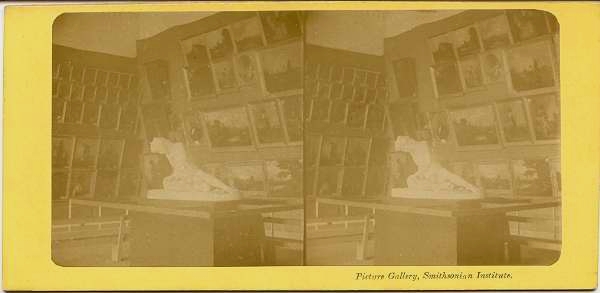
Gallery of Art in the Smithsonian Institution Building

The Castle Stereos: Exterior Views of the Smithsonian Institution

QUA-TA-WA-PLA. A SHAWANOE CHIEF from History of the Indian Tribes of North America

META-KOOSEGA. A CHIPPEWAY WARRIOR., from History of the Indian Tribes of North America

TSHUSICK. AN OJIBWAY WOMAN., from History of the Indian Tribes of North America

NAW-KAW. A WINNEBAGO CHIEF., from History of the Indian Tribes of North America

SE-QUO-YAH, from History of the Indian Tribes of North America

History of the Indian Tribes of North America

CHONO CA PE. AN OTTOE CHIEF., from History of the Indian Tribes of North America

MO-HON-GO. OSAGE WOMAN., from History of the Indian Tribes of North America

PAYTA-KOOTHA. A SHAWANOE WARRIOR., from History of the Indian Tribes of North America

A WINNEBAGO., from History of the Indian Tribes of North America

A-MIS-QUAM, A WINNEBAGO BRAVE., from History of Indian Tribes of North America

KEOKUK. CHIEF OF THE SACS AND FOXES., from History of the Indian Tribes of North America

PET-A-LE-SHAR-RO. A PAWNEE BRAVE., from History of the Indian Tribes of North America

Petelesharro (Generous Chief)

WA-BAUN-SEE, A POTTAWATOMIE CHIEF, from History of the Indian Tribes of North America

PUSH-MA-TA-HA. CHACTAN WARRIOR, from History of the Indian Tribes of North America

arrow-up Back to top
Home
  • Facebook facebook
  • Instagram instagram
  • LinkedIn linkedin
  • YouTube youtube

  • Contact Us
  • Get Involved
  • Shop Online
  • Job Opportunities
  • Equal Opportunity
  • Inspector General
  • Records Requests
  • Accessibility
  • Host Your Event
  • Press Room
  • Privacy
  • Terms of Use