Skip to main content Skip to main navigation
heart-solid My Visit Donate
Home Smithsonian Institution IK development site for ODI
Press Enter to activate a submenu, down arrow to access the items and Escape to close the submenu.
    • Overview
    • Museums and Zoo
    • Entry and Guidelines
    • Museum Maps
    • Dine and Shop
    • Accessibility
    • Visiting with Kids
    • Group Visits
    • Overview
    • Exhibitions
    • Online Events
    • All Events
    • IMAX & Planetarium
    • Overview
    • Topics
    • Collections
    • Research Resources
    • Stories
    • Podcasts
    • Overview
    • For Caregivers
    • For Educators
    • For Students
    • For Academics
    • For Lifelong Learners
    • Overview
    • Become a Member
    • Renew Membership
    • Make a Gift
    • Volunteer
    • Overview
    • Our Organization
    • Our Leadership
    • Reports and Plans
    • Newsdesk
heart-solid My Visit Donate

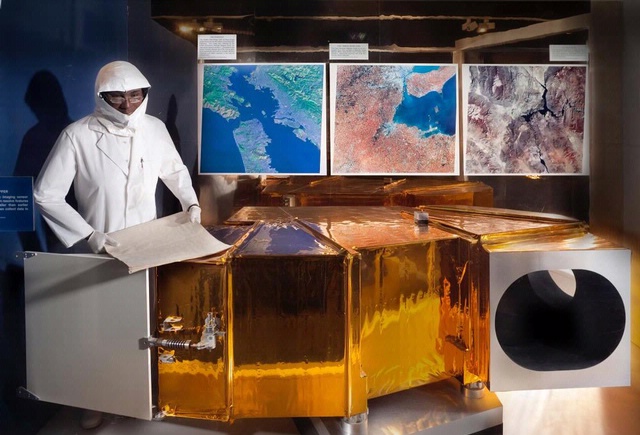
Test Interface Box, Spacecraft Checkout Station, INTELSAT VIIIA (805)

Air and Space Museum

There are restrictions for re-using this image. For more information, visit the Smithsonian's Terms of Use page .
International media Interoperability Framework
IIIF provides researchers rich metadata and media viewing options for comparison of works across cultural heritage collections. Visit the IIIF page to learn more.
View manifest View in Mirador Viewer

Object Details

Manufacturer

Martin Marietta

Summary

Geostationary communications satellites, once launched and in orbit, need to operate for years with high reliability. To achieve such performance, satellites undergo a rigorous process of testing during manufacture to ensure that each spacecraft component and system can withstand the rigors of launch and the extremes of the space environment.
This artifact--a Test Interface Box--is a component of the satellite check-out station for Intelsat VIIIA (805) communications spacecraft, built by Lockheed Martin and launched in 1998. The checkout station was a suite of testing devices used to simulate and assess a broad range of spacecraft functions after final assembly. Technicians tested the satellite at the factory and then again at the launch site.
The Test Interface Box was designed to simulate one such function: The load placed on the spacecraft electronics when a pyrotechnic charge was activated. Pyrotechnic charges had a special role in the deployment of satellites once in orbit: They cut the cables that held solars arrays and antennas in place during launch.
This artifact was donated by Lockheed Martin to the Museum in 1998.

Credit Line

Gift of Lockheed Martin

Inventory Number

A19980306002

Restrictions & Rights

Usage conditions apply

Type

EQUIPMENT-Test

Materials

Aluminum, Plastic, Stainless Steel, Steel, Rubber, Brass, Gold, Adhesive, Paint, Synthetic Fabric

Dimensions

3-D: 57.2 x 44.5 x 18.4cm (22 1/2 x 17 1/2 x 7 1/4 in.)

Country of Origin

United States of America

See more items in

National Air and Space Museum Collection

Data Source

National Air and Space Museum

Metadata Usage

Not determined

Link to Original Record

http://n2t.net/ark:/65665/nv9e66074e8-24af-40bd-906d-a7e3e6a25409

Record ID

nasm_A19980306002

Discover More

Civilian Application Satellites Object Group

Civilian Application Satellites

Civilian Application Satellites Object Group

Civilian Application Satellites

arrow-up Back to top
Home
  • Facebook facebook
  • Instagram instagram
  • LinkedIn linkedin
  • YouTube youtube

  • Contact Us
  • Get Involved
  • Shop Online
  • Job Opportunities
  • Equal Opportunity
  • Inspector General
  • Records Requests
  • Accessibility
  • Host Your Event
  • Press Room
  • Privacy
  • Terms of Use