
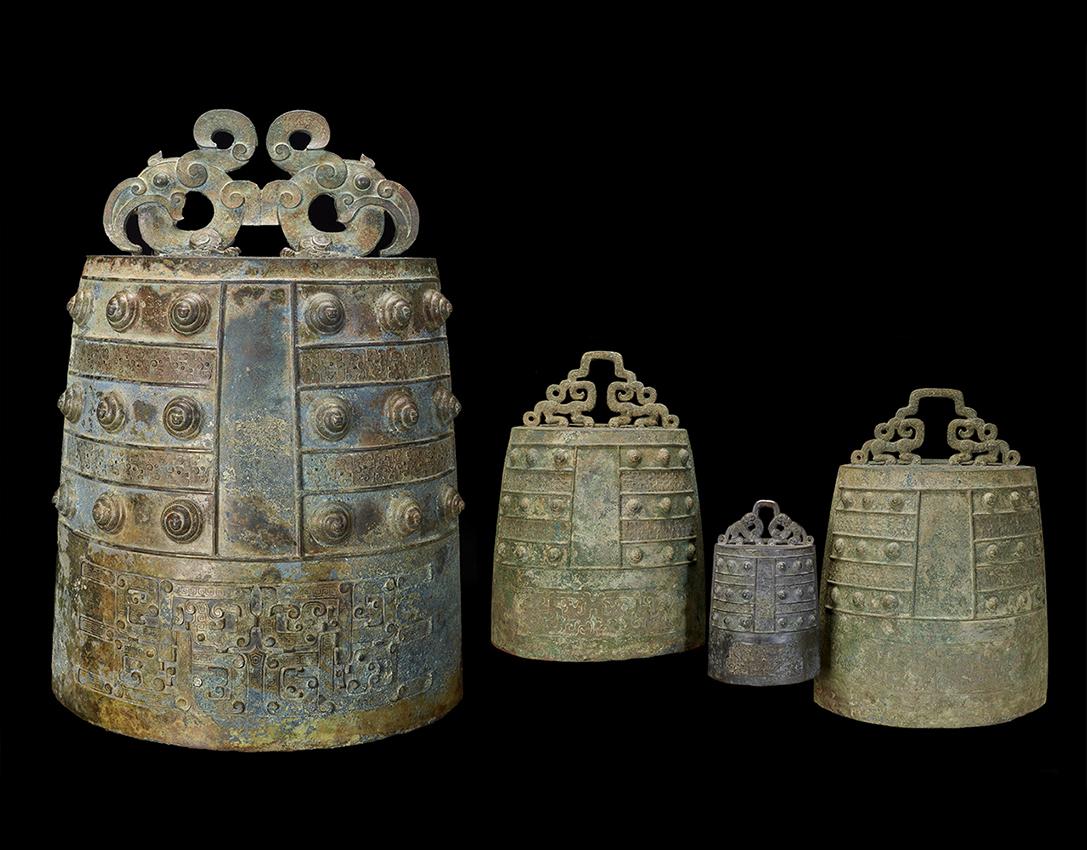
Object Details
Label
The birds and taotie, or monster masks, on this bell suggest that the bronze may have been cast in southern China in the environs of Hunan Province during the latter part of the Shang dynasty. The simplified modeling of the taiotie on either side of the bell is unlike the versions designed in northern China.
Provenance
By 1924-to at least 1934
C.T. Loo & Company, New York, method of acquisition unknown [1]
By 1959
Tonying and Company, Inc., New York, method of acquisition unknown [2]
1959-1987
Arthur M. Sackler (1913-1987), purchased from Tonying & Company, New York [3]
From 1987
The Arthur M. Sackler Gallery, gift of Arthur M. Sackler [4]
Notes:
[1] See Tch’ou Tö-Yi, “Bronzes Antiques de le Chine appartenant à C.T. Loo et Cie” [book] (Paris et Bruxelles: Librairie Nationale d’Art et d’Histoire, 1924), pl. 7, pp. 18-19. See also Serge Elisséeff, “Quelques heures à l’Exposition des Bronzes Chinois: Orangerie, Mai-Juin 1934” in “Revue des arts asiatiques,” vol. 8, no. 4 (1934), pl. 67a, p. 234, where the object is identified as C.T. Loo catalog no. 178. C. T. Loo (1880-1957) was one of the most prominent and well-known figures in the world of Chinese art in the first half of the twentieth century. Loo owned and operated eponymous galleries in New York and Paris, where he offered Chinese, Indian, and South Asian antiquities for study and sale.
[2] See object file for copy of Tonying and Company invoice #144 to Dr. Arthur M. Sackler, dated January 12, 1959, for a “Fine Bronze Bell with incised floral decoration.” The Tonying (Tongyun) Company was established in Paris in 1902 by Zhang Renjie (1877-1950), also known as Zhang Jingjiang. Zhang gained an official appointment in 1902 as an attaché of the Qing government’s Minister to France, and while in Paris he established the Tonying Company for the import and sale of works of art, tea and silk. The Tonying Company remained a family business while branching out to New York, from its original base in Paris and its source in Shanghai, where Zhang’s brother-in-law C. F. Yau was the manager.
[3] See Robert W. Bagley, “Shang Ritual Bronzes in the Arthur M. Sackler Collections: Volume 1 of Ancient Chinese Bronzes in the Arthur M. Sackler Collections” [book] (The Arthur M. Sackler Foundation, and The Arthur M. Sackler Museum, Harvard University: Washington, D.C. and Cambridge, MA, 1987), cat. 104, pp. 538-551. Dr. Arthur M. Sackler was a physician, medical publisher, pharmaceutical marketer, and collector of Asian art. See also note 2.
[4] Pursuant to the agreement between Arthur M. Sackler and the Smithsonian Institution, dated July 28, 1982, legal title of the donated objects was transferred to the Arthur M. Sackler Gallery on September 11, 1987.
Research updated April 25, 2023
Collection
Arthur M. Sackler Collection
Exhibition History
Anyang: China's Ancient City of Kings (February 25, 2023 to April 28, 2024)
Resound: Ancient Bells of China (October 14, 2017 - July 5, 2021)
The Arts of China (November 18, 1990 to September 7, 2014)
Chinese Bronzes from the Sackler Collection (November 19 to December 30, 1989)
In Praise of Ancestors: Ritual Objects from China (September 28, 1987 to January 1, 1989)
Previous custodian or owner
C. T. Loo & Company (1914-1948)
Tonying and Company 通運公司 (established 1902)
Dr. Arthur M. Sackler (1913-1987)
Credit Line
Gift of Arthur M. Sackler
Date
ca. 1100-1050 BCE
Accession Number
S1987.10
Restrictions & Rights
Usage conditions apply
Type
Musical Instrument
Medium
Bronze
Dimensions
H x W x D: 31.4 × 26.2 × 15.2 cm (12 3/8 × 10 5/16 × 6 in)
Origin
middle Yangzi River valley, China
Related Online Resources
Google Arts & Culture
See more items in
National Museum of Asian Art
Data Source
National Museum of Asian Art
Topic
casting
metal
bronze
bird
China
Chinese Art
Link to Original Record
Record ID
fsg_S1987.10