
Object Details
Manufacturer
Hughes Aircraft Co.
Summary
In the 1970s NASA inaugurated the Landsat series of satellites to study the Earth's surface from space. The program demonstrated the practical benefits of space-based mapping and study of the Earth's natural resources continuously and on a global basis.
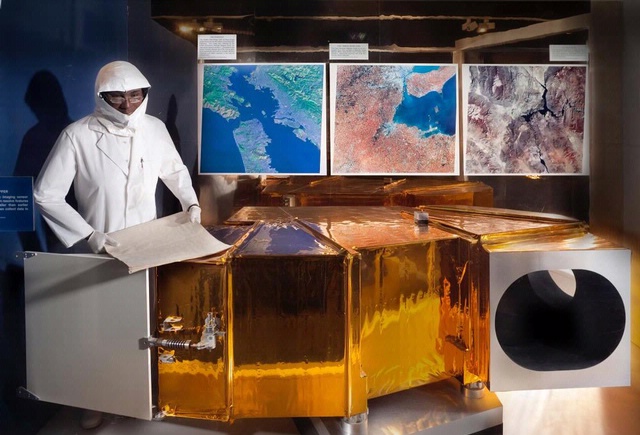
This artifact is an engineering model of the Multispectral Scanner (MSS) instrument used on Landsat 4, launched in 1982 and operational until 1993. As the instrument flew over the Earth it "saw" only selected wavelengths of light that, when processed, provided information on the condition of land, water, and vegetation. The MSS, complemented the satellite's other major instrument, the Thematic Mapper (TM), an innovation on Landsat 4. Compared to the first generation of Landsat satellites, these instruments provided a greatly improved range and quality of data on Earth resources.
NASA transferred the model to the Museum in 1985.
Credit Line
Transferred from the National Aeronautics and Space Administration
Inventory Number
A19850405000
Restrictions & Rights
Usage conditions apply
Type
SPACECRAFT-Uncrewed-Instruments & Payloads
Materials
Aluminum, glass, plastic
Dimensions
Overall (Instrument structure): 1 ft. 6 in. tall x 2 ft. wide x 3 ft. long (45.72 x 60.96 x 91.44cm). Approximate (Instrument aperture): 11 in. tall x 1 ft. 2 1/2 in. long (27.94 x 36.83cm). Weight: 131.5 kg (290 lbs)
Country of Origin
United States of America
See more items in
National Air and Space Museum Collection
Data Source
National Air and Space Museum
Link to Original Record
Record ID
nasm_A19850405000