
Object Details
Manufacturer
NASA Marshall Space Flight Center
Summary
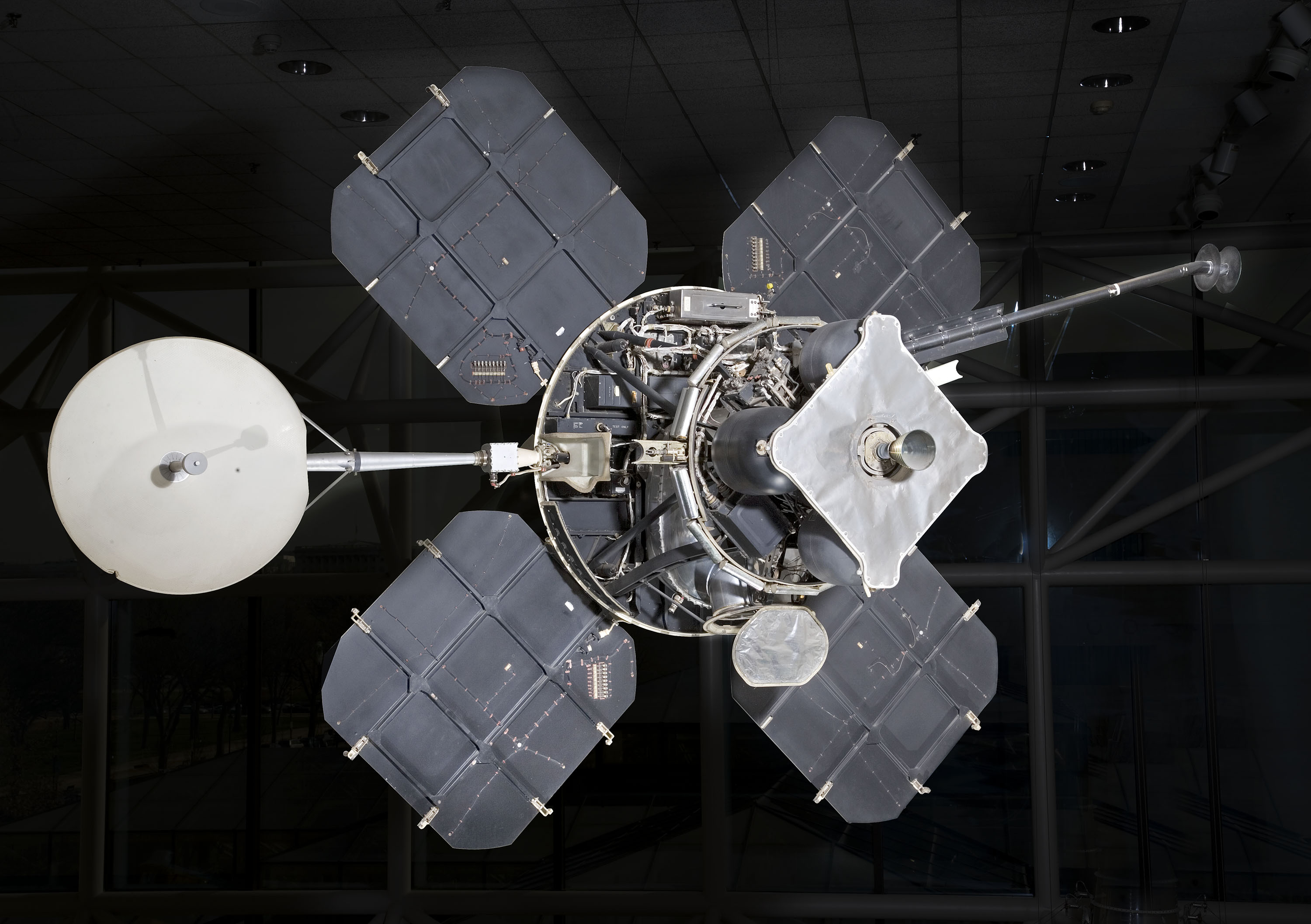
These components of payload instrumentation are unflown examples of those from Explorer 8 and show miniaturization used in early space satellites. Explorer 8 [see A19750180 or A19761107 entries] was one of the early satellites built by the Jet Propulsion Laboratory based upon a double truncated cone design. Called the "Ionosphere Direct Measurements Satellite," it was launched on November 3, 1960 atop a Juno II vehicle and successfully went into orbit, lasting for about one month before battery failure. The spacecraft carried six specialized instruments designed to study the field of charged particles that surround the Earth called the ionosphere. The satellite also carried telemetry equipment, batteries and other components required to keep station. These two columns of potted electronics managed the operations for the scientific instruments on board, including ion traps, a Langmuir probe, micrometeorite sensors (acoustic and light), electric fields, and satellite drag (atmospheric density). The last experiment was conducted post-hoc by the Smithsonian Astrophysical Observatory using tracking data.
The "potting" or insulation illustrates the extreme care needed to operate electrical devices in a vacuum to avoid short circuits. The theme of the original display of these objects centered on the use of miniaturized electronic components in early space research, necessitated by weight and size restrictions, but also fostered by the intrinsic ruggedness of the solid state designs.
The display was transferred to the Smithsonian Institution by NASA's Marshall Space Flight Center in May 1974.
Credit Line
Transferred from the National Aeronautics and Space Administration
Inventory Number
A19740877000
Restrictions & Rights
Usage conditions apply
Type
INSTRUMENTS-Scientific
Materials
HAZMAT: Cadmium Plating, Magnesium
Polyurethane, Gold Plating, Silver, Rubber (Silicone), Aluminum, Epoxy, Brass, Plastic, Phenolic Resin
Dimensions
3-D: 104.1 x 61 x 175.3cm (41 x 24 x 69 in.)
Country of Origin
United States of America
See more items in
National Air and Space Museum Collection
Data Source
National Air and Space Museum
Link to Original Record
Record ID
nasm_A19740877000