
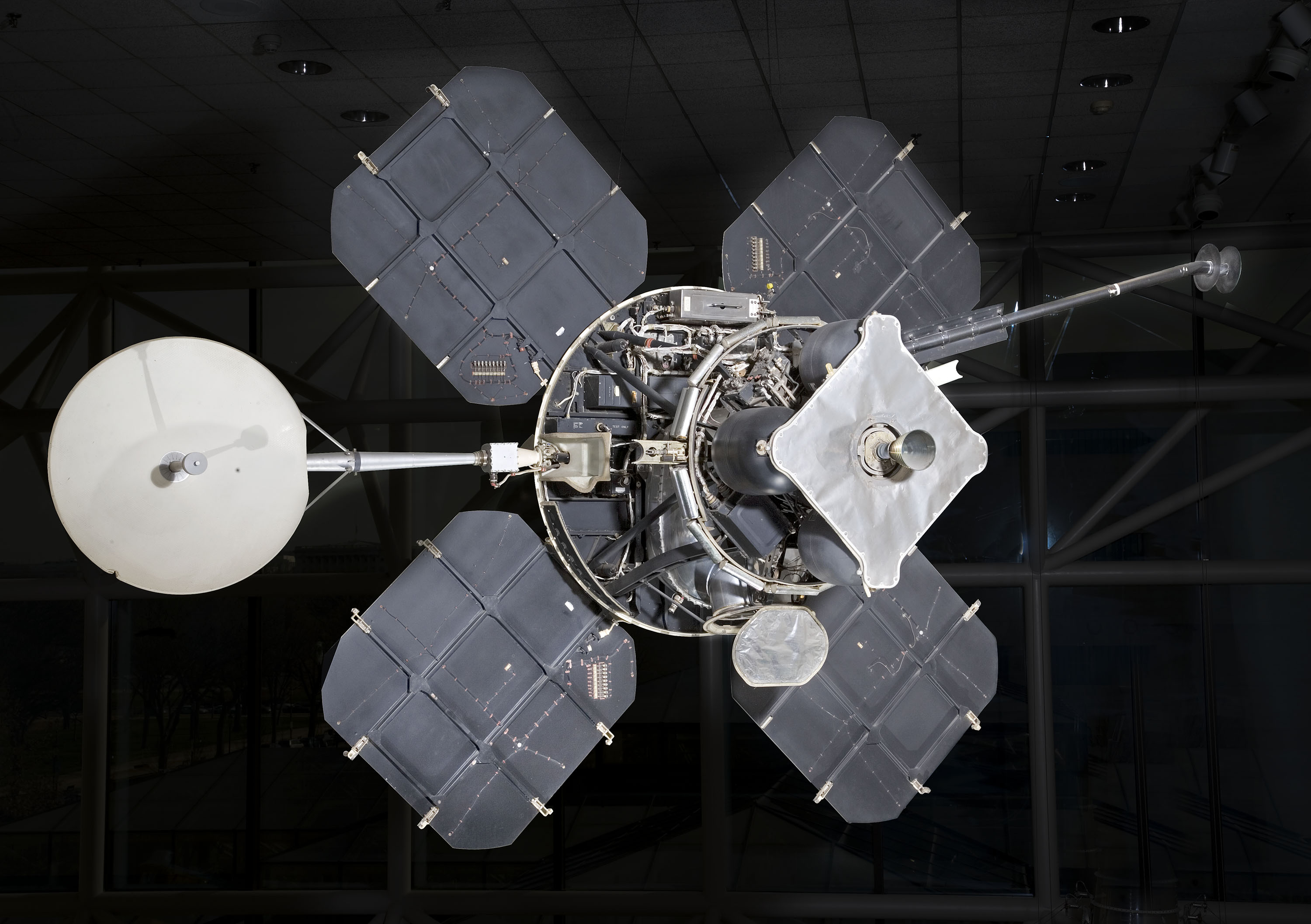
Object Details
Manufacturer
Boeing Aerospace Company
Summary
Explorer XI, launched on April 27, 1961, by a Juno II rocket, was NASA's first fully dedicated gamma-ray satellite. The satellite was built under a contract overseen by the Marshall Space Flight Center who also supplied the supporting electronic equipment. It carried a gamma-ray telescope built at MIT by W. Kraushaar and G. Clark, and was designed to detect gamma radiation above 50 MeV. During a period of just over 23 days in orbit it detected 22 true gamma-ray events as well as 22,000 events due to charged cosmic rays. The artifact in the collection is one of two backup-up satellites.
NASA transferred the object to the Museum in 1975.
Credit Line
Transferred from the National Aeronautics and Space Administration
Inventory Number
A19761110000
Restrictions & Rights
Usage conditions apply
Type
SPACECRAFT-Uncrewed
Materials
aluminum, steel, Stainless Steel, Magnesium, glass, Paint, plastic, Acrylic (Plexiglas), Adhesive, Rubber (Silicone), Copper, brass, Phenolic Resin ,Composite, Epoxy, Synthetic Fabric
Shell - aluminum alloy
Solar cells - silicon
Dimensions
Overall: 16 3/4 × 16 1/2 in., 104.8cm (42.5 × 41.9cm, 41 1/4 in.)
Storage (Aluminum pallet and frame with fabric dust cover): 121.9 × 121.9 × 73.7cm, 57.2kg (48 × 48 × 29 in., 126lb.)
Country of Origin
United States of America
See more items in
National Air and Space Museum Collection
Data Source
National Air and Space Museum
Link to Original Record
Record ID
nasm_A19761110000