Skip to main content Skip to main navigation
heart-solid My Visit Donate
Home Smithsonian Institution IK development site for ODI
Press Enter to activate a submenu, down arrow to access the items and Escape to close the submenu.
    • Overview
    • Museums and Zoo
    • Entry and Guidelines
    • Museum Maps
    • Dine and Shop
    • Accessibility
    • Visiting with Kids
    • Group Visits
    • Overview
    • Exhibitions
    • Online Events
    • All Events
    • IMAX & Planetarium
    • Overview
    • Topics
    • Collections
    • Research Resources
    • Stories
    • Podcasts
    • Overview
    • For Caregivers
    • For Educators
    • For Students
    • For Academics
    • For Lifelong Learners
    • Overview
    • Become a Member
    • Renew Membership
    • Make a Gift
    • Volunteer
    • Overview
    • Our Organization
    • Our Leadership
    • Reports and Plans
    • Newsdesk
heart-solid My Visit Donate

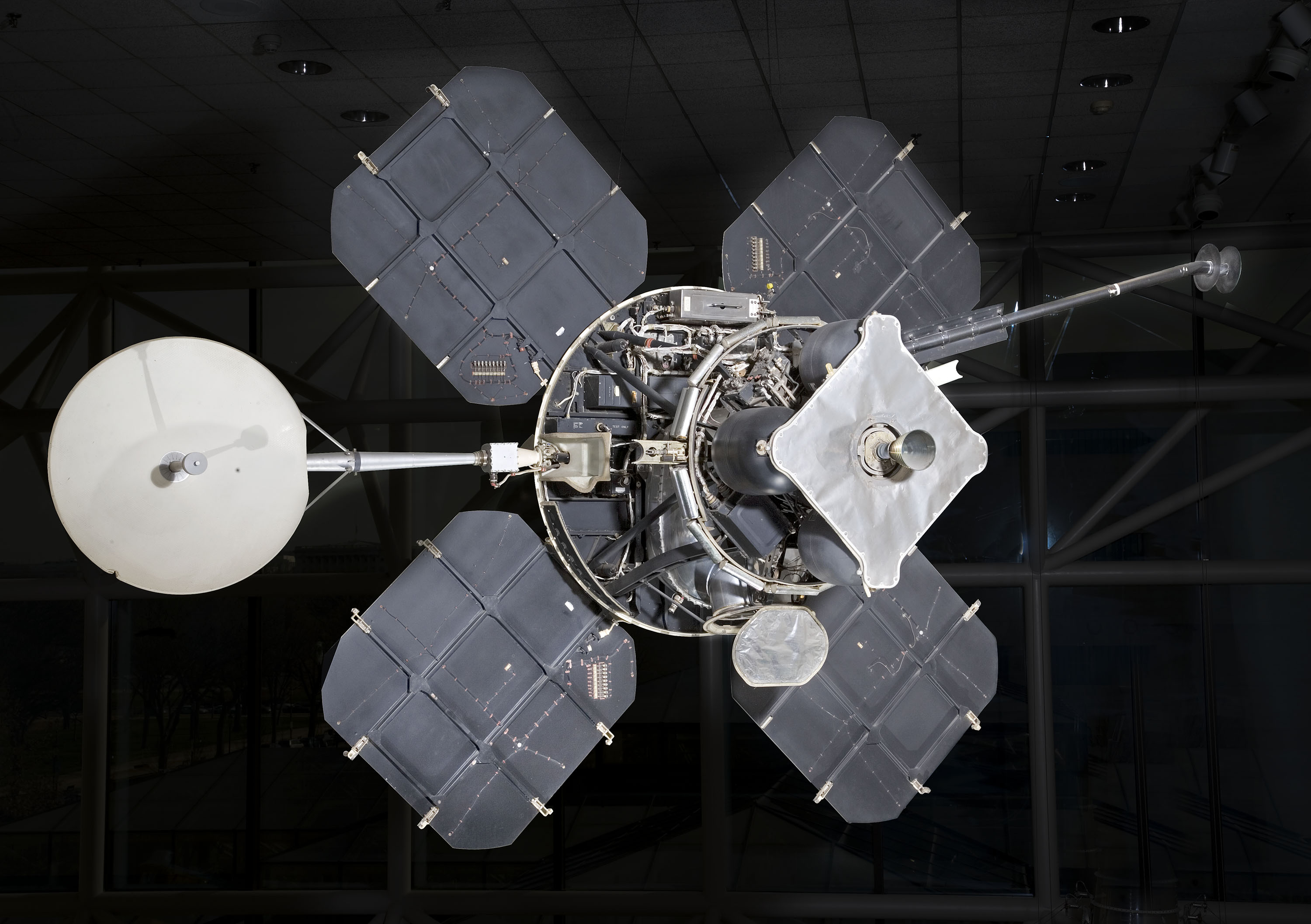
Satellite, Explorer 10, Reconstructed Model

Air and Space Museum

There are restrictions for re-using this image. For more information, visit the Smithsonian's Terms of Use page .
International media Interoperability Framework
IIIF provides researchers rich metadata and media viewing options for comparison of works across cultural heritage collections. Visit the IIIF page to learn more.
View manifest View in Mirador Viewer

    Object Details

    Manufacturer

    NASA, Goddard Space Flight Center

    Summary

    This is a full-scale reconstructed model of the Explorer 10 satellite. Explorer 10 was designed to map the interplanetary magnetic field using three different magnetometers, as well as a plasma probe. The most sensitive of those was mounted in a very prominent sphere mounted atop a fiberglass support boom. The magnetometers were produced by Goddard Space Flight Center, and the Massachusetts Institute of Technology provided the plasma probe. It launched in March 1961 aboard a Thor-Delta with the intention of inserting it into a highly elliptical orbit to reach the region of space between the Earth and Moon. The data stream lasted only for 52 hours when the craft was estimated to be over 40 earth-radii distant, 2/3rds the distance to the lunar orbit. Explorer 10 made the first measurements of magnetic fields and solar plasmas outside the Earth's magnetosphere. The data gathered gave support to the theory that the magnetic field surrounding the Earth is closely tied to that of the Sun.
    The replica was refurbished by technicians at the Goddard Space Flight Center prior to its transfer to NASM from NASA in March 1975. All the major internal scientific instruments are represented, but many of the internal elements are dummies.

    Alternate Name

    Explorer 10 Satellite (Reconstructed Model)

    Credit Line

    Transferred from the National Aeronautics and Space Administration

    Inventory Number

    A19751408000

    Restrictions & Rights

    Usage conditions apply

    Type

    SPACECRAFT-Uncrewed

    Materials

    Aluminum, magnesium, lead, fiberglass and plastic

    Dimensions

    Overall: 1 ft. 8 in. wide x 4 ft. 7 in. deep, 48 lb. (50.8 x 139.7cm, 21.8kg)

    Country of Origin

    United States of America

    See more items in

    National Air and Space Museum Collection

    Location

    Steven F. Udvar-Hazy Center in Chantilly, VA

    Exhibit Station

    Space Science

    Data Source

    National Air and Space Museum

    Metadata Usage

    Not determined

    Link to Original Record

    http://n2t.net/ark:/65665/nv9f8692680-0e24-489b-abe2-ae313fdc67c2

    Record ID

    nasm_A19751408000

    Discover More

    Lunar orbiter on display

    Space Science

    Lunar orbiter on display

    Space Science

    arrow-up Back to top
    Home
    • Facebook facebook
    • Instagram instagram
    • LinkedIn linkedin
    • YouTube youtube

    • Contact Us
    • Get Involved
    • Shop Online
    • Job Opportunities
    • Equal Opportunity
    • Inspector General
    • Records Requests
    • Accessibility
    • Host Your Event
    • Press Room
    • Privacy
    • Terms of Use