
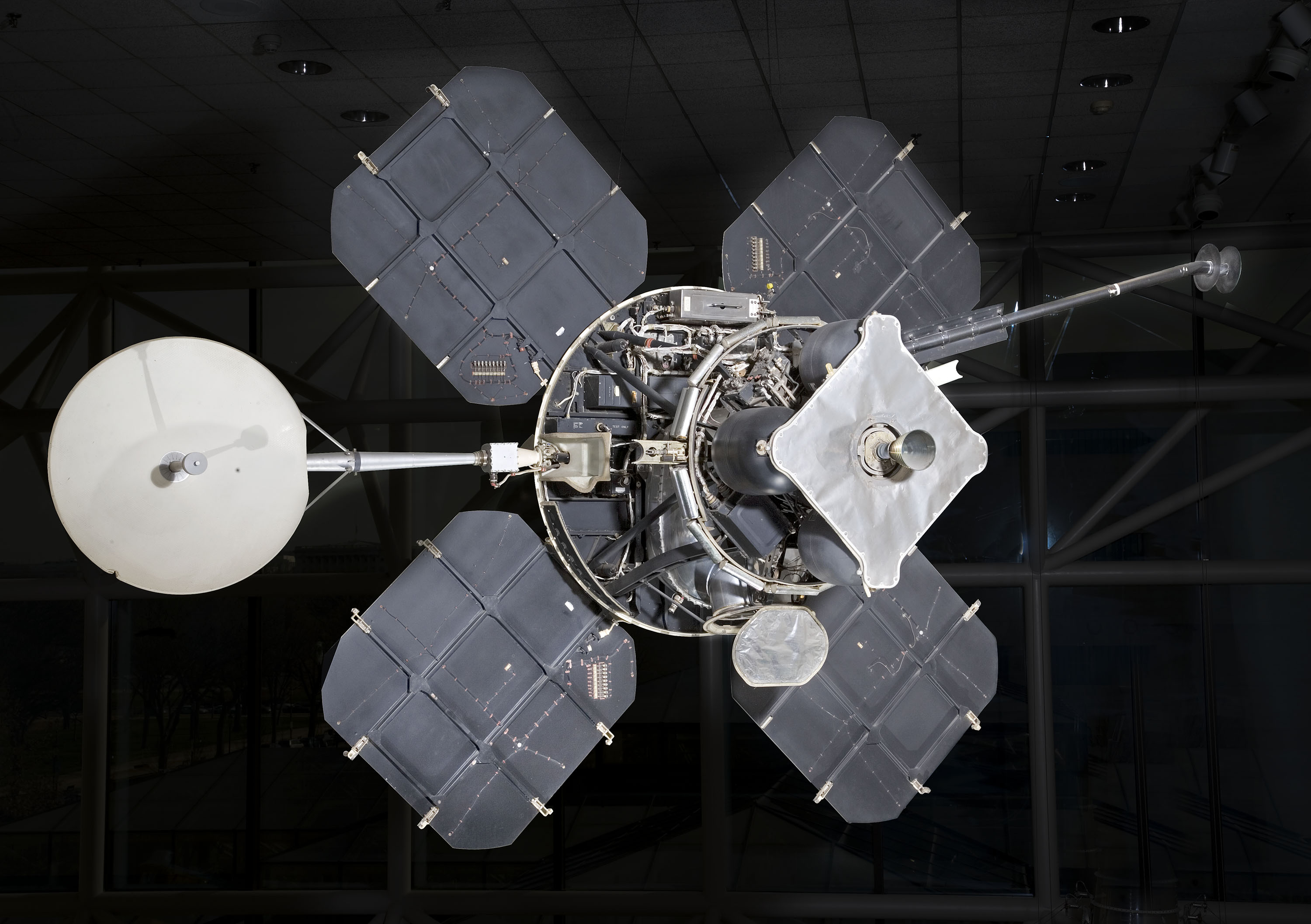
Object Details
Manufacturer
Hughes Aircraft Co.
Summary
This data recorder from the Surveyor spacecraft would record data from the various instruments on the Surveyor Moon lander, and then relay it back to Earth through the Deep Space Network of tracking stations. Although a non-flight item, it is identical to those sent to the Moon on the five Surveyor spacecraft that successfully landed on the Moon during the period from May 30, 1966 to January 9, 1968. The overall objectives of the Surveyor program were to accomplish soft landings on the Moon, obtain data concerning temperature, chemical composition, and load-bearing characteristics of the lunar soil in support of the Apollo program, televise high quality photographs of the lunar surface, and perform operations on the lunar surface that would contribute new scientific knowledge about the Moon.
Donated by Hughes Aircraft Co. to the Museum in 1969.
Long Description
Surveyor (1966-1968)
The Surveyor probes were the first U.S. spacecraft to land safely on the Moon. The main objectives of the Surveyors were to obtain close-up images of the lunar surface and to determine if the terrain was safe for manned landings. Each Surveyor was equipped with a television camera. In addition, Surveyors 3 and 7 each carried a soil mechanics surface sampler scoop which dug trenches and was used for soil mechanics tests and Surveyors 5, 6, and 7 had magnets attached to the footpads and an alpha scattering instrument for chemical analysis of the lunar material. The following Surveyor missions took place.
Surveyor 1
Launched 30 May 1966
Landed 02 June 1966, 06:17:37 UT
Latitude 2.45 S, Longitude 316.79 E - Flamsteed P
Surveyor 2
Launched 20 September 1966
Crashed on Moon 22 September 1966
Vernier engine failed to ignite - southeast of Copernicus Crater
Surveyor 3
Launched 17 April 1967
Landed 20 April 1967, 00:04:53 UT
Latitude 2.94 S, Longitude 336.66 E - Oceanus Procellarum (Ocean of Storms)
Surveyor 4
Launched 14 July 1967
Radio contact lost 17 July 1967
2.5 minutes from touchdown - Sinus Medii
Surveyor 5
Launched 08 September 1967
Landed 11 September 1967, 00:46:44 UT
Latitude 1.41 N, Longitude 23.18 E - Mare Tranquillitatus (Sea of Tranquility)
Surveyor 6
Launched 07 November 1967
Landed 10 November 1967, 01:01:06 UT
Latitude 0.46 N, Longitude 358.63 E - Sinus Medii
Surveyor 7
Launched 07 January 1968
Landed 10 January 1968, 01:05:36 UT
Latitude 41.01 S, Longitude 348.59 E - Tycho North Rim
Credit Line
Gift of Hughes Aircraft Company
Inventory Number
A19700328000
Restrictions & Rights
Usage conditions apply
Type
SPACECRAFT-Uncrewed-Communications
Materials
Rubber (Silicone), Acrylic (Plexiglas), Adhesive, Plastic, Paper, Copper, Nylon, Steel, Aluminum, Gold Plating, Mylar (Polyester)
Dimensions
3-D (Display Case): 30.5 x 30.5 x 30.5cm (12 x 12 x 12 in.)
Country of Origin
United States of America
See more items in
National Air and Space Museum Collection
Data Source
National Air and Space Museum
Link to Original Record
Record ID
nasm_A19700328000