
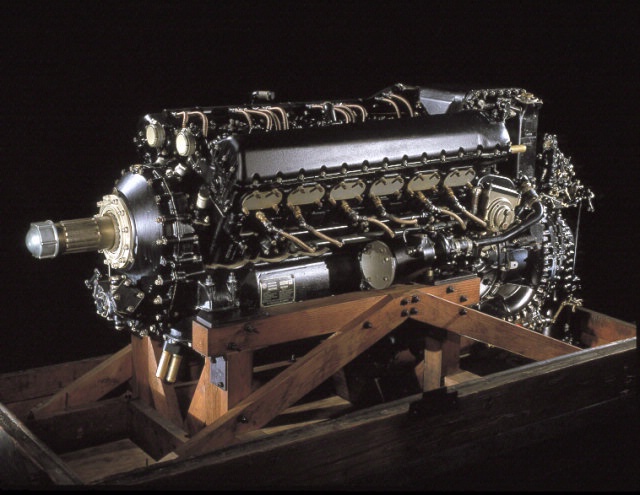
Object Details
Manufacturer
Pratt & Whitney
Physical Description
Type: Reciprocating, 14 cylinders, 2-rows, radial, air cooled
Power rating: 895 kW (1,200 hp) at 2,700 rpm
Displacement: 30.0 L (1,830 cu in.)
Bore and Stroke: 140 mm (5.5 in.) x 140 mm (5.5 in.)
Weight: 678.1 kg (1,495 lb)
Summary
Founded in 1925 by Frederick Rentschler, formerly the president of Wright Aeronautical, Pratt & Whitney became the world’s biggest aero-engine company. By 1930, its first engines, the Wasp and Hornet had set many world records. Certificated 1n 1933, the Pratt & Whitney Twin Wasp R-1830 was a two-row radial that delivered up to 1,007 kW (1,350 shp), and opened a market unreachable for single-row engines . Beginning in 1936, Pratt & Whitney focused on the R-1830 with single-stage and 2-stage or turbo-superchargers. The engine powered a wide variety of military and commercial aircraft. Production totaled 173,618, more than any other aircraft engine.
The R-1830-90C was a Navy engine and had a two-speed supercharger. It powered Douglas C-47B, TC-47B, C-47D, and C-117A aircraft. The Pratt & Whitney designation for this engine was R-1830-S3C4-G. The commercial version of the engine powered the Douglas DC-3C.
Credit Line
Transferred from the U.S. Air Force Central Museum
Date
Circa 1938
Inventory Number
A19600115000
Restrictions & Rights
Usage conditions apply
Type
PROPULSION-Reciprocating & Rotary
Materials
HAZMAT: Cadmium
Ferrous Alloy
Aluminum
Paint
Plastic
Dimensions
Diameter 122.4 (48.19 in.), Length 159.1 cm (62.63 in.)
Country of Origin
United States of America
See more items in
National Air and Space Museum Collection
Data Source
National Air and Space Museum
Link to Original Record
Record ID
nasm_A19600115000