
Object Details
Manufacturer
University of Colorado-Boulder
Summary
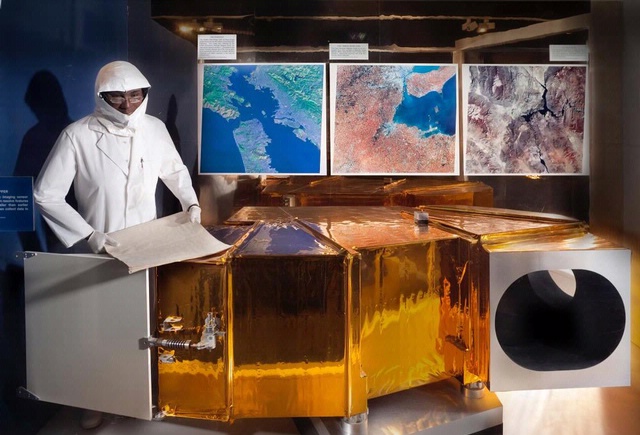
This nanosatellite (nicknamed "Petey") was the result of a Department of Defense (DoD) initiative to encourage university engineering students to design and build spacecraft. Students at the University of Colorado at Boulder, Arizona State University, and New Mexico State University collaborated in developing Petey, using off-the-shelf electronics and materials.
Petey was designed fly as part of a network of three nanosatellites. Each satellite was to be a "nerve" in a larger system, individually and together performing communications and remote imaging functions. The hardware and software requirements of these dual function, network satellites demonstrated a new level of complexity in the "amateur" field, a direct result of DoD funding and project guidance.
This artifact is a flight-qualified article, with complete instrumentation; due to launch vehicle complications it never flew. The University of Colorado at Boulder, Arizona State University, and New Mexico State University donated Petey to the Museum in 2006.
Credit Line
Gift of Arizona State University, University of Colorado at Boulder and New Mexico Sate University.
Inventory Number
A20060590000
Restrictions & Rights
Usage conditions apply
Type
SPACECRAFT-Uncrewed
Materials
Aluminum Alloy
Plastics
Electronic Components
Glass (Solar Cells)
Non-Magnetic White Metals
Adhesive
Synthetic Fiber Fabrics
Copper Alloy
Uncharacterized Coatings
Dimensions
3-D (Diameter x Height): 51.4 × 48.3cm (1 ft. 8 1/4 in. × 1 ft. 7 in.)
Storage (Including Plastic Crate and Aluminum Pallet): 94.8kg (209lb.)
Country of Origin
United States of America
See more items in
National Air and Space Museum Collection
Data Source
National Air and Space Museum
Link to Original Record
Record ID
nasm_A20060590000