
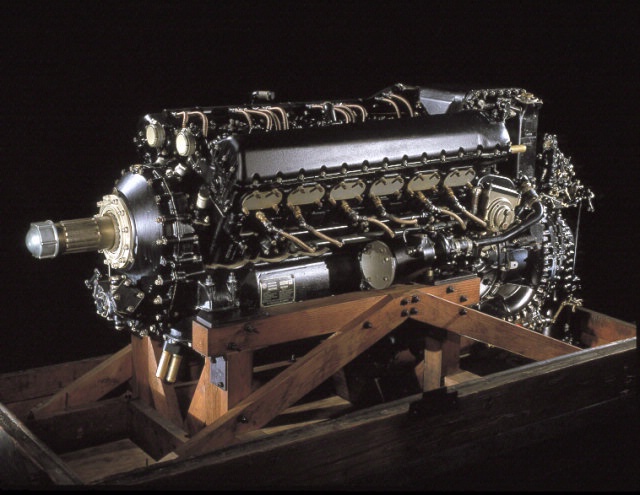
Object Details
Physical Description
Type: Reciprocating, 18 cylinders, 2-rows, radial, air cooled
Power rating: 1,361 kW (1,825 hp)
Displacement: 35.9 L (2,195 cu in.)
Bore and Stroke: 130 mm (5.1 in.) x 150 mm (5.9 in.)
Weight: Unknown
Summary
The Homare (Honor) was Japan’s most-used engine in the latter years of World War II. It had a very high specific output, incorporating for the first time in a Japanese engine, a steel crankcase, dynamic balancers, a dual magneto with a remote distributor (on the nose), and a nose sump pump. Its supercharger drive followed a Wright design, with a planetary reduction gear in series with the high gear for obtaining a lower compression ratio. All models suffered from unreliability, service difficulty (particularly when first entering service), and vibration.
The artifact powered the Yokusuka P1Y1 Ginga (Milky Way) (Allied Code Name FRANCES) twin- engine aircraft for low-altitude torpedo and dive-bombing attacks. Several of these aircraft carried out Kamikaze suicide attacks against American warships. This particular NK9C (Ha45-12) engine model also powered the Aichi B7A2 Ryusei (Shooting Star) single engine torpedo bomber (Allied Code Name GRACE), the largest and heaviest Japanese carrier-based aircraft to fly in World War II.
Credit Line
Transferred from the U.S. Air Force
Date
1945
Inventory Number
A19600340004
Restrictions & Rights
Usage conditions apply
Type
PROPULSION-Reciprocating & Rotary
Materials
Aluminium
Paint
Steel
Plastic
Adhesive
Magnesium Alloy
Rubber
Natural Fabric
Dimensions
Length 157.5 cm (62 in.), Width 152.4 cm (60 in.), Height 189.2 cm (74.5 in.) (Approximate)
Country of Origin
Japan
See more items in
National Air and Space Museum Collection
Data Source
National Air and Space Museum
Link to Original Record
Record ID
nasm_A19600340004