Skip to main content Skip to main navigation
heart-solid My Visit Donate
Home Smithsonian Institution IK development site for ODI
Press Enter to activate a submenu, down arrow to access the items and Escape to close the submenu.
    • Overview
    • Museums and Zoo
    • Entry and Guidelines
    • Museum Maps
    • Dine and Shop
    • Accessibility
    • Visiting with Kids
    • Group Visits
    • Overview
    • Exhibitions
    • Online Events
    • All Events
    • IMAX & Planetarium
    • Overview
    • Topics
    • Collections
    • Research Resources
    • Stories
    • Podcasts
    • Overview
    • For Caregivers
    • For Educators
    • For Students
    • For Academics
    • For Lifelong Learners
    • Overview
    • Become a Member
    • Renew Membership
    • Make a Gift
    • Volunteer
    • Overview
    • Our Organization
    • Our Leadership
    • Reports and Plans
    • Newsdesk
heart-solid My Visit Donate

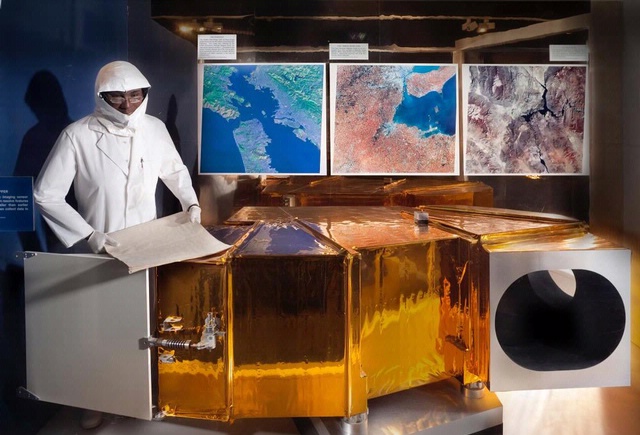
Model, Laser Geodynamics Satellite (LAGEOS)

Air and Space Museum

There are restrictions for re-using this image. For more information, visit the Smithsonian's Terms of Use page .
International media Interoperability Framework
IIIF provides researchers rich metadata and media viewing options for comparison of works across cultural heritage collections. Visit the IIIF page to learn more.
View manifest View in Mirador Viewer

    Object Details

    Manufacturer

    Bendix Corp.

    Summary

    Launched in May 1976, LAGEOS (Laser Geodynamics Satellite) has provided long-term data on key geophysical properties of the Earth, including movement of tectonic plates, and measurement of the planet's gravitational field and the "wobble" in the axis of rotation.
    The satellite design was elegantly simple--it carried no onboard sensors, electronics, or moving parts, and was not attitude controlled. It consisted of a brass core surrounded by a sphere of aluminum embedded with 426 cube-corner retroreflectors. Pulsed laser beams transmitted from Earth hit the reflectors and bounce back to ground stations. The travel times are precisely measured, allowing highly accurate measurements of geophysical properties.
    At its altitude of 5858 kilometers (3640 miles), the satellite will orbit for thousands of years, which led designers to include a "time capsule" plaque featuring maps of the Earth from 3 different eras: 268 million years in the past, the 1970s, and 8 million years in the future.
    This artifact is a 1/2 scale model, donated by R. L. Bullock to the Museum in 1978.

    Credit Line

    Gift of R.L. Bullock

    Inventory Number

    A19781633000

    Restrictions & Rights

    Usage conditions apply

    Type

    MODELS-Uncrewed Spacecraft & Parts

    Materials

    Aluminum
    Glass
    Plastic
    Copper Alloy
    Steel

    Dimensions

    Model: 27.9 x 30.5cm (11 x 12 in.)
    Storage: 33 x 33 x 38.1cm (13 x 13 x 15 in.)

    Country of Origin

    United States of America

    See more items in

    National Air and Space Museum Collection

    Data Source

    National Air and Space Museum

    Metadata Usage

    Not determined

    Link to Original Record

    http://n2t.net/ark:/65665/nv9fbd5d375-bf71-41d2-958f-c4e6e5371a9c

    Record ID

    nasm_A19781633000

    Discover More

    Civilian Application Satellites Object Group

    Civilian Application Satellites

    Civilian Application Satellites Object Group

    Civilian Application Satellites

    arrow-up Back to top
    Home
    • Facebook facebook
    • Instagram instagram
    • LinkedIn linkedin
    • YouTube youtube

    • Contact Us
    • Get Involved
    • Shop Online
    • Job Opportunities
    • Equal Opportunity
    • Inspector General
    • Records Requests
    • Accessibility
    • Host Your Event
    • Press Room
    • Privacy
    • Terms of Use