
Object Details
Manufacturer
Boeing Company
Summary
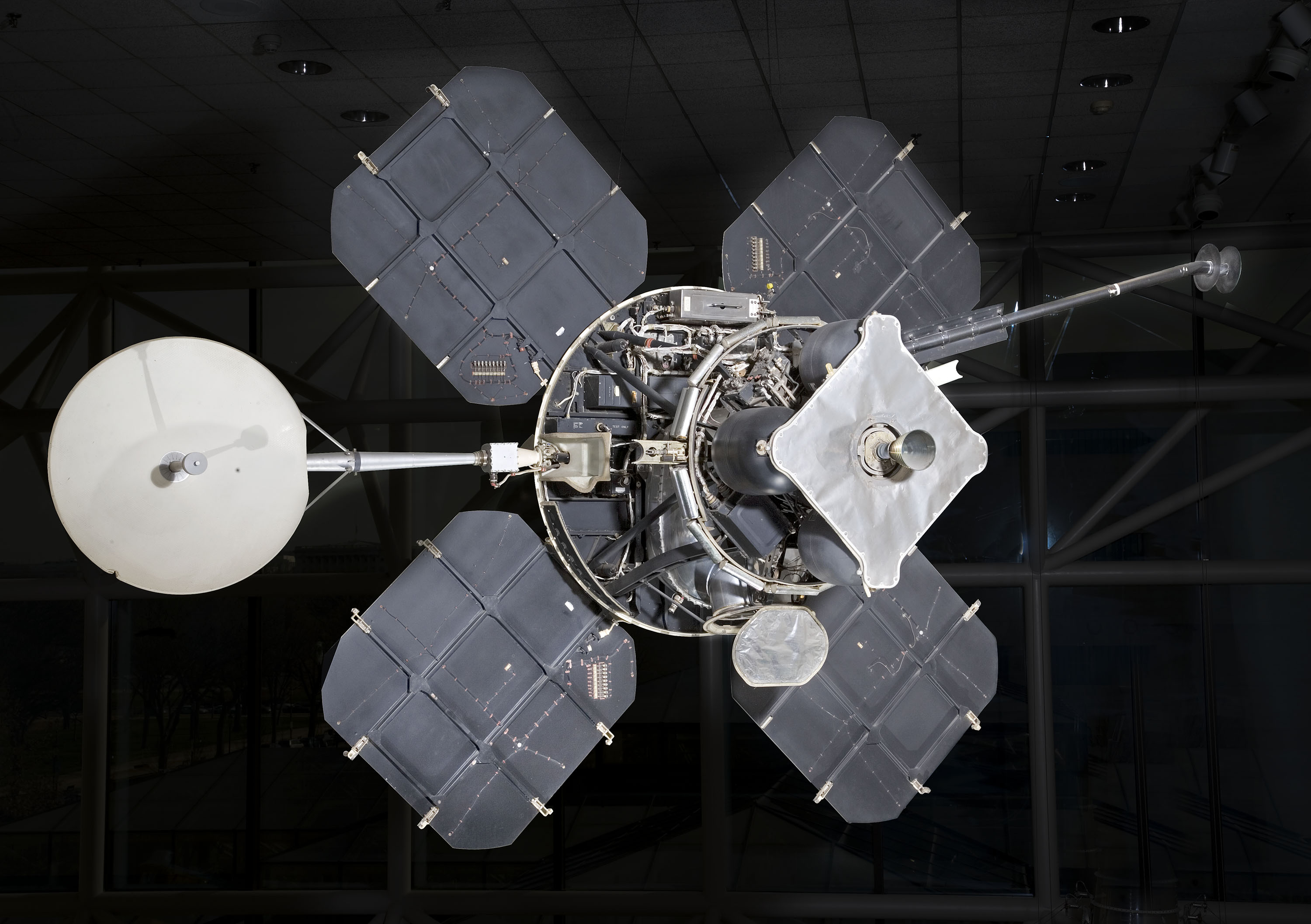
Lunar Orbiter was the project that mapped the Moon in preparation for the Apollo landings. A total of five Lunar Orbiters were flown to the Moon. They were built for NASA's Langley Research Center by Boeing and launched to the Moon on Atlas-Agena rockets. The first three orbited around the Moon's equator and provided detailed photographic coverage of the primary Apollo landing sites, including stereo images. Because of the success of these earlier missions, the final two Lunar Orbiters were placed into a polar orbit so that virtually the entire surface of the Moon was mapped. In addition to images of the Apollo landing sites, Lunar Orbiter provided many breathtaking photographs, including features on the farside.
In addition to the near global photographic coverage of the Moon, Lunar Orbiter provided additional information that aided Apollo. Sensors on board indicated that radiation levels near the Moon would pose no danger to the astronauts. Analysis of the spacecraft orbits found evidence of gravity perturbations, which suggested that the Moon was not gravatationally uniform. Instead it appeared as if buried concentrations of mass were under the mare deposits. By discovering and defining these "mascons," Lunar Orbiter made it possible for the Apollo missions to conduct highly accurate landings and precision rendezvous.
After depleting their film supplies, all five Lunar Orbiters were purposely crashed onto the Moon to prevent their radio transmitters from interfering with future spacecraft.
Long Description
"The pictures returned by the Lunar Orbiter series not only paved the way for the Apollo missions but also gave us images of the Moon that that are still used extensively by scientists today."-Paul D. Spudis, lunar scientist (The Once and Future Moon, 1996, p. 61)
Lunar Orbiter
Lunar Orbiter was the second of three robotic projects to undertake a reconnaissance of the Moon prior to the first Apollo missions. It was approved in 1960 to place probes in orbit around the Moon for satellite mapping. This project, originally not intended to support Apollo, was reconfigured in 1962 and 1963 to further the presidential mandate by mapping the surface. In addition to a powerful camera that could send photographs to Earth tracking stations, it carried three scientific experiments-selnodesy (the Lunar equivalent of geodesy), meteoroid detection, and radiation measurement. It helped to scout the lunar surface, down to one-meter resolution, and identify potential landing sites. The spacecraft allowed NASA mission planners to select the safest, but most scientifically interesting landing sites for the Apollo missions.
Managed by Langley Research Center, NASA eventually sent five Lunar Orbiters to the Moon on Atlas-Agena rockets in 1966-1967. While the returns from these spacecraft interested scientists in and of themselves, they were critical to Apollo. NASA launched the five Lunar Orbiter satellites between 10 August 1966 and 1 August 1967, all successfully achieving their objectives. In total, they mapped roughly 99 percent of the lunar surface. Lunar Orbiter 1 became the first spacecraft to take a picture of the Earth from the Moon, preempting the famous "Earthrise" photograph of Apollo 8 by more than two years. But this Lunar Orbiter image, for all of its significance did not have the salience of the more famous image in part because it was not full color. At the completion of the third mission, moreover, the Apollo planners announced that they had sufficient data to press on with an astronaut landing, and were able to use the last two missions for other activities. They conducted more general scientific surveys and also mapped the lunar gravitational field. For example, Lunar Orbiter 4 photographed the entire nearside and 95 percent of the farside, and Lunar Orbiter 5 completed the farside coverage and acquired up to two-meter resolution images of 36 pre-selected areas.
The photographic system on board Lunar Orbiter was particularly unique. Instead of sending television pictures back to Earth as electrical signals, Lunar Orbiter took actual photographs, developed them on board, and then scanned them using a special photoelectric system. For this reason scientists referred to Lunar Orbiter as the "flying drugstore." Due to the possibility that radiation in space would fog photographic film, a slow speed film was used. This required the spacecraft to move slightly whenever its shutters were opened to prevent blurring. The resulting images had exceptional quality and provided resolutions of up to 3 feet from an altitude of 30 nautical miles.
In addition to the broad photographic coverage of the Moon, Lunar Orbiter provided additional information that also aided Apollo. Sensors mapped the radiation levels around the Moon, analysis of the spacecraft orbits found evidence of gravity perturbations which suggested that the Moon was not gravatationally uniform. Instead it appeared as if buried concentrations of mass were under the mare deposits. By discovering and defining these "mascons," Lunar Orbiter made it possible for the Apollo missions to conduct highly accurate landings and precision rendezvous.
After depleting their film supplies, all five Lunar Orbiters were proposely crashed onto the Moon to prevent their radio transmitters from interfering with future spacecraft. The item on display is an engineering mock-up of the spacecraft built by the Boeing Company obtained by the National Air and Space Museum in 1970.
Alternate Name
Lunar Orbiter
Key Accomplishment(s)
Mapped the Moon for Lunar Landings
Brief Description
In preparation for the Apollo landings, five Lunar Orbiters were flown to the Moon. Three orbited the Moon's equator and provided detailed photograpy of Apollo landing sites. Two were placed into polar orbit and mapped virtually the entire surface of the Moon.
Credit Line
Transferred from the Boeing Company through NASA - Langley Research Center
Inventory Number
A19700318000
Restrictions & Rights
CC0
Type
SPACECRAFT-Uncrewed-Test Vehicles
Materials
Aluminum, mixed metals, phenolics
Dimensions
Approximate: 12ft 2 7/16in. x 5ft 4 15/16in. x 4ft 11 1/16in. (3.72m x 1.65m x 1.5m, 385.6kg)
Country of Origin
United States of America
See more items in
National Air and Space Museum Collection
Location
National Air and Space Museum in Washington, DC
Exhibition
Boeing Milestones of Flight Hall
Data Source
National Air and Space Museum
Link to Original Record
Record ID
nasm_A19700318000