Object Details
Manufacturer
Hughes Aircraft Co.
Summary
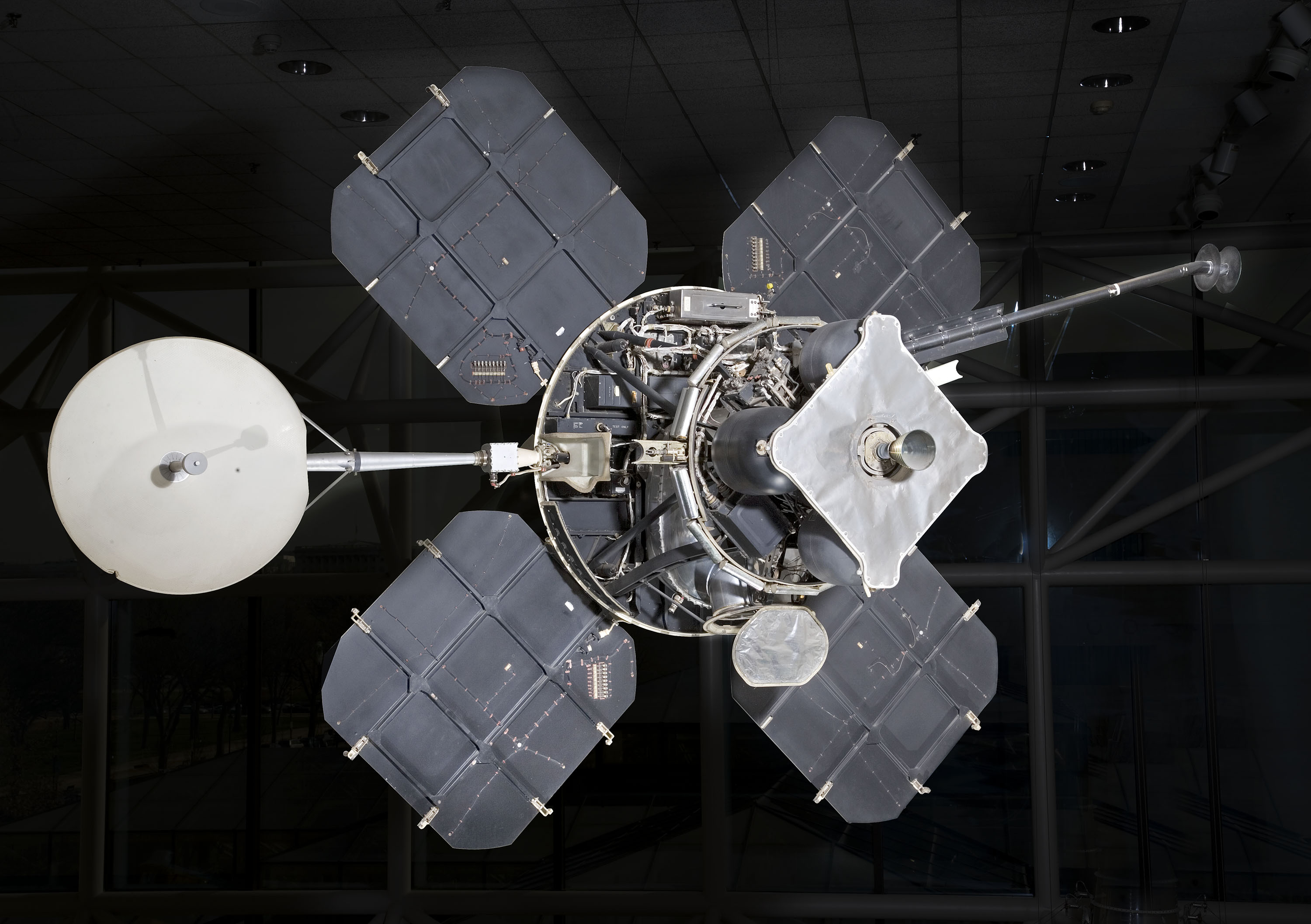
The artifact in the collection is an engineering model, S-10, used for thermal control tests. It was reconfigured to represent a flight model of Surveyor 3 or later, since it was the first to have a scoop and claw surface sampler. After receipt in 1968 it was displayed in Smithsonian's Arts & Industries Building and then was moved to its present location in Gallery 112, Lunar Exploration Vehicles, in 1976.
The Surveyor series was designed to carry out soft landings on the Moon and provide data about its surface and possible atmosphere. These were the first U.S. probes to soft-land on the Moon. Once landed they provided detailed pictures of the surface by means of a TV camera carried on each of the spacecraft. Later Surveyors carried the instrumented soil mechanics surface scoop seen on the artifact. These were used to study the mechanical properties of lunar soil. Some of the spacecraft were also equipped to perform simple chemical analyses on lunar soil by means of alpha particle scattering. There were seven Surveyor launches starting in May, 1966, all launched by the Atlas-Centaur rocket. All but two successfully achieved program goals returning over 88,000 high resolution photographs and invaluable detailed data on the nature and strength of the lunar surface.
Long Description
Surveyor (1966-1968)
The Surveyor probes were the first U.S. spacecraft to land safely on the Moon. The main objectives of the Surveyors were to obtain close-up images of the lunar surface and to determine if the terrain was safe for manned landings. Each Surveyor was equipped with a television camera. In addition, Surveyors 3 and 7 each carried a soil mechanics surface sampler scoop which dug trenches and was used for soil mechanics tests and Surveyors 5, 6, and 7 had magnets attached to the footpads and an alpha scattering instrument for chemical analysis of the lunar material. The following Surveyor missions took place.
Surveyor 1
Launched 30 May 1966
Landed 02 June 1966, 06:17:37 UT
Latitude 2.45 S, Longitude 316.79 E - Flamsteed P
Surveyor 2
Launched 20 September 1966
Crashed on Moon 22 September 1966
Vernier engine failed to ignite - southeast of Copernicus Crater
Surveyor 3
Launched 17 April 1967
Landed 20 April 1967, 00:04:53 UT
Latitude 2.94 S, Longitude 336.66 E - Oceanus Procellarum (Ocean of Storms)
Surveyor 4
Launched 14 July 1967
Radio contact lost 17 July 1967
2.5 minutes from touchdown - Sinus Medii
Surveyor 5
Launched 08 September 1967
Landed 11 September 1967, 00:46:44 UT
Latitude 1.41 N, Longitude 23.18 E - Mare Tranquillitatus (Sea of Tranquility)
Surveyor 6
Launched 07 November 1967
Landed 10 November 1967, 01:01:06 UT
Latitude 0.46 N, Longitude 358.63 E - Sinus Medii
Surveyor 7
Launched 07 January 1968
Landed 10 January 1968, 01:05:36 UT
Latitude 41.01 S, Longitude 348.59 E - Tycho North Rim
Alternate Name
Surveyor Lunar Lander
Key Accomplishment(s)
First U.S. Probes to Soft-Land on the Moon
Brief Description
Surveyor was designed to soft land on the Moon and provide data about its surface and possible atmosphere. It took detailed pictures of the surface using an onboard TV camera. Seven Surveyors launched starting in May, 1966 and all but two were successful.
Credit Line
Transferred from the National Aeronautics and Space Administration and the Jet Propulsion Laboratory
Inventory Number
A19700294000
Restrictions & Rights
CC0
Type
SPACECRAFT-Uncrewed
Materials
Aluminum, mixed metals, phenolics
Dimensions
Overall: 10 ft. tall x 14 ft. wide (304.8 x 426.7cm)
Support (base of extended landing gear): 14ft. (426.7cm)
Country of Origin
United States of America
See more items in
National Air and Space Museum Collection
Location
National Air and Space Museum in Washington, DC
Exhibition
Destination Moon
Data Source
National Air and Space Museum
Link to Original Record
Record ID
nasm_A19700294000