
Object Details
Designer
Samuel P. Langley
Manufacturer
Samuel P. Langley
Physical Description
Type: Two-blade, fixed pitch, wood, metal and fabric
Diameter: 250.2 cm (98.5 in.)
Chord: 67.3 cm (26.5 in.)
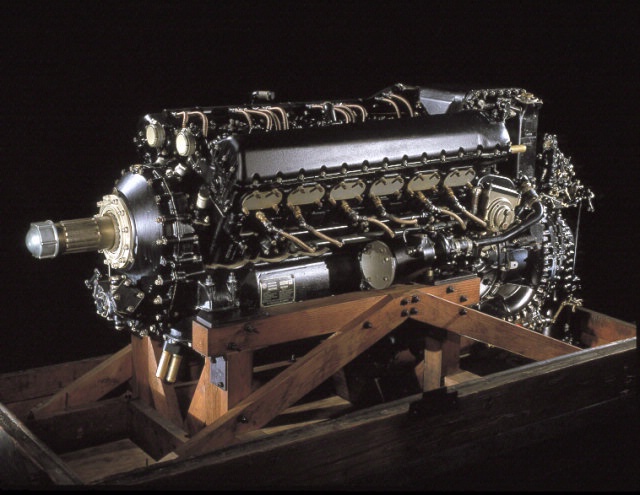
Engine Application: 39 kw (52-hp), five cylinder, radial, gasoline, water-cooled, geared transmission
Summary
Samuel P. Langley's successful 1896 flights of model Aerodromes Numbers 5 and 6 led to plans to build a larger, human-carrying airplane. However, his simple scaling of these earlier small aircraft to the required larger size proved unsuccessful. Despite an excellent engine, the larger Aerodrome A met with disastrous results, crashing twice on takeoff in late-1903. This ended Langley's aeronautical work, and he died in 1906.
Tests showed Langley that helical propellers made from solid wood were more efficient than blades constructed with a frame over which cloth was tightly drawn. However, it was found that cost and ease of repair made the latter type more practical. Furthermore, at the size required for Langley's Aerodrome A, solid wood propellers were too heavy. The design of this propeller, having a unit pitch ratio and 30-degree blade, was arrived at following tests both in a closed room and open air, and with various wood and steel frames.
Credit Line
Transferred from the Smithsonian Institution
Date
ca. 1903
Inventory Number
A19320022000
Restrictions & Rights
Usage conditions apply
Type
PROPULSION-Propellers & Impellers
Materials
Wood, Steel, Brass, Textile, Original Varnish, Paper, Adhesive
Dimensions
Rotor/Propeller: 250.2 × 68.6 × 3.2 × 40.6cm (98 1/2 × 27 × 1 1/4 × 16 in.)
Storage (aluminum pallet and frame with fabric cover): 250.2 × 121.9 × 105.4cm, 111.1kg (98 1/2 × 48 × 41 1/2 in., 245lb.)
Country of Origin
United States of America
See more items in
National Air and Space Museum Collection
Data Source
National Air and Space Museum
Link to Original Record
Record ID
nasm_A19320022000