
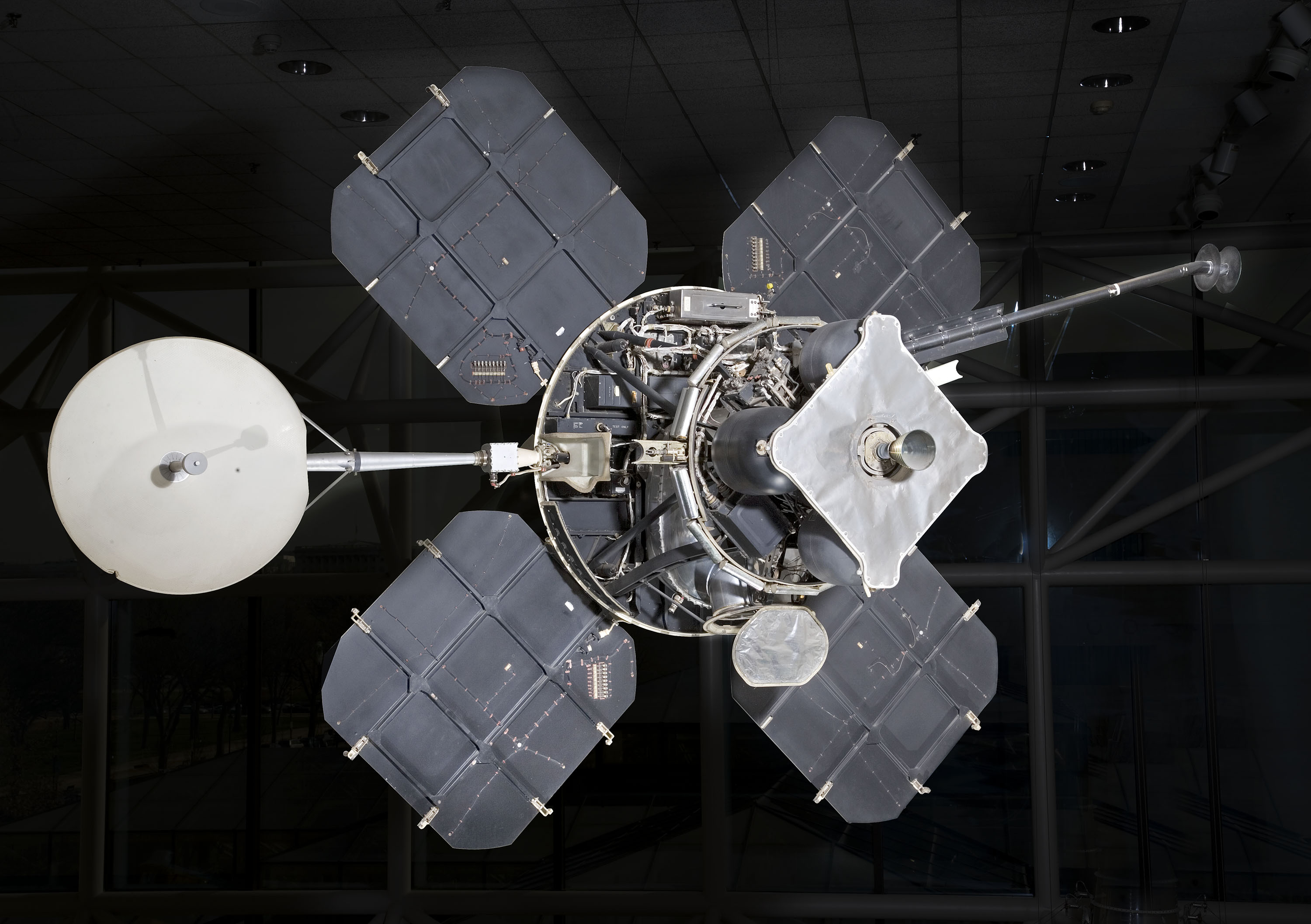
Object Details
Manufacturer
Westinghouse Electric
Summary
This is an ultraviolet detector from project Celescope. Celescope was a battery of four telescopes developed at the Smithsonian Astrophysical Observatory in the 1960s to survey the entire ultraviolet sky, looking for unusually hot sources of energy. The detector, the smaller diameter back end of the glass tube, is based upon standard Westinghouse "Vidicon" technology used in TV systems of that day. The larger front section is a special imaging system that converts ultraviolet light into electrons and focuses them electrostatically onto the front of the Vidicon, which then scans the surface, producing a varying current that was telemetered to the ground for analysis. Celescope was flown on December 7, 1968, as part of the payload for the second Orbiting Astronomical Satellite (OAO II). The data from Celescope resulted in a catalog of over 5,000 ultraviolet colors for stars.
The Smithsonian Astrophysical Observatory transferred this detector to the Museum in 1973.
Credit Line
Transferred from the Smithsonian Astrophysical Observatory
Inventory Number
A19840154000
Restrictions & Rights
Usage conditions apply
Type
EQUIPMENT-Electronics
Materials
Image sensor: Glass, steel, aluminum, ceramic, teflon/plastic
Housing: synthetic foam
Dimensions
Overall: 2 3/4in. x 11 1/2in. (6.99 x 29.21cm)
Country of Origin
United States of America
See more items in
National Air and Space Museum Collection
Data Source
National Air and Space Museum
Link to Original Record
Record ID
nasm_A19840154000