Skip to main content Skip to main navigation
heart-solid My Visit Donate
Home Smithsonian Institution IK development site for ODI
Press Enter to activate a submenu, down arrow to access the items and Escape to close the submenu.
    • Overview
    • Museums and Zoo
    • Entry and Guidelines
    • Museum Maps
    • Dine and Shop
    • Accessibility
    • Visiting with Kids
    • Group Visits
    • Overview
    • Exhibitions
    • Online Events
    • All Events
    • IMAX & Planetarium
    • Overview
    • Topics
    • Collections
    • Research Resources
    • Stories
    • Podcasts
    • Overview
    • For Caregivers
    • For Educators
    • For Students
    • For Academics
    • For Lifelong Learners
    • Overview
    • Become a Member
    • Renew Membership
    • Make a Gift
    • Volunteer
    • Overview
    • Our Organization
    • Our Leadership
    • Reports and Plans
    • Newsdesk
heart-solid My Visit Donate

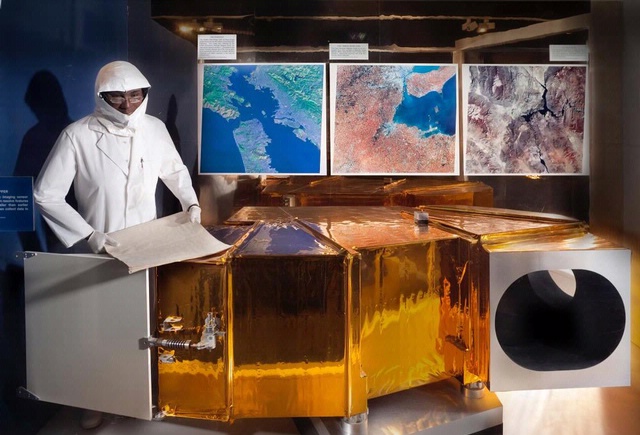
Engineering Test Model, Communications Satellite, Syncom

Air and Space Museum

There are restrictions for re-using this image. For more information, visit the Smithsonian's Terms of Use page .
International media Interoperability Framework
IIIF provides researchers rich metadata and media viewing options for comparison of works across cultural heritage collections. Visit the IIIF page to learn more.
View manifest View in Mirador Viewer

    Object Details

    Manufacturer

    Hughes Aircraft Co.

    Summary

    The Syncom series of spacecraft (Syncom 1, 2, and 3), all launched during 1963, were the first attempts to test the idea of satellite communications from geostationary orbit.
    As satellite communications evolved in the first years of the space age, geostationary orbits gradually emerged as the most effective approach to satellite communications. Spacecraft in this orbit matched the orbital rotation of the Earth and remained continuously over the same geographical area, making communication via satellite reliable and consistent.
    Syncom 1 failed soon after launch, but Syncom 2 and 3 each operated for more than two years. In a historic first, Syncom 3 transmitted television signals of the 1964 Olympic games in Tokyo to the United States. Geostationary satellites still provide the bulk of communications via satellite today.
    This artifact is an engineering test model (known as T-4), used primarily to conduct tests on spacecraft attitude and reaction control systems. The National Museum of American History transferred this artifact to the Museum in 2006.

    Credit Line

    Transferred from National Museum of American History

    Inventory Number

    A20070112000

    Restrictions & Rights

    Usage conditions apply

    Type

    SPACECRAFT-Uncrewed

    Materials

    Aluminum, Steel, Gold plating, Plastic, Copper, Epoxy, Carbon Fibers, Nylon, Adhesive, Fiberglas, Glass

    Dimensions

    Storage (Aluminum pallet andf frame with fabric dust cover): 121.9 × 121.9 × 119.4cm, 68kg (48 × 48 × 47 in., 150lb.)
    3-D: 77.5 × 74.9cm (30 1/2 × 29 1/2 in.)

    Country of Origin

    United States of America

    See more items in

    National Air and Space Museum Collection

    Data Source

    National Air and Space Museum

    Metadata Usage

    Not determined

    Link to Original Record

    http://n2t.net/ark:/65665/nv981cf3242-00b5-425c-87ad-eabe5765c144

    Record ID

    nasm_A20070112000

    Discover More

    Civilian Application Satellites Object Group

    Civilian Application Satellites

    Civilian Application Satellites Object Group

    Civilian Application Satellites

    arrow-up Back to top
    Home
    • Facebook facebook
    • Instagram instagram
    • LinkedIn linkedin
    • YouTube youtube

    • Contact Us
    • Get Involved
    • Shop Online
    • Job Opportunities
    • Equal Opportunity
    • Inspector General
    • Records Requests
    • Accessibility
    • Host Your Event
    • Press Room
    • Privacy
    • Terms of Use