
Object Details
Manufacturer
Hughes Aircraft Co.
Summary
The Syncom series of spacecraft (Syncom 1, 2, and 3), all launched during 1963, were the first attempts to test the idea of satellite communications from geostationary orbit.
As satellite communications evolved in the first years of the space age, geostationary orbits gradually emerged as the most effective approach to satellite communications. Spacecraft in this orbit matched the orbital rotation of the Earth and remained continuously over the same geographical area, making communication via satellite reliable and consistent.
Syncom 1 failed soon after launch, but Syncom 2 and 3 each operated for more than two years. In a historic first, Syncom 3 transmitted television signals of the 1964 Olympic games in Tokyo to the United States. Geostationary satellites still provide the bulk of communications via satellite today.
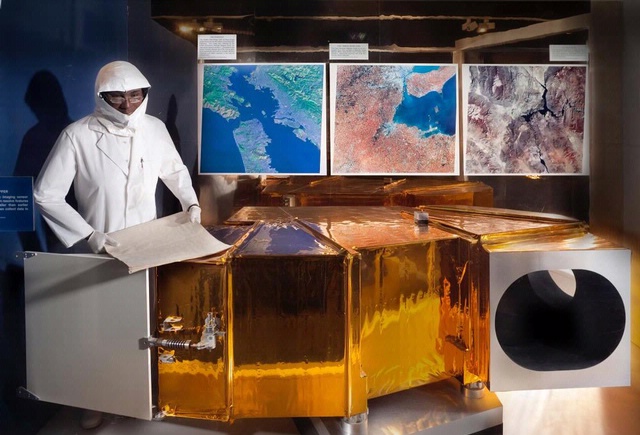
This artifact is an engineering test model (known as T-4), used primarily to conduct tests on spacecraft attitude and reaction control systems. The National Museum of American History transferred this artifact to the Museum in 2006.
Credit Line
Transferred from National Museum of American History
Inventory Number
A20070112000
Restrictions & Rights
Usage conditions apply
Type
SPACECRAFT-Uncrewed
Materials
Aluminum, Steel, Gold plating, Plastic, Copper, Epoxy, Carbon Fibers, Nylon, Adhesive, Fiberglas, Glass
Dimensions
Storage (Aluminum pallet andf frame with fabric dust cover): 121.9 × 121.9 × 119.4cm, 68kg (48 × 48 × 47 in., 150lb.)
3-D: 77.5 × 74.9cm (30 1/2 × 29 1/2 in.)
Country of Origin
United States of America
See more items in
National Air and Space Museum Collection
Data Source
National Air and Space Museum
Link to Original Record
Record ID
nasm_A20070112000