
Object Details
Manufacturer
NASA - Jet Propulsion Laboratory
Summary
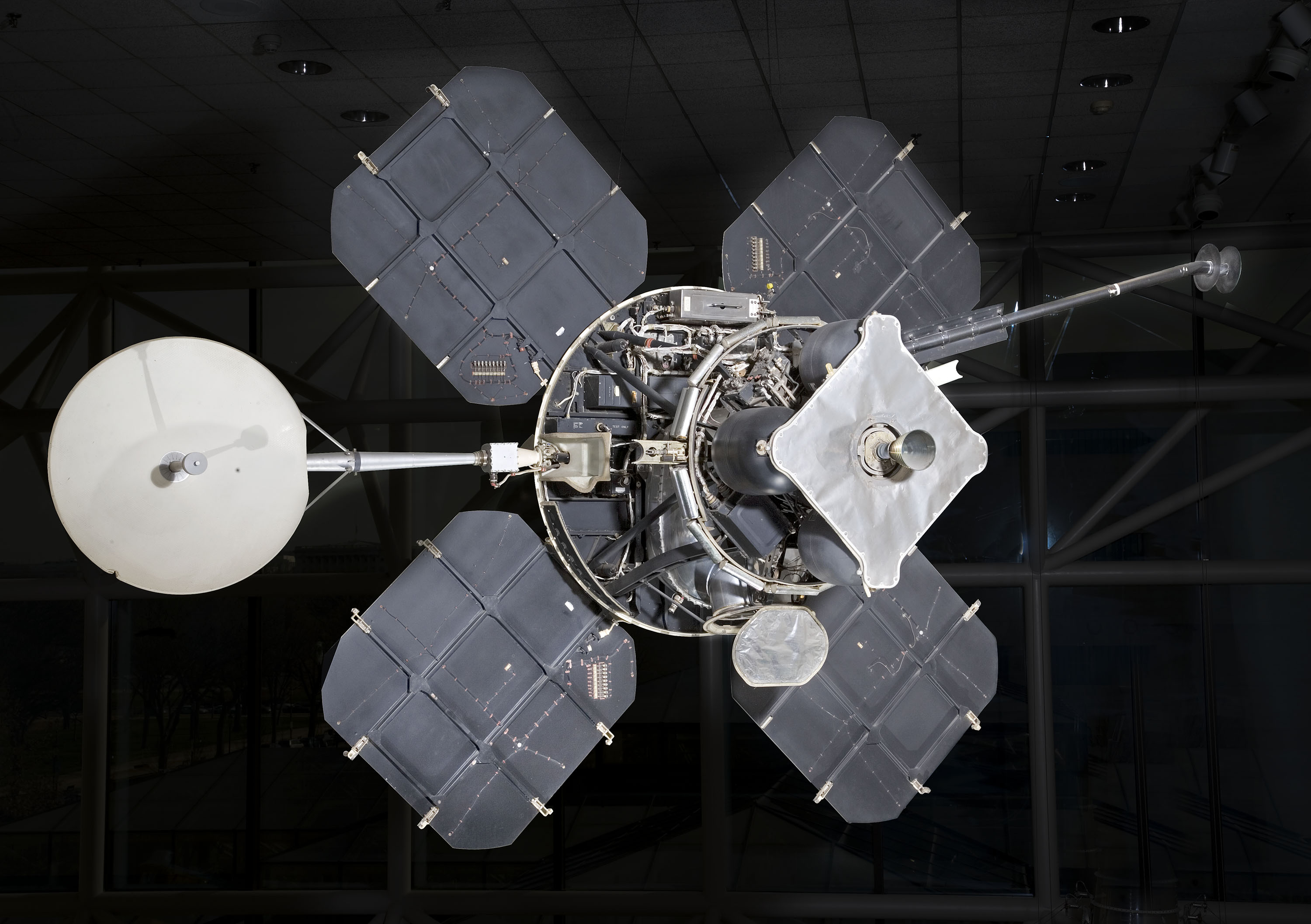
On December 14, 1962, useful scientific information was radioed to Earth from the vicinity of another planet for the first time. The unmanned Mariner 2 spacecraft, with its six scientific instruments, passed within 34,800 kilometers (21,600 miles) of Venus. Mariner 2 indicated that Venus is very hot and has no measurable magnetic fields or radiation belts. On the way to Venus, Mariner 2's instruments detected and measured the radiation, magnetic fields, and dust of interplanetary space.
Contact with Mariner 2 was lost on January 2, 1963; it is now in orbit around the Sun. The spacecraft on display was constructed from test components by engineers from NASA's Jet Propulsion Laboratory.
Long Description
"Before Mariner II lost its sing-song voice, it produced 13 million data words of computer space lyrics to accompany the music of the spheres."-Mariner Mission to Venus (McGraw-Hill, 1963), p. 112
Mariner 2
Planetary exploration began, just as lunar exploration had, in a race between the United States and the Soviet Union to see who would be the first to place some sort of spacecraft near Venus, and Mariner 2 was the first successful spacecraft from Earth to reach the planet. Exploration of the inner solar system was not just an opportunity to best a rival in the Cold War; scientists in both the United States and the Soviet Union recognized the attraction of Venus for the furtherance of planetary studies. Regarded as both the evening and the morning star, Venus had long enchanted humans-and all the more so since astronomers had realized that it was shrouded in a mysterious cloak of clouds permanently hiding the surface from view. It was also the closest planet to Earth, and a near twin to this planet in terms of size, mass, and gravitation.
These attributes brought myriad speculations about the nature of Venus and the possibility of life existing there in some form. For instance, in the first half of the twentieth century a popular theory held that the sun had gradually been cooling for millennia and that as it did so, the terrestrial planets of the solar system had a turn as a haven for life of various types. Although it was now Earth's turn to harbor life, the theory suggested that Mars had once been habitable and that life on Venus was now just beginning to evolve. Beneath the clouds of the planet, the theory offered, was a warm, watery world and the possibility of aquatic and amphibious life. "It was reasoned that if the oceans of Venus still exist, then the Venusian clouds may be composed of water droplets," noted a 1963 publication about the Mariner 2 mission; "if Venus were covered by water, it was suggested that it might be inhabited by Venusian equivalents of Earth's Cambrian period of 500 million years ago, and the same steamy atmosphere could be a possibility."
Mariner 2 helped to determine that none of these speculations were true. The second in a series of planetary exploration spacecraft, this was the world's first spacecraft to fly-by a planet. Both Mariner 1 and 2 were part of a 1961 NASA planetary exploration initiative that took some of its design from the Ranger program, Mariner 2 bears a striking resemblance to the basic framework, solar panels, and antennas of its Ranger predecessor. Although Mariner 1 was lost during launch on July 22, 1962, Mariner 2 successfully took off on August 27, 1962. A 450-pound vehicle, it carried six scientific instruments, a two-way radio, a solar-power system, and assorted electronic and mechanical devices. Its controllers, numbering roughly 75, worked from NASA's Jet Propulsion Laboratory in Pasadena, California.
Mariner 2 made its closest approach to Venus on December 14, 1962, after a 108-day journey from Earth, coming within 21,648 miles of the planet. It carried several scientific instruments that provided information about the nature of the venusian atmosphere and surface as well as interplanetary space. A microwave radiometer measured the temperatures of both the planet's surface and its upper atmosphere, and found that the surface of Venus was indeed very hot; some 800 degrees F as measured by the microwave radiometer.
Mariner 2 also carried a high-energy radiation experiment and a magnetometer. These did not detect any noticeable differences in radiation from space once in the vicinity of Venus, nor did it seem likely that the planet had an appreciable magnetosphere. Perhaps the most important observation these instruments made was that an astronaut would not be exposed to lethal doses of radiation even on a four month interplanetary voyage. Contact with Mariner 2 was lost on January 2, 1963, and it is now in orbit around the Sun.
This object is a full scale engineering prototype and was constructed from flight spares by engineers at the Jet Propulsion Laboratory in 1977.
Alternate Name
Mariner 2
Key Accomplishment(s)
World’s First Successful Interplanetary Spacecraft
Impact or Innovation
Mariner 2 began the era of robotic exploration of the planets, moons, asteroids, and comets in our solar system.
Brief Description
Mariner 2 flew by Venus in 1962, discovering its surface is extremely hot and unlikely to support life. The spacecraft on display is an engineering model.
Credit Line
Transferred from the National Aeronautics and Space Administration
Date
July 1, 1976 to present
Inventory Number
A19760027000
Restrictions & Rights
CC0
Type
SPACECRAFT-Uncrewed-Test Vehicles
Materials
Aluminum, mixed metals
Dimensions
Overall: 8 ft. 1 in. tall x 5 ft. 10 in. wide x 5 ft. 10 in. deep, 1118 lb. (246.4 x 177.8 x 177.8cm, 507.1kg)
Country of Origin
United States of America
See more items in
National Air and Space Museum Collection
Location
National Air and Space Museum in Washington, DC
Exhibition
Boeing Milestones of Flight Hall
Data Source
National Air and Space Museum
Link to Original Record
Record ID
nasm_A19760027000