
Object Details
Physical Description
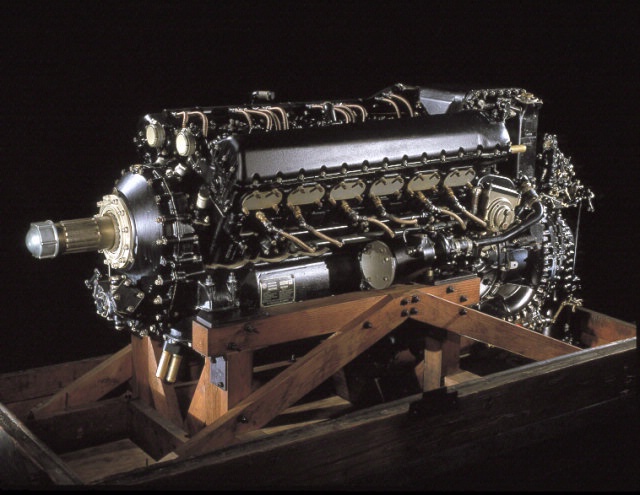
Type: Reciprocating, 24 cylinders, X-configuration, Fuel injected, Liquid cooled,
Power rating: 1,864 kW (2,500 hp) at (Unknown) rpm
Displacement: 63.4 L (3,868 cu in.)
Bore and Stroke: 145 mm (5.71 in.) x 160 mm (6.30 in.)
Weight: Unknown
Summary
During the mid-1930s, the Japanese had an interest in powerful, low frontal area engines. Around 1940, the Japanese Navy began development of the YE3A, a 24-cylinder, liquid-cooled, X-type engine, derived from the 18-cylinder YE2A, having the same bore and stroke as the YE2H. By 1943, an experimental engine, known as Ken No. 1 (believed to be this YE3B, or Ha74 Model 01), was being developed and tested by the Yokosuka Naval Air Arsenal for internal wing installation. A similar engine for internal fuselage installation, known as Ken No. 2 (believed to be the YE3E, also Ha 74 Model 11), was rated at 2,386 kW (3,200 shp) and scheduled for completion in 1944.
However, none of the several high power liquid-cooled engines under development by Japan could keep up with the faster development of air-cooled radial engines, and did not reach operational status by the war’s end. Also the focus of international engine development had turned toward turbine engines.
Credit Line
Transferred from the U.S. Air Force Museum
Date
Circa World War II
Inventory Number
A19670119000
Restrictions & Rights
Usage conditions apply
Type
PROPULSION-Reciprocating & Rotary
Materials
Aluminum, Rubber, Steel, Textile, Paint, Preservative coating, Copper, Magnesium, Wood
Dimensions
Depth 182.9 cm (72 in.), Length 228.6 cm(90 in.), Width 175.3 cm (69 in.)
Country of Origin
Japan
See more items in
National Air and Space Museum Collection
Data Source
National Air and Space Museum
Link to Original Record
Record ID
nasm_A19670119000