
Object Details
Manufacturer
Napier Aero Engines Ltd.
Physical Description
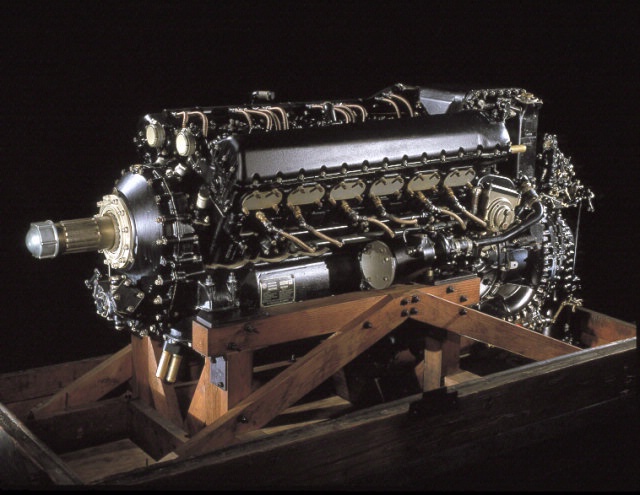
Type: Reciprocating, 12 cylinders, W-type (three banks of four cylinders), water-cooled
Power rating: 336 kW (450 hp) at 2,000 rpm
Displacement: 24 L (1,462 cu in.)
Bore and Stroke: 140 mm (5.5 in.) x 130 mm (5.13 in.)
Weight: 389.2 kg (858 lb)
Summary
With an industrial history dating to the early nineteenth century, D. Napier and Son began building aircraft engines in the World War I era. Napier began work on a remarkable new engine, the Lion, in 1916. Its three banks of four cylinders formed a "W" or "Broad Arrow" configuration. The arrangement provided a much shorter crankcase, a stiffer and simpler crankshaft, and a more compact engine than the 12-cylinder "V" construction of other high-performance engines of the period.
Napier produced the reliable and widely used Lion series from 1917 until 1932 for military, commercial, and special-purpose racing aircraft. One especially notable application was the Supermarine S.5, which, powered by a 656 kW (880-hp) Lion VIIB engine, won the Schneider Trophy Race in 1927.
Although the Lion became uncompetitive for aviation after 1930, the Sea Lion marine version stayed in production for RAF rescue application until 1943.
Credit Line
Transferred from the U.S. Air Force, Wright-Patterson AFB, Ohio
Date
Circa 1919
Inventory Number
A19610134000
Restrictions & Rights
Usage conditions apply
Type
PROPULSION-Reciprocating & Rotary
Materials
Aluminum
Steel
Paint
Rubber
Copper Alloy
Dimensions
Length 167.6 cm (66 in.), Width 121.9 cm (48 in.), Height 109.2 cm (43in.)
Country of Origin
United Kingdom
See more items in
National Air and Space Museum Collection
Data Source
National Air and Space Museum
Link to Original Record
Record ID
nasm_A19610134000