
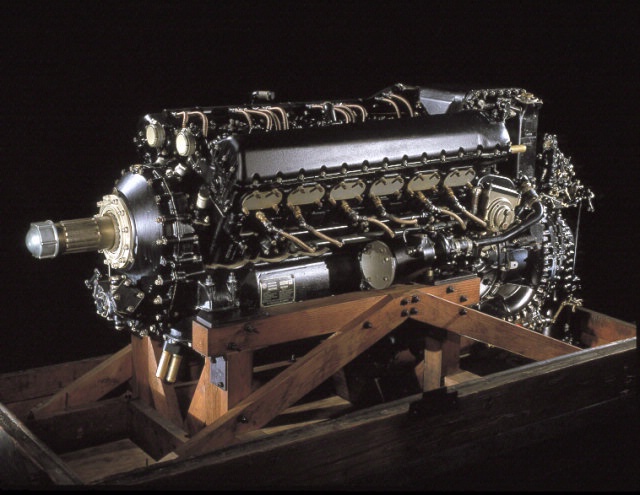
Object Details
Physical Description
Type: Reciprocating, 18 cylinders, 2-rows, radial, air cooled
Power rating: 1,491 kW (2,000 hp) at 3,000 rpm
Displacement: 35.9 L (2,195 cu in.)
Bore and Stroke: 130 mm (5.1 in.) x 150 mm (5.9 in.)
Weight: 830 kg (1,830 lb.)
Summary
The Homare (Honor) was Japan’s most-used engine in the latter years of World War II. Fan cooling, fuel injection, turbo-supercharging and water-methanol injection differed in various versions. All models suffered from unreliability, service difficulty (particularly when first entering service), and vibration.
The artifact powered the carrier based Nakajima C6N-1 Saiun (Painted Cloud) (Allied Code Name MYRT) single engine reconnaissance aircraft, which is in the museum’s collection, and is the only remaining example of this aircraft. This particular NK9H (Ha45-21) engine model also powered the Nakajima J5N1 Tenrai (Heavenly Thunder) (Allied Code Name IRVING) twin-engine experimental fighter, which was never produced, and the Kawanishi N1K2-Ja Shiden (Violet Lightning) (Allied Code Name GEORGE), probably the best naval fighter produced by the Japanese. Both of these aircraft are also in the museum’s collection. The latter aircraft was first produced as a floatplane, but was later land based to counter the U.S. Grumman F6F Hellcat and Vought F4U Corsair.
Credit Line
Transferred from the U.S. Air Force
Date
Circa World War II
Inventory Number
A19600337003
Restrictions & Rights
Usage conditions apply
Type
PROPULSION-Reciprocating & Rotary
Materials
Aluminum
Steel
Magnesium Alloy
Paint
Copper Alloy
Plastic
Leather
Natural Fabric
Dimensions
Length 224.8 cm (88.5 in.), Width 152.4 cm (60 in.), Height 165.1 cm (65 in.)
Country of Origin
Japan
See more items in
National Air and Space Museum Collection
Data Source
National Air and Space Museum
Link to Original Record
Record ID
nasm_A19600337003