
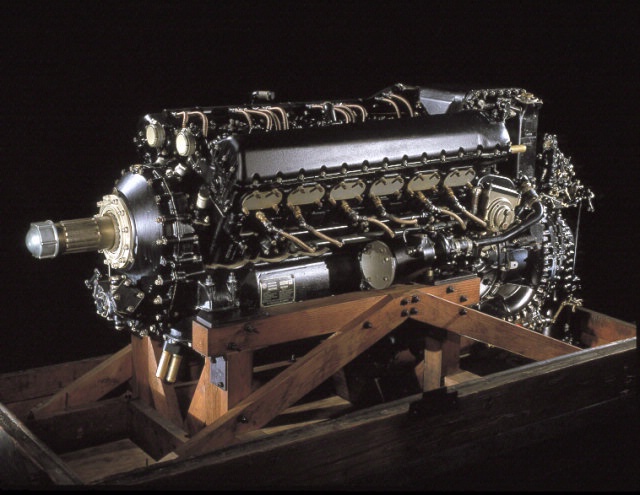
Object Details
Manufacturer
Nakajima Hikoki K. K.
Physical Description
Type: Reciprocating, 18 cylinders, 2 rows, Radial, Air cooled
Power rating: 1,827 kW (2,450 hp) at 2,800 rpm
Displacement: 48.2 L (2,941 cu in.)
Bore and Stroke: 146 mm (5.75 in.) x 160 mm (6.30 in.)
Weight: 1,150 kg (2,535 lb)
Summary
Nakajima provided Japan with its first large radials by building Bristols beginning in the late 1920s. In 1936, Nakajima began building Gnome-Rhone engines under license. Its own World War II designs were apparently not considered very good.
With a starboard fuselage exhaust-driven turbo-supercharger and engine-mounted cooling fan, the fuel-injected Nakajima Ha 44 Model 12 powered the Nakajima Ki-87 high-altitude fighter. The government specified performance objectives that were very ambitious, i.e. 800 km/hr (497 mph) with a range of 3,000 km (1,864 miles). These were later revised, but by February 1945, only one prototype aircraft was completed, with turbo-supercharger development problems contributing to the delay. Test flights began in April and, while the aircraft demonstrated good flying characteristics, only five flights were made as difficulties with the engine prevented further testing.
When the war ended, an improved aircraft was on the drawing board, which included a 2,237 kW (3,000 hp) Nakajima Ha-217 engine and belly turbo-supercharger mounting.
Credit Line
Transferred from the United States Army Air Forces
Date
Circa World War II
Inventory Number
A19670105000
Restrictions & Rights
Usage conditions apply
Type
PROPULSION-Reciprocating & Rotary
Materials
Aluminum
Magnesium Alloy
Steel
Copper Alloy
Paint
Plastic
Rubber
Cadmium Plating
Dimensions
Diameter 128 cm (50.4 in.), Length 152.4 cm (60 in.)
Country of Origin
Japan
See more items in
National Air and Space Museum Collection
Data Source
National Air and Space Museum
Link to Original Record
Record ID
nasm_A19670105000