
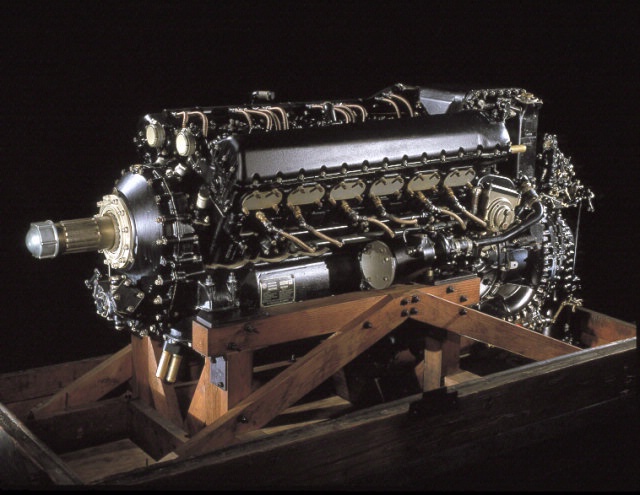
Object Details
Manufacturer
Nakajima Hikoki K. K.
Physical Description
Type: Reciprocating, 18 cylinders, 2 rows, radial, air-cooled, supercharged
Power rating: 1,491 kW (2,000 hp)
Displacement: 35.9 L (2,195 cu in)
Bore and Stroke: 130 mm (5.1 in.) x 150 mm (5.9 in.)
Weight: 800-900 kg (1800-2000 lb)
Summary
After overcoming some initial reliability problems, the Homare (Honour) became the most important 18-cylinder Japanese engine toward the end of World War II. It powered aircraft with Allied Code Names George, Sam, Rita, and Frank. A very compact design, it had a very high specific output; and incorporated for the first time in a Japanese engine, a steel crankcase, dynamic balancers, a dual magneto with a remote distributor (on the nose), and a nose sump pump. Its supercharger drive followed the Wright Aeronautical design, with a planetary reduction gear in series with the high gear for obtaining a lower compression ratio. It was equipped with water-methanol injection.
Credit Line
Transferred from the U.S. Navy, Naval Supply Center, Cheatham Annex, Williamsburg, Virginia
Date
Circa World War II
Inventory Number
A19731565000
Restrictions & Rights
Usage conditions apply
Type
PROPULSION-Reciprocating & Rotary
Materials
Aluminum
Steel
Paint
Leather
Rubber
Paper
Adhesive
Cadmium Plating
Magnesium Alloy
Dimensions
Overall: 46 7/16 in., 830lb. (118cm, 376.5kg)
Other: 46 7/16 x 52 x 84 x 55in. (118 x 132.1 x 213.4 x 139.7cm)
Storage: 213.4 × 139.1 × 142.2cm (84 × 54 3/4 × 56 in.)
Country of Origin
Japan
See more items in
National Air and Space Museum Collection
Data Source
National Air and Space Museum
Link to Original Record
Record ID
nasm_A19731565000