Skip to main content Skip to main navigation
heart-solid My Visit Donate
Home Smithsonian Institution IK development site for ODI
Press Enter to activate a submenu, down arrow to access the items and Escape to close the submenu.
    • Overview
    • Museums and Zoo
    • Entry and Guidelines
    • Museum Maps
    • Dine and Shop
    • Accessibility
    • Visiting with Kids
    • Group Visits
    • Overview
    • Exhibitions
    • Online Events
    • All Events
    • IMAX & Planetarium
    • Overview
    • Topics
    • Collections
    • Research Resources
    • Stories
    • Podcasts
    • Overview
    • For Caregivers
    • For Educators
    • For Students
    • For Academics
    • For Lifelong Learners
    • Overview
    • Become a Member
    • Renew Membership
    • Make a Gift
    • Volunteer
    • Overview
    • Our Organization
    • Our Leadership
    • Reports and Plans
    • Newsdesk
heart-solid My Visit Donate

Detector, Neutrino, Photomultiplier, Kamiokande II

Air and Space Museum

There are restrictions for re-using this image. For more information, visit the Smithsonian's Terms of Use page .
International media Interoperability Framework
IIIF provides researchers rich metadata and media viewing options for comparison of works across cultural heritage collections. Visit the IIIF page to learn more.
View manifest View in Mirador Viewer

    Object Details

    Manufacturer

    Hamamatsu Photonics

    Summary

    This a special photomultiplier tube built in the mid 1980s by the Hamamatsu Corporation, designed to detect proton decay predicted by the Grand Unified Theory. The tube, one of the original array of 1000 that surrounded an immense underground water reservoir, was designed to detect a flash of Cerenkov radiation caused by the decay process. But when no interactions were found in over a year of operation, the instrument was upgraded to be sensitive enough to detect the interaction of a neutrino and an electron in the mass of water molecules in the chamber. Renamed Kamiokande II, this detector recorded the passage of eleven neutrinos, members of a vast storm resulting from the eruption of the brightst supernova in the past 400 years (SN 1987A) that took place in the large Magellanic Cloud. This opened up a new form of observaitonal astronomy called today "neutrino astronomy," an event which has since been recognized by the award of the Nobel Prize for physics to the principal scientist heading the project, M. Koshiba.
    During normal operations the array of 1000 tubes is periodically checked for vacuum leakage, and this one was found to be defective and so was decommissioned in 1990. The leakage is most evident in the evaporation of the antimony coating on the inside of the glass, which renders its inner workings visible. The tube was selected by the curator during a site visit in 199to the mine in Japan that houses the detector. It was donated to NASM in 1997 by the Institute for Cosmic Ray Research of the University of Tokyo and prepared for shipment by Hamamatsu.

    Credit Line

    Gift of Dr. Y. Totsuka, Institute of Cosmic Ray Research, University of Tokyo.

    Inventory Number

    A19990004000

    Restrictions & Rights

    Usage conditions apply

    Type

    INSTRUMENTS-Scientific

    Materials

    Glass and mixed metals

    Dimensions

    3-D (Overall): 66 × 48.3 × 49.5cm (2 ft. 2 in. × 1 ft. 7 in. × 1 ft. 7 1/2 in.)
    3-D: 11.3kg (25lb.)

    Country of Origin

    Japan

    See more items in

    National Air and Space Museum Collection

    Data Source

    National Air and Space Museum

    Metadata Usage

    Not determined

    Link to Original Record

    http://n2t.net/ark:/65665/nv9e7bba87d-051f-4714-8029-2b562bf74e89

    Record ID

    nasm_A19990004000

    Discover More

    astronaut holding an American flag with a cosmic view in the background

    Cosmic Collections

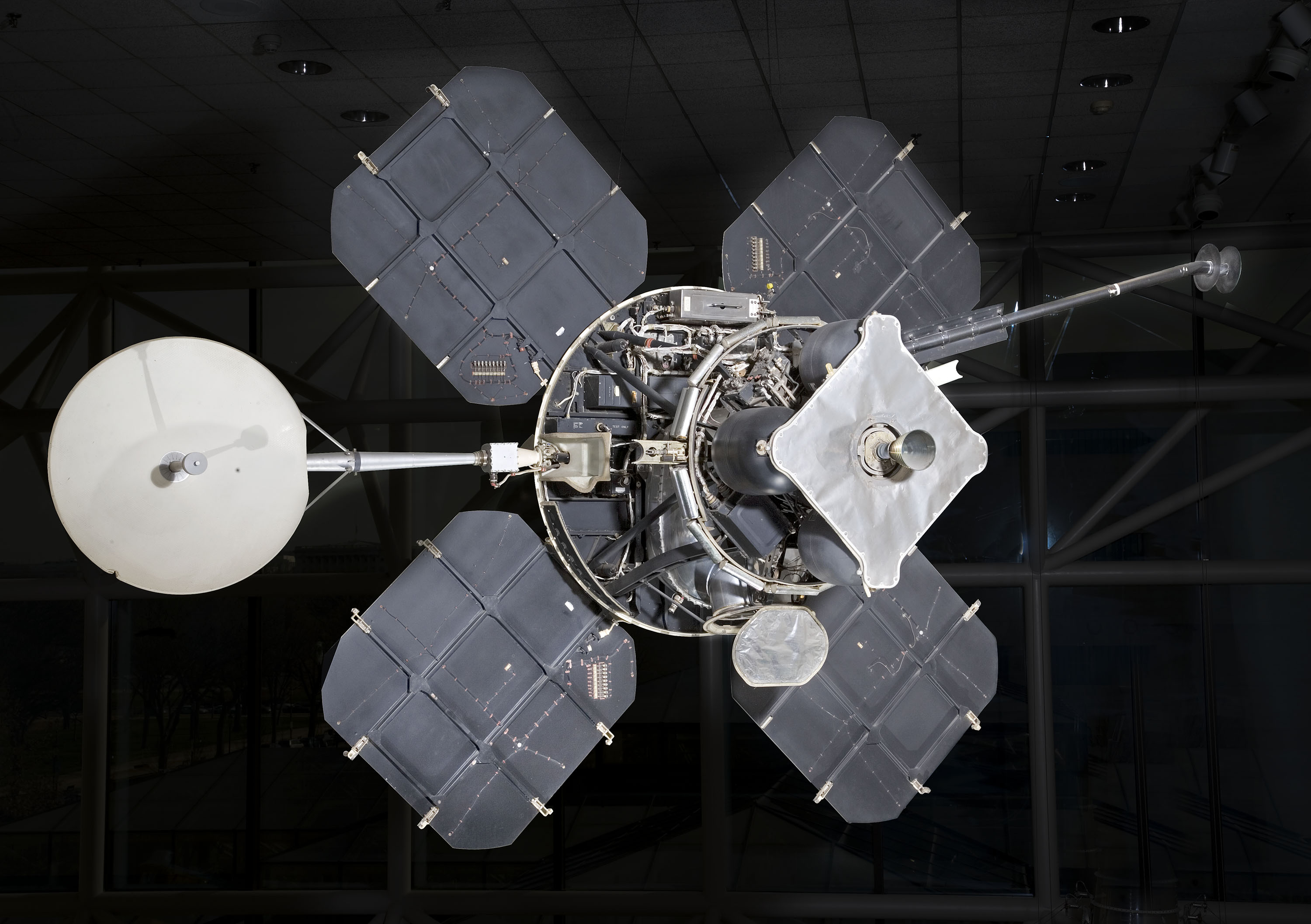
    Lunar orbiter on display

    Space Science

    Lunar orbiter on display

    Space Science

    arrow-up Back to top
    Home
    • Facebook facebook
    • Instagram instagram
    • LinkedIn linkedin
    • YouTube youtube

    • Contact Us
    • Get Involved
    • Shop Online
    • Job Opportunities
    • Equal Opportunity
    • Inspector General
    • Records Requests
    • Accessibility
    • Host Your Event
    • Press Room
    • Privacy
    • Terms of Use