
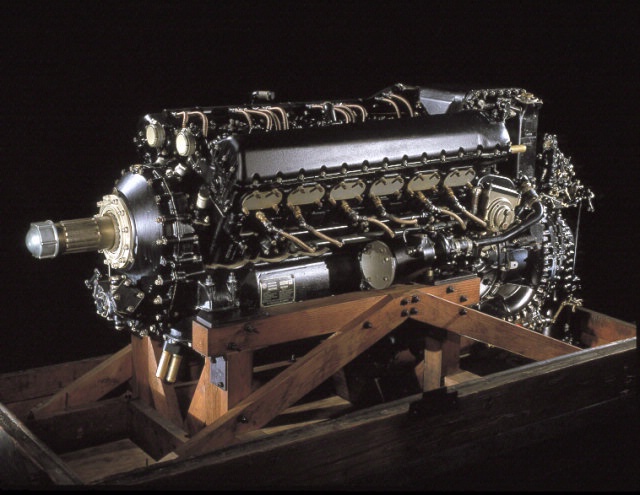
Object Details
Manufacturer
Continental, Inc.
Physical Description
Type: Reciprocating, 7 cylinders, single row, radial, air-cooled
Power rating: 261 kW (350 hp) at 2,000 rpm
Displacement: 13.0 L (794 cu in.)
Bore and Stroke: Not available
Weight: 259 kg (571 lb)
Summary
In 1925, Continental, a successful manufacturer of automotive engines, purchased the rights for a Burt-McCollum single-sleeve valve engine design. Believing this technology might replace poppet valves in aircraft engines, Continental announced the R-790 engine in 1927, incorporating single-sleeve valves initially installed on a Wright 9-cylinder engine. It was never fully tested, but followed by the 7-cylinder R-794, for which five engines were ordered by the U.S. Navy in 1934. It was tested, but did not go into production.
The Navy later sponsored a number of unconventional engine designs; however, few entered production. In the case of the 1939 XR-1740-2 development, the outcome was apparently typical of single-sleeve valve history. For example, Bristol’s Roy Fedden, one of history’s great aircraft engine experts, was unable to mass produce single-sleeve engines. Continental only became successful after reverting to poppet valves, and this artifact represents a seemingly simple new concept that could not compete with older, conventional technology better developed for practical application.
Credit Line
Transferred from the U.S. Navy
Date
Circa 1937
Inventory Number
A19710902000
Restrictions & Rights
Usage conditions apply
Type
PROPULSION-Reciprocating & Rotary
Materials
Steel
Aluminum
Coating
Copper Alloy
Ceramic
Synthetic
Plastic
Dimensions
Overall: 571lb. (259kg)
Other (Engine): 3 ft. 3 in. × 3 ft. 4 1/8 in. (99.1 × 101.9cm)
Storage (Stand): 5 ft. 4 1/4 in. × 4 ft. 2 in. (163.2 × 127cm)
3-D (Overall): 104.1 × 88.9 × 144.8cm (3 ft. 5 in. × 2 ft. 11 in. × 4 ft. 9 in.)
Country of Origin
United States of America
See more items in
National Air and Space Museum Collection
Data Source
National Air and Space Museum
Link to Original Record
Record ID
nasm_A19710902000