
Object Details
Manufacturer
Massachusetts Institute of Technology, Lincoln Laboratory
Summary
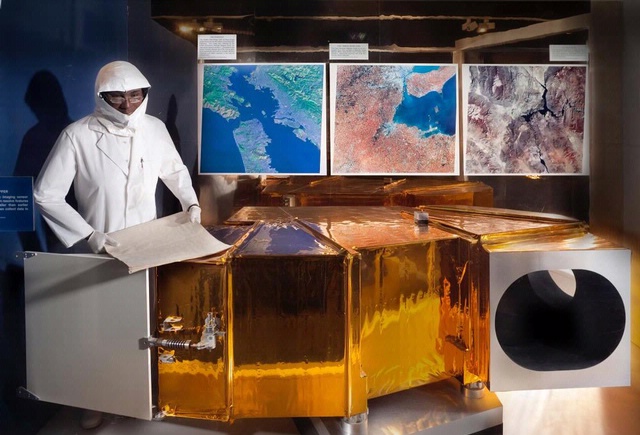
Launched by the U.S. Air Force in 1963, the West Ford satellite used a unique concept to test the new undertaking of communications from space. Once in space, a dispenser via a spring mechanism pushed a canister, packed with millions of tiny needles (dipoles), into orbit. The needles in the canister slowly separated and formed a ring around the Earth. Antennas on the ground bounced radio signals off the ring of needles to communicate.
The museum's satellite is a prototype; this artifact is part of the power unit.
Transferred from the National Museum of American History to the Museum in 2004.
Credit Line
Transferred from the Smithsonian Institution, National Museum of American History
Inventory Number
A20040113003
Restrictions & Rights
Usage conditions apply
Type
SPACECRAFT-Uncrewed-Instruments & Payloads
Materials
Steel
Paint
Copper Alloy
Ceramic
Rubber
Aluminum
Plastic
White metal plating
Paper
Adhesive
Unidentified Sealant
Dimensions
Overall: 19.1 × 45.7 × 12.7cm, 12lb. (7 1/2 × 18 × 5 in., 5.4kg)
Storage: 61 × 71.8 × 33.7cm (24 in. × 28 1/4 in. × 13 1/4 in.)
Country of Origin
United States of America
See more items in
National Air and Space Museum Collection
Data Source
National Air and Space Museum
Link to Original Record
Record ID
nasm_A20040113003