
Object Details
Manufacturer
Massachusetts Institute of Technology, Lincoln Laboratory
Summary
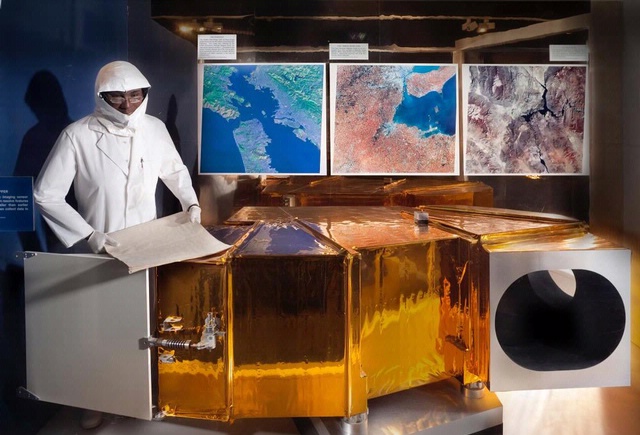
Launched by the U.S. Air Force in 1963, the West Ford satellite used a unique concept to test the new undertaking of communications from space. Once in space, the dispenser via a spring mechanism pushed the canister (this artifact), packed with millions of tiny needles (dipoles), into orbit. The needles in the canister slowly separated and formed a ring around the Earth. Antennas on the ground bounced radio signals off the ring of needles to communicate.
The museum's satellite is a prototype.
Transferred from the National Museum of American History to the Museum in 2004.
Credit Line
Transferred from the Smithsonian Institution, National Museum of American History
Inventory Number
A20040113001
Restrictions & Rights
Usage conditions apply
Type
SPACECRAFT-Uncrewed-Instruments & Payloads
Materials
Plastic, copper, aluminum
Dimensions
Overall: 8.89 high x 13.97 wide x 13.97cm deep, 5.4kg weight (3 1/2in. x 5 1/2in. x 5 1/2in., 12lb.)
Country of Origin
United States of America
See more items in
National Air and Space Museum Collection
Location
Steven F. Udvar-Hazy Center in Chantilly, VA
Hangar
James S. McDonnell Space Hangar
Data Source
National Air and Space Museum
Link to Original Record
Record ID
nasm_A20040113001