
Object Details
Manufacturer
United States Naval Academy
Summary
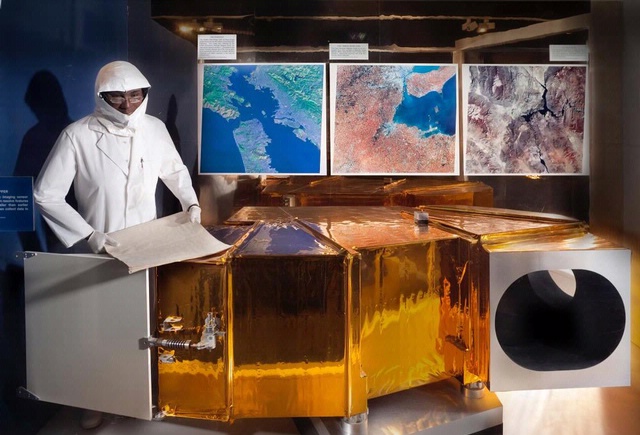
PCsat, developed by U.S. Naval Academy students and launched in 2001, allows amateur users to report and receive position information and messages from specially designed walkie-talkies nearly anywhere in the world. This artifact is an engineering model used to test the thermal and mass properties of the satellite. Note that the antennas are metal strips cut from commercially-available measuring tape.
The United States Naval Academy donated this artifact to the Museum in 2004.
Credit Line
Gift of the United States Naval Academy Small Satellite Program
Inventory Number
A20040208000
Restrictions & Rights
Usage conditions apply
Type
SPACECRAFT-Uncrewed
Materials
Aluminum, steel, Kapton tape, electrical components, insulated wires, paper, paint
Dimensions
Display (Object will fit into a rectangular space measuring): 86.4 × 76.2 × 94cm (2 ft. 10 in. × 2 ft. 6 in. × 3 ft. 1 in.)
Overall (Spacecraft bus): 10 × 10 × 10 in. (25.4 × 25.4 × 25.4cm)
Other (Four of the antennae): 6 1/2 in. (16.5cm)
Other (Four of the antennae): 1 ft. 7 1/2 in. (49.5cm)
Approximate (Including antennae, as displayed in current case): 81.3 × 81.3 × 71.1cm (2 ft. 8 in. × 2 ft. 8 in. × 2 ft. 4 in.)
Support (Height of previous mount): 29.8cm (11 3/4 in.)
3-D (Not including bottom tape measures): 74.9 × 67.3 × 83.8cm (2 ft. 5 1/2 in. × 2 ft. 2 1/2 in. × 2 ft. 9 in.)
Country of Origin
United States of America
See more items in
National Air and Space Museum Collection
Data Source
National Air and Space Museum
Link to Original Record
Record ID
nasm_A20040208000