
Object Details
Manufacturer
G. T. Schjeldahl Co.
Grumman Aircraft, Inc.
Summary
During the late 1950s and early 1960s, researchers considered two possible technologies for space satellite communications. One was "active" satellites, designed to receive a signal, amplify it, and then transmit it back to earth. This technique became the basis for the communications satellites prevalent today.
"Passive" satellites, such as Echo, were also briefly considered. This type of satellite only served as a reflective surface: signals transmitted from the Earth were bounced back to the ground. While Echo had the advantage of simplicity, active satellites quickly surpassed the limited range of communications possible from a reflective surface in space. Echo 1 was launched in 1960 and Echo 2 in 1964. By the time of the second Echo, active communications satellites had clearly demostrated their much greater capabilities and the passive satellite was used primarily for scientific experiments.
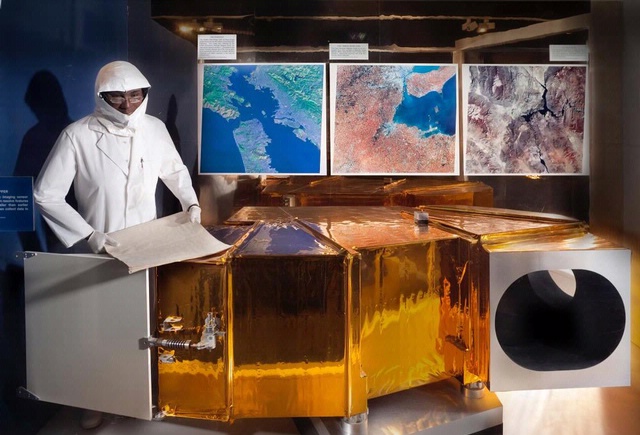
The Echo satellites did pose a unique technical challenge. They were essentially balloons which were sent into orbit folded flat and then inflated. When inflated, Echo 1 was a 100 foot sphere; Echo 2 was a slightly larger 135 foot sphere. The inflation had to proceed carefully to ensure the integrity of the satellite.
The Museum's artifact is a prototype of Echo 2.
Credit Line
Transferred from the National Aeronautics and Space Administration
Inventory Number
A19731560000
Restrictions & Rights
Usage conditions apply
Type
SPACECRAFT-Uncrewed
Materials
Mylar polyester, aluminum film
Dimensions
Overall (spacecraft, inflated): 135 ft. tall x 135 ft. wide, 375 lb. (4114.8 x 4114.8cm, 170.1kg)
Country of Origin
United States of America
See more items in
National Air and Space Museum Collection
Data Source
National Air and Space Museum
Link to Original Record
Record ID
nasm_A19731560000