

Smithsonian Institution Building
The Castle
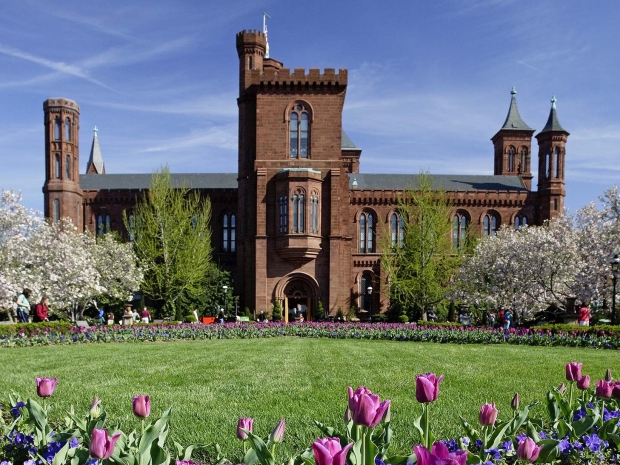
The Smithsonian Institution Building, more commonly known as the Castle, is the Smithsonian’s first and oldest building. It opened its doors in 1855 and serves not only as a historic architectural and cultural icon, but also as the public doorway to the Smithsonian.
The Castle closed February 1, 2023, for its first major renovation in more than 50 years. All elements of the building are undergoing extensive repairs and upgrades to prepare for a special reopening in honor of the 250th anniversary of the signing of the Declaration of Independence.
In 2026, the Castle will temporarily pause renovation to reopen to the public from Memorial Day weekend through Labor Day. The space will feature a new visitors’ center, café, shop, and a special exhibition, American Aspirations, featuring objects from across the Smithsonian.
American Aspirations exhibition: May 22 to September 7, 2026
For nearly 250 years, Americans have been inspired by the ideals expressed in the Declaration of Independence. American Aspirations will bring together some of the Smithsonian’s most treasured objects to commemorate this founding document and examine how Americans have risen to the challenges it sets forth.
Objects on view will include:
- Thomas Jefferson’s desk, on which he drafted the Declaration of Independence.
- Harriet Tubman’s hymnal, which echoes the spiritual resilience of those who fought for freedom.
- The gold flake discovered at Sutter’s mill that sparked the California gold rush.
From the aspirations of the founding generation to the dreams of Americans today, these objects tell the story of a nation that has continued to reach for the ideals set forth in the Declaration of Independence.
Castle History
The Castle is the Smithsonian’s first home and its symbolic heart. Located on the south side of the National Mall in downtown Washington, D.C., the building today symbolizes the Smithsonian and is its most recognized, built artifact on the Mall.
It was designed by James Renwick, Jr., under the direction of the Smithsonian’s first Secretary Joseph Henry. When completed in 1855, the building housed all the Smithsonian’s operations including research and administrative offices, lecture and exhibition halls, a library and reading room, chemical laboratories, storage areas for specimens, and living quarters for Joseph Henry and his family. It has served as the headquarters of the Smithsonian since then.
Castle Renovation
The Castle, along with the Arts and Industries Building, which opened in 1881 as the first home of the National Museum, comprise the Smithsonian’s Historic Core. Both buildings are in need of major revitalization—work that will include new, efficient heating, air conditioning, and ventilation systems; new electrical and plumbing systems, and new telecommunications, security and life safety systems. A new, underground Central Utility Plant will also provide mechanical and electrical infrastructure and a new Consolidated Loading Facility will improve the efficiency and safety of materials handling in the South Mall Campus. A goal of the revitalization will prioritize exterior and interior restoration, and to provide efficient and accessible space for visitors and staff. Public spaces will be restored to their historic state after decades of remodels altered their originally intended floorplans.
Read more about the process from the Smithsonian Architectural History and Historic Preservation office.
Things to Do While the Castle Is Closed

Plan Your Smithsonian Visit
The Smithsonian Virtual Visitor Center features information and tools to help you plan your visit.

Smithsonian Castle
Scavenger Hunts
Smithsonian Gardens
Enid A. Haupt Garden
This 4.2-acre rooftop park features an embroidered parterre in a geometric design of plants and flowers rotated seasonally.

Smithsonian Gardens
Kathrine Dulin Folger Rose Garden
This rose garden features roses in a rainbow of colors, along with plants chosen for year-round interest.