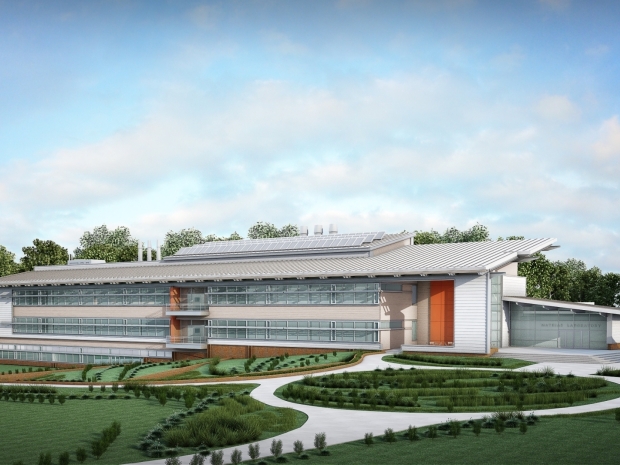
Smithsonian Scales Up Energy Efficiency with $45 Million Green Lab
Reconstructed Mathias Lab Will Boost Environmental Research and Renewable Energy

Media Contact
Kristen Goodhue
With a $45 million federal appropriation to the Smithsonian Institution, the Smithsonian Environmental Research Center in Edgewater, Md., on the Chesapeake Bay, will start building today what is expected to be one of the most energy-efficient laboratories in the country.
Sustainable houses and office buildings have seen their popularity surge in recent years. But creating a more sustainable laboratory, especially one with chemistry research, where fume hoods can consume up to three times as much energy as an average home, presents a greater challenge. The expanded and remodeled Mathias Laboratory will reduce its environmental impact on all fronts, from where it gets its power to where it gets its materials. Analysts estimate it will consume at least 37 percent less energy, and emit 37 percent less carbon dioxide, than a similar building that meets baseline LEED certification standards. Today’s groundbreaking ceremony at SERC marks the beginning of the two-year project.
“The Mathias Laboratory project is a cornerstone of the Smithsonian’s environmental research,education and commitment to sustainability,” said Smithsonian Secretary Wayne Clough. “This innovative facility will support SERC’s leadership in long-term research and professional training on ecosystem services and human impacts in the biosphere. With this model facility on the nation’s largest estuary, SERC’s research extends across the nation and around the world.”
“The new Mathias Laboratory will serve as a lasting and living tribute to the legacy of my friend Sen. Mac Mathias, who was a leader in the efforts to restore the Chesapeake Bay,” said Rep. Steny Hoyer (D-Md.). Former U.S. Sen. Charles “Mac” Mathias Jr. (R-Md.) helped create the Chesapeake Bay Program in 1983 and was one of the earliest environmental defenders. “I am pleased to have been a strong advocate for this important project,” Hoyer said. Besides leaving a less intense carbon footprint, the new building will enhance SERC’s capacity for cutting-edge environmental research on the Chesapeake. SERC scientists specialize in a multitude of disciplines, including global change, terrestrial and marine ecology, invasive species and nutrient pollution. The laboratory is designed to promote cross-disciplinary collaboration for SERC’s research teams.
Totaling 90,000 square feet, the new building will add 69,000 square feet of laboratory, office and support space to 21,000 square feet of remodeled existing space. A two-story atrium will connect the old and new sections and create an area where staff from various departments can share ideas.
“The new laboratory represents a renewed long-term commitment by the Smithsonian to world-class environmental research on the Chesapeake Bay estuary and watershed, and on coastal ecosystems around the world,” said SERC Director Anson Hines. “By example this innovative laboratory will lead the challenge to build and operate facilities in a sustainable way.”
The project will seek gold-level LEED certification by the U.S. Green Building Council, targeting the maximum gold score of 51 credits. The lab already has gained recognition from the national Labs21 program and the Department of Energy’s National Renewable Energy Laboratory, which expressed interest in featuring the Mathias Laboratory as a national model.
To leave a greener footprint, the new laboratory will include:
- An HVAC system supplied by a large geothermal well field (300 wells 350 feet deep) and high-efficiency enthalpy wheels that recover energy from exchanged air
- Roof-mounted solar panels to provide hot water
- Space for nearly 650 solar panels that will provide almost 10 percent of the building’s electricity
- Low-flow fume hoods for chemistry experiments
- Asystem to reclaim wastewater by cleaning it at an outside treatment plant and re-using it in toilets, gardens, fire suppression and constructed wetlands
- Storm-water management with cisterns and wetlands made up of a series of cascading pools lined with native plants to receive runoff
- Bicycle racks and priority parking for carpools and high-efficiency vehicles, along with solar panel recharging stations for electric vehicles
- Redistributed parking across the site, to decrease construction of new parking lots and impervious surfaces, thus minimizing storm-water run-off
The laboratory will also use regional materials to prevent long-distance transportation and use only certified sustainable wood. EwingCole of Philadelphia provided the architects and engineers for the project, with Howard Skoke as principal. The general contractor is Hensel Phelps.
The groundbreaking ceremony will take place Friday, May 6, at 3 p.m. Open to press or by invitation only. For more information or to attend, contact Kristen Minogue at minoguek@si.edu or (443) 482-2325.
# # #
SI-192-2011