Scientists Find That Non-native Snakes Are Taking a Toll on Native Birds

The Everglades National Park in Florida is home to hundreds of species of native wildlife. It has also become the well-established home of the non-native Burmese python—known to be a predator of native species. Now scientists, for the first time, have conducted a detailed analysis of the avian component of the python’s diet and the negative impact the snakes may have on Florida’s native birds, including some endangered species.
The Burmese python (Python molurus bivittatus), native to Southeast Asia, was first recorded in the Everglades in 1979—thought to be escaped or discarded pets. Their numbers have since grown, with an estimated breeding population in Florida in the tens of thousands.As researchers investigate the impact of this snake in the Everglades, scientists from the Smithsonian Institution, South Florida Natural Resources Center and the University of Florida examined the snake’s predation of the area’s birds. They found that birds, including endangered species, accounted for 25 percent of the python’s diet in the Everglades.
“These invasive Burmese pythons are particularly hazardous to native bird populations in North America because the birds didn’t evolve with this large reptile as a predator,” said Carla Dove, ornithologist at the Smithsonian’s Feather Identification Lab in the National Museum of Natural History. “Conversely, the python is able to thrive here partly because it has no natural predator to keep its numbers in check.”
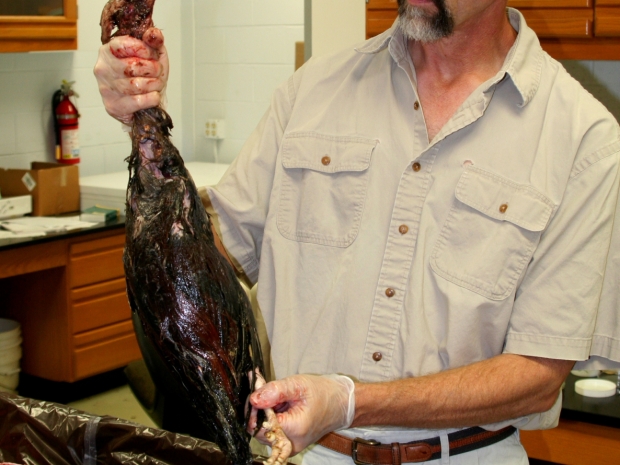
The scientists collected 343 Burmese pythons in Everglades National Park as part of their study between 2003 and 2008. Eighty-five of these snakes had bird remains in their intestinal tract. From these remains the team identified 25 species of birds by comparing feathers and bone fragments with specimens in the Smithsonian’s collection. The results reflected a wide variety of species, from the 5-inch-long house wren to the 4-foot-long great blue heron. Four of the species identified (snowy egret, little blue heron, white ibis and limpkin) are listed as “species of special concern” by the Florida Fish and Wildlife Conservation Commission. The team also identified the remains of a wood stork, which is a federally endangered species.
“These pythons can also inhabit a wide variety of habitats, so their impact is not restricted to just the native species within the Everglades,” Dove said. “The python’s high reproductive rate, longevity, ability to consume large prey and consumption of bird species are causes for serious conservation and control measures.”
The team’s findings are published in the scientific journal BioOne, March 2011.
# # #
SI-101-2011