
The Mummies Return
Expanded Smithsonian Exhibition Showcases More Mummies Than Ever Before
Media Contact
Randall Kremer
A 3-D CT scan of a mummy at the National Museum of Natural History. More...
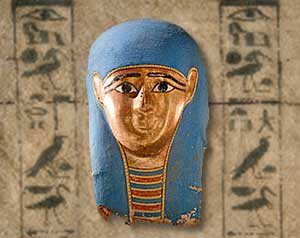
The Smithsonian’s National Museum of Natural History will officially debut its largest exhibition of ancient Egyptian mummies and artifacts in “Eternal Life in Ancient Egypt” Nov. 17. The opening follows a preview in the spring of three cases on Egyptian burial rights. With the completion of the new hall, the Smithsonian will offer the largest public presentation of mummies in its history. The expanded exhibition is permanent and will include an additional eight cases focusing on the science behind studying mummies. A combination of rare artifacts and cutting-edge research tools will illuminate how Smithsonian scientists have pieced together the lives of ancient Egyptians through their burial practices and rituals in preparation for their eternal life. Many of the objects going on display will be on view for the first time.
“Ancient Egyptians were obsessed with life and with a quest to achieve an eternal life after death,” said Melinda Zeder, curator of new world archaeology at the National Museum of Natural History. “This new exhibition explores this obsession showcasing more mummies and more of our remarkable collections of Egyptian artifacts than we have ever been able to share with our visitors. The exhibit takes a unique perspective as it examines the lives of everyday Egyptians, their close relationship with their gods and the steps they took to assure everlasting life both before and after death.”
Two of the new cases focus specifically on mummy science. State-of-the-art scientific techniques like CT scanning and two different types of facial reconstruction allow scientists to better understand burial practice, health and demography in ancient Egypt. Using forensic tools to study specimens like the adult male and child mummy featured, scientists are able to determine things like age, sex and overall health of ancient Egyptians who were selected for mummification. These cases also feature facial reconstructions that help bring the mummies to life for the visitor.
Humans were not the only species mummified in ancient Egypt. Animals were also mummified and included in burials in an attempt by the Egyptians to fulfill their after-life experience offerings to the gods as well as symbolic food and even pets. A variety of different species were mummified and will be presented in these three cases, including cats, ibises, raptors, crocodiles and snakes. One of the most impressive specimens is a bull mummy that was specially chosen for mummification because certain bulls were believed to be the living representation of the sun god, Re. Some animals were in such high demand for mummification that they became extinct due to the practice, which had a serious impact on the Egyptian environment.
As important as the items they took with them, their vessel to the underworld was equally important to the Egyptians. Tentkhonsu’s inner coffin stands alone in the exhibition as a premiere and personal example of the importance of mummification and burial ritual in Egyptian life. Tentkhonsu was a member of a group of noble women who participated in temple services and festivals singing praises to the gods. The richly decorated panels of her inner coffin tell the story of her journey through the underworld to her judgment and resurrection.
Preparing for eternal life was both a personal responsibility and an obligation of family members to the deceased. Living Egyptians gave top priority to ensuring their place among the gods in eternal life. The case dedicated to this preparation features a number of amulets, charms and other objects used by the living to help them fulfill their responsibilities to the gods and their families. Statues and other offerings placed in and near the tombs of the deceased to provision family members after death. This case also explores the relationship myth between the gods Osiris and Re through the devotion people showed to them while preparing for the afterlife.
Finally, adjacent to the Insect Zoo, the last new section focuses on the significance of insects in Egyptian life and death. Scarab beetles, scorpions, bees and locusts all play an important role in ancient Egyptian culture. This case examines the role of these insects in Egyptian mythology, economy and history.
For more information about the exhibition visit: http://www.mnh.si.edu/exhibits/eternal-life/index.html.
The Smithsonian’s National Museum of Natural History, located at 10th Street and Constitution Avenue, N.W. in Washington, D.C., welcomes more than 6 million visitors annually. The museum is open daily from 10 a.m. to 5:30 p.m, except Dec. 25. Admission is free. More information about the museum is available at www.mnh.si.edu or by calling (202) 633-1000, TTY (202) 357-1729.
# # #
SI-493A-2011


