
Have Thieving Rodents Saved Tropical Trees?
Media Contact
Beth King
Big seeds produced by many tropical trees were probably once ingested and then defecated whole by huge mammals called gomphotheres that dispersed the seeds over large distances. But gomphotheres were probably hunted to extinction more than 10,000 years ago. So why aren’t large-seeded plants also extinct? A new Smithsonian report to be published online in the Early Edition of Proceedings of the National Academy of Sciences during the week of July 16 suggests that rodents may have taken over the seed-dispersal role of gomphotheres.
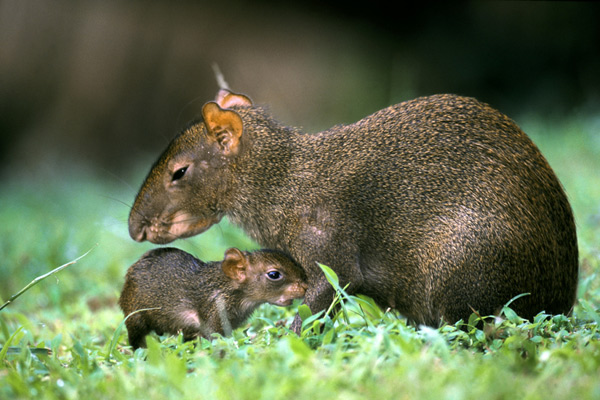
By attaching tiny radio transmitters to more than 400 seeds, Patrick Jansen, scientist at the Smithsonian Tropical Research Institute and Wageningen University, and his colleagues found that 85 percent of the seeds were buried in caches by agoutis, common, house cat-sized rodents in tropical lowlands. Agoutis carry seeds around in their mouths and bury them for times when food is scarce.
Relative movement paths of 224 radio-tagged palm seeds handled by rodents on Barro Colorado Island, Panama.
Radio tracking revealed a surprising finding: when the rodents dig up the seeds, they usually do not eat them, but instead move them to a new site and bury them, often many times. One seed in the study was moved 36 times, traveling a total distance of 749 meters and ending up 280 meters from its starting point. It was ultimately retrieved and eaten by an agouti 209 days after initial dispersal.
Researchers used remote cameras to catch the animals digging up cached seeds. They discovered that frequent seed movement was primarily caused by animals stealing seeds from one another. Ultimately, 35 percent of the seeds ended up more than 100 meters from their origin. “Agoutis moved seeds at a scale that none of us had ever imagined,” said Jansen.
“Previously, researchers had observed seeds being moved and buried up to five times, but in this system it seems that this re-caching behavior was on steroids,” said Ben Hirsch, who ran the fieldwork as a post-doctoral fellow at the Smithsonian Tropical Research Institute in Panama. “By radio-tagging the seeds, we were able to track them as they were moved by agoutis, to find out if they were taken up into trees by squirrels, and to discover seeds inside spiny rat burrows. This resolution allowed us to gain a much better understanding of how each rodent species affects seed dispersal and survival.”
By taking over the role of large Pleistocene mammals in dispersing these large seeds, thieving, scatter-hoarding agoutis may have saved these tree species from extinction.
The Smithsonian Tropical Research Institute, headquartered in Panama City, Panama, is a unit of the Smithsonian Institution. The Institute furthers the understanding of tropical nature and its importance to human welfare, trains students to conduct research in the tropics and promotes conservation by increasing public awareness of the beauty and importance of tropical ecosystems. Website: www.stri.si.edu.
# # #
SI-326-2012
Jansen, P.A., Hirsch, B.T., Emsens, W.J., Zamora-Gutierrez, V., Wikelski, M., and Kays, R. 2012. Thieving rodents as substitute dispersers of megafaunal seeds. Proceedings of the National Academy of Sciences. July 16, 2012.
Authors and institutions:
Jansen, Patrick A., Smithsonian Tropical Research Institute; Department of Environmental Sciences, Wageningen University
Hirsch, Ben T., Smithsonian Tropical Research Institute; School of Environment and Natural Resources, Ohio State University
Emsens, Willem-Jan, Department of Environmental Sciences, Wageningen University; Ecosystem Management Research Group, Department of Biology, University of Antwerp
Zamora-Gutierrez, Veronica, Department of Environmental Sciences, Wageningen University; Department of Zoology, University of Cambridge
Wikelski, Martin, Smithsonian Tropical Research Institute; Max Planck Institute for Ornithology; Department of Ornithology, University of Konstanz
Kays, Roland W., Smithsonian Tropical Research Institute; North Carolina Museum of Natural Sciences; North Carolina State University
