Adult Fish Struggle To Bounce Back in Marine Protected Areas
To Replenish Adult Spawners, Marine Protected Areas Need Strong Enforcement and Climate-Friendly Design

Media Contact
Kristen Goodhue
Age matters when determining how to protect life in the ocean; every population needs a strong cohort of adults to produce the next generation. But many marine protected areas (MPAs) are falling short of their most basic purpose: to rebuild struggling fish populations. In a new study published April 4 in Global Change Biology, scientists looked at the age breakdown of reef fish in marine protected areas for the first time. They discovered in almost all of them, adult fish populations have either flatlined or declined.
“Adult fish are really important,” said Steve Canty, marine ecologist with the Smithsonian Environmental Research Center and a lead author of the study. “They are the primary catch within commercial fisheries that support livelihoods and food security of coastal communities. Additionally, it is the adults that breed and rebuild the fisheries, and here size matters. Bigger and older female fish produce more and better eggs, and therefore are critical to rebuilding fish populations.”
It is a vital lesson as the world races to meet the “30 by 30” target to conserve 30% of Earth’s ocean by 2030. Delegates at the United Nations Biodiversity Conference set that ambitious goal in December 2022. However, many experts say the target will mean little unless nations choose sites where marine life can flourish and balance the needs of coastal communities.
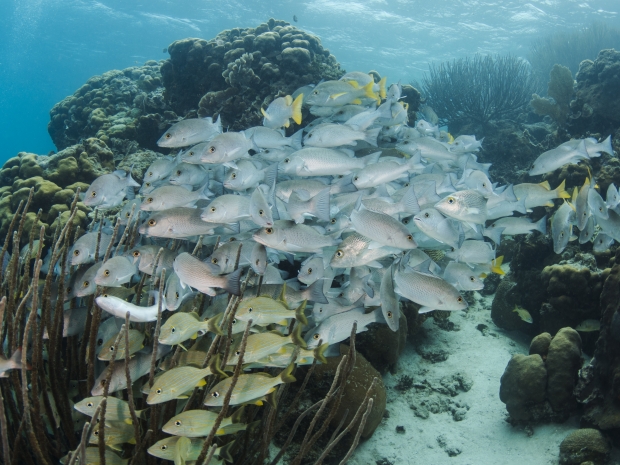
The study looked at fish in the Mesoamerican Reef. The longest reef in the Western Hemisphere, it stretches over 600 miles along the coasts of southern Mexico, Belize, Guatemala and Honduras. The region is a biodiversity hotspot, home to over 500 fish species, 60 kinds of corals and one of the largest whale shark congregations on Earth. The marine resources of the region also support the livelihoods and food security of over 1 million people.
The scientists examined adult versus juvenile fish biomass in 139 reef sites—111 protected and 28 unprotected. Protected sites in the Mesoamerican Reef fall into three categories: “fully protected areas” where fishing is completely banned, “highly protected areas” that allow activities like subsistence and catch-and-release sport fishing and “general use zones” where commercial fishing is often allowed but specific methods or equipment are banned. Of the marine protected areas in the study, a mere 24% were either fully or highly protected.
“It’s always difficult to prohibit fishing from any part of the sea—as if it goes against a basic human instinct,” said Melanie McField, co-author and director of the Healthy Reefs Initiative. “But fully protecting and enforcing these areas is the best way to grow bigger fish that can rebuild the populations and actually increase overall fish catches outside the fully protected areas.”
The team took their fish biomass data from the Healthy Reefs Initiative, which uses scuba divers to survey fish at hundreds of reefs throughout the region. The initiative has also evaluated the four countries in the Mesoamerican Reef for enforcement and other management practices in protected sites. The study included additional data about coastal development, sea surface temperature and other key variables known to affect fish populations. The scientists looked at data over a 12-year timeframe, from 2006 to 2018.
The results were troubling. Though marine protected areas exist largely to rebuild fish populations, only 11 sites in the study—8% total—saw significant increases in adult biomass. Most sites saw no change, and 28 sites saw declines. The sites with declines had several things in common: They all had heavy coastal development nearby and experienced high levels of warming in their waters. They were also all in general use zones—the weakest type of marine protected area—and even then had only “inadequate or moderate enforcement.”
“Minimal protection in the weakest MPAs proved to be more detrimental than no protection at all, because it allowed for continued and concentrated exploitation without effective management,” said co-author Abel Valdivia, marine conservation scientist with the World Wildlife Fund. “Unlike open-access zones, where fishing pressure may be spread out, weakly protected areas faced unchecked coastal development, warming waters and inadequate enforcement, leading to the decline in adult biomass.”
However, the 11 sites where adults rebounded also had some common trends. They were all in fully protected areas with adequate enforcement, experienced fewer sea surface temperature spikes and were beside areas with a lower human footprint.
This 12-year snapshot of the Mesoamerican Reef offers clues for how the rest of the globe can succeed at “30 by 30” conservation. Strong enforcement and effective management are key to a marine protected area’s success, as is community buy-in and support. Choosing sites with climate change in mind is also critical, the authors said. While many parts of the ocean cannot escape warming waters, sites that could act as climate refuges for both adult and juvenile life stages need to be top candidates for full protection.
“Our study shows that adults and juvenile fish respond very differently to management and environmental change,” said Justin Nowakowski, a lead author and ecologist with the Smithsonian Environmental Research Center. “Adults were more sensitive to stressors like climate change, which can undermine the local benefits of MPAs. The big question now is where to locate new MPAs to maximize positive impacts for the regional fishery. To do this, we need to consider the unique requirements of adult and juvenile life stages—otherwise we are missing the full picture.”
The Smithsonian Marine Station, Conservation International, Barefoot Ocean, Louisiana State University and the University of Maryland Center for Environmental Science also contributed to the study. The article will be available after publication on the journal’s website. For photos, an advance copy of the study or to speak with one of the authors, contact Kristen Goodhue at goodhuek@si.edu.
# # #
SI-118-2024