Skip to main content Skip to main navigation
heart-solid My Visit Donate
Home Smithsonian Institution IK development site for ODI
Press Enter to activate a submenu, down arrow to access the items and Escape to close the submenu.
    • Overview
    • Museums and Zoo
    • Entry and Guidelines
    • Museum Maps
    • Dine and Shop
    • Accessibility
    • Visiting with Kids
    • Group Visits
    • Overview
    • Exhibitions
    • Online Events
    • All Events
    • IMAX & Planetarium
    • Overview
    • Topics
    • Collections
    • Research Resources
    • Stories
    • Podcasts
    • Overview
    • For Caregivers
    • For Educators
    • For Students
    • For Academics
    • For Lifelong Learners
    • Overview
    • Become a Member
    • Renew Membership
    • Make a Gift
    • Volunteer
    • Overview
    • Our Organization
    • Our Leadership
    • Reports and Plans
    • Newsdesk
heart-solid My Visit Donate
  1. Home
  2. forward-slash
  3. About
  4. forward-slash
  5. Newsdesk
  6. forward-slash
  7. Photos and Video
  8. forward-slash
  9. MARSIS Radar Sounder Instrument

About

  • Overview
  • Our Organization
    • Board of Regents
    • Museums and Zoo
    • Research Centers
    • Cultural Centers
    • Education Centers
    • General Counsel
    • Office of Human Resources
    • Office of Equal Opportunity
    • Office of Sponsored Projects
    • Office of Protection Services
  • Our Leadership
  • Reports and Plans
    • Annual Reports
    • Strategic Plan
    • Smithsonian Dashboard
  • Newsdesk
    • News Releases
    • Media Contacts
    • Photos and Video
    • Media Kits
    • Fact Sheets
    • Visitor Stats
    • Secretary and Admin Bios
    • Filming Requests

MARSIS Radar Sounder Instrument
Media Photo/Video

September 25, 2017

Artists illustration
download Download press_image_3.jpg

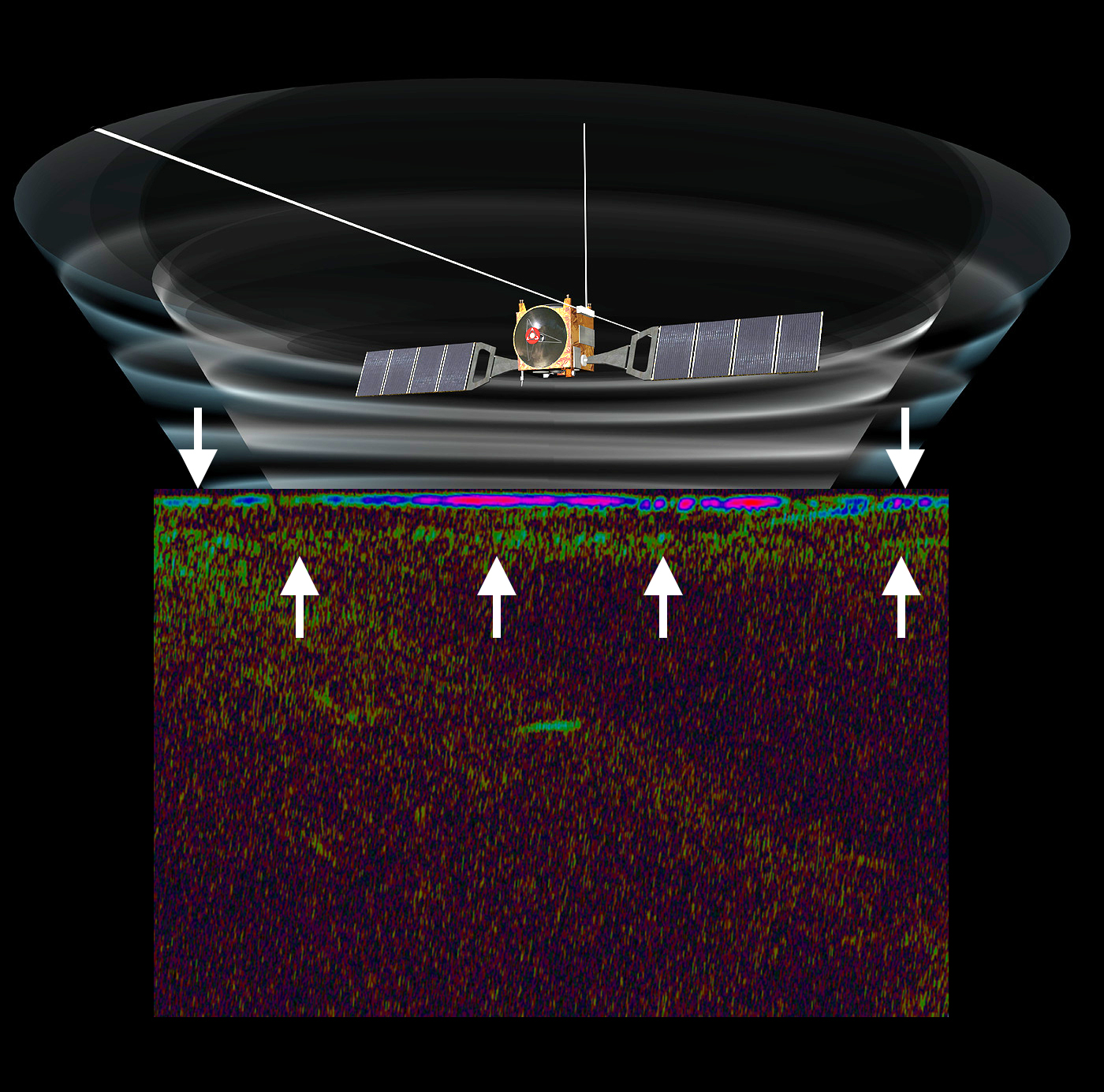
The MARSIS radar sounder instrument on the European Space Agency’s Mars Express spacecraft is comprised of a 40 meter (about 131 feet) dipole antenna. MARSIS transmits long wavelength, low frequency radio waves that can penetrate certain geologic materials and are reflected back where the radio waves encounter a change in bulk density or composition. The radargram, a time delay rendering of the reflected radar pulses, shows a subsurface feature or reflector (upper pointing arrows) separated from the surface reflection (downward pointing arrows) in Meridiani Planum. The subsurface reflector is interpreted to be the base the Meridiani Planum deposits, about 1 kilometer (about 0.62 miles) beneath the surface.   

Image courtesy ESA/NASA/JPL/KU/Smithsonian


Tags

  • Air and Space Museum

Related Media

rendering of surface of Mars

Image

document

Meridiani Planum

09.25.2017
Mars surface with tire tracks

Image

document

Meridiani Planum as seen by the Opportunity rover

09.25.2017
section view of Mars surface

Image

document

Miyamoto crater in Meridiani Planum

09.25.2017

Related Content

  • Mars surface with tire tracks

    Meridiani Planum and the Search for Ice on Mars

    New findings reveal deposits on Mars that could be interpreted to be ice-rich may contain little or no ice at all, based on an analysis of radar sounder data for Meridiani Planum—an area on the planet’s equator being explored by the Opportunity rover.
    • September 25, 2017
    • News Release
    • Air and Space Museum
    • Air and Space Museum
arrow-up Back to top
Home
  • Facebook facebook
  • Instagram instagram
  • LinkedIn linkedin
  • YouTube youtube

  • Contact Us
  • Get Involved
  • Shop Online
  • Job Opportunities
  • Equal Opportunity
  • Inspector General
  • Records Requests
  • Accessibility
  • Host Your Event
  • Press Room
  • Privacy
  • Terms of Use