Skip to main content Skip to main navigation
heart-solid My Visit Donate
Home Smithsonian Institution IK development site for ODI
Press Enter to activate a submenu, down arrow to access the items and Escape to close the submenu.
    • Overview
    • Museums and Zoo
    • Entry and Guidelines
    • Museum Maps
    • Dine and Shop
    • Accessibility
    • Visiting with Kids
    • Group Visits
    • Overview
    • Exhibitions
    • Online Events
    • All Events
    • IMAX & Planetarium
    • Overview
    • Topics
    • Collections
    • Research Resources
    • Stories
    • Podcasts
    • Overview
    • For Caregivers
    • For Educators
    • For Students
    • For Academics
    • For Lifelong Learners
    • Overview
    • Become a Member
    • Renew Membership
    • Make a Gift
    • Volunteer
    • Overview
    • Our Organization
    • Our Leadership
    • Reports and Plans
    • Newsdesk
heart-solid My Visit Donate
  1. Home
  2. forward-slash
  3. About
  4. forward-slash
  5. Newsdesk
  6. forward-slash
  7. Photos and Video
  8. forward-slash
  9. Flying Foxes Composite

About

  • Overview
  • Our Organization
    • Board of Regents
    • Museums and Zoo
    • Research Centers
    • Cultural Centers
    • Education Centers
    • General Counsel
    • Office of Human Resources
    • Office of Equal Opportunity
    • Office of Sponsored Projects
    • Office of Protection Services
  • Our Leadership
  • Reports and Plans
    • Annual Reports
    • Strategic Plan
    • Smithsonian Dashboard
  • Newsdesk
    • News Releases
    • Media Contacts
    • Photos and Video
    • Media Kits
    • Fact Sheets
    • Visitor Stats
    • Secretary and Admin Bios
    • Filming Requests

Flying Foxes Composite
Media Photo/Video

October 29, 2013

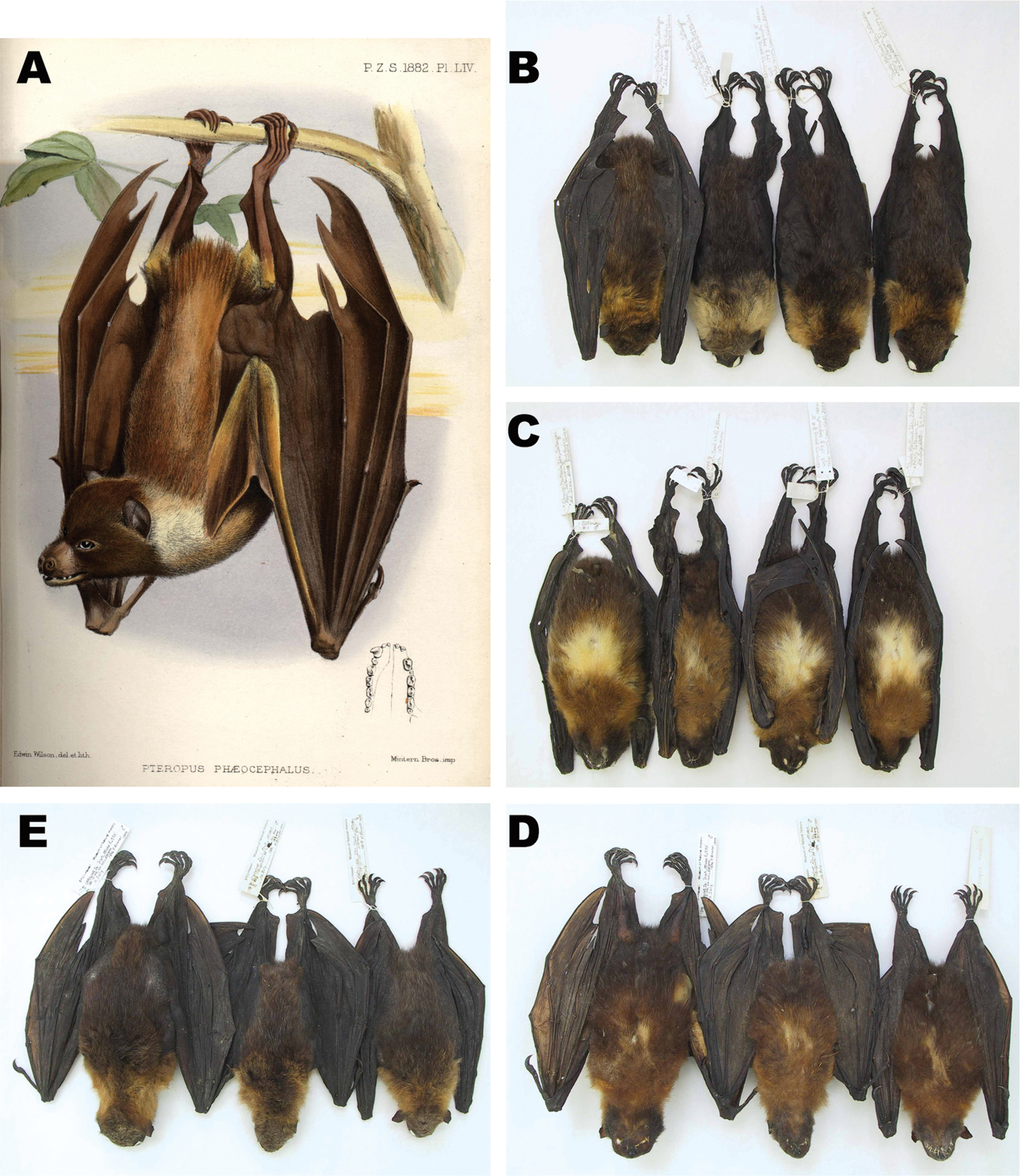
Flying foxes composite
download Download zookeys-345-097-g003.jpg

(A) This 1882 illustration of the Mortlock flying fox from Proceedings of the Zoological Society of London uses the now incorrect name for the animal. Its original and correct name is “Pteropus pelagicus.” Shown is the scanned image of Plate LIV from original description of Pteropus phaeocephalus Thomas 1882, which is presumably based on the holotype
(B) dorsal view and
(C) ventral view of Pteropuspelagicus pelagicus from Satawan Atoll
(D) ventral view and
(E) dorsal view of Pteropusphaeocephalus insularis from Weno, Chuuk Lagoon.

See http://www.pensoft.net/journals/zookeys/article/5840/abstract/taxonomy-distribution-and-natural-history-of-flying-foxes-chiroptera-pteropodidae-in-the-mortlock-islands-and-chuuk-stat


Tags

  • Natural History Museum

Related Media

Mortlock Islands Flying Fox

Image

document

Mortlock Islands Flying Fox

10.29.2013

Related Content

  • Mortlock Islands flying fox

    Scientists Shine Light on World’s Least-Studied Bat

    The Mortlock Islands flying fox, a large, breadfruit-eating bat native to a few remote and tiny Pacific islands, has long been regarded as one of the world’s least studied bats. For more than 140 years nearly all that scientists knew about this animal was derived from one lonely specimen preserved in a jar of alcohol in the Natural History Museum, London.
    • October 29, 2013
    • News Release
    • Natural History Museum
arrow-up Back to top
Home
  • Facebook facebook
  • Instagram instagram
  • LinkedIn linkedin
  • YouTube youtube

  • Contact Us
  • Get Involved
  • Shop Online
  • Job Opportunities
  • Equal Opportunity
  • Inspector General
  • Records Requests
  • Accessibility
  • Host Your Event
  • Press Room
  • Privacy
  • Terms of Use