Skip to main content Skip to main navigation
heart-solid My Visit Donate
Home Smithsonian Institution IK development site for ODI
Press Enter to activate a submenu, down arrow to access the items and Escape to close the submenu.
    • Overview
    • Museums and Zoo
    • Entry and Guidelines
    • Museum Maps
    • Dine and Shop
    • Accessibility
    • Visiting with Kids
    • Group Visits
    • Overview
    • Exhibitions
    • Online Events
    • All Events
    • IMAX & Planetarium
    • Overview
    • Topics
    • Collections
    • Research Resources
    • Stories
    • Podcasts
    • Overview
    • For Caregivers
    • For Educators
    • For Students
    • For Academics
    • For Lifelong Learners
    • Overview
    • Become a Member
    • Renew Membership
    • Make a Gift
    • Volunteer
    • Overview
    • Our Organization
    • Our Leadership
    • Reports and Plans
    • Newsdesk
heart-solid My Visit Donate
  1. Home
  2. forward-slash
  3. Explore
  4. forward-slash
  5. Collections
  6. forward-slash
  7. Smithsonian Snapshot
  8. forward-slash
  9. V-Mail Stationery

Explore

  • Overview
  • Topics
    • Art & Design
    • History & Culture
    • Science & Nature
    • Tech & Innovation
  • Collections
    • Open Access
    • Smithsonian Snapshot
    • Collection Spotlights
  • Research Resources
    • Libraries
    • Archives
  • Stories
  • Podcasts
Smithsonian Snapshot

V-Mail Stationery

June 13, 2012
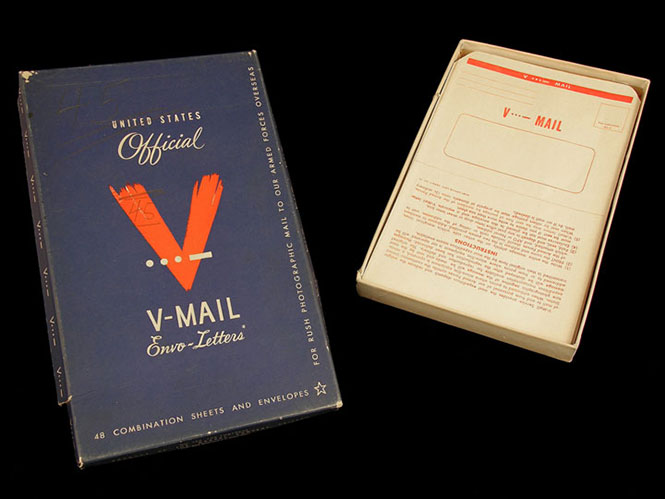
V-Mail Stationery, 1942 Smithsonian’s National Postal Museum

V-Mail Stationery, 1942, Smithsonian’s National Postal Museum

This Smithsonian Snapshot marks the June 15, 1942, launch of V-Mail, the overseas communication service used between military personnel, family and friends.

During World War II, Army post offices, Fleet post offices and U.S. post offices were flooded with mail sent by service members and family. V-Mail was a solution to the volume of mail competing with essential wartime supplies for cargo space.

The U.S. adapted Great Britain’s Airgraph service and integrated microfilm technology into its wartime system. V-Mail letters were copied onto microfilm, which was shipped overseas and reproduced at one-quarter of the original size at a processing station where it was then delivered to the addressee.

V-Mail required standardized 8 ½-by-11-inch stationery like that pictured here from the Wessel Co. in Chicago. The distinguishing marks and uniform size of the stationery helped workers gather the folded letter sheets to be photographed onto 16 mm microfilm. All sheets were set to standard dimensions, weight, grain and layout so they fit in the Kodak microfilming machines.

Correspondents could obtain two sheets per day from their local post office for free. Others opted to purchase the materials that were available in neighborhood stores.

The National Postal Museum’s collection of V-Mail stationery demonstrates the intersection of governmental and commercial efforts to facilitate mail for the military. Frequent letter writing was encouraged for its morale-boosting effects on America’s soldiers.

To learn more about American military history, visit the National Museum of American History’s “Price of Freedom” exhibition website. To learn more about V-Mail, visit the National Postal Museum’s, “Victory Mail” online exhibition.

arrow-up Back to top
Home
  • Facebook facebook
  • Instagram instagram
  • LinkedIn linkedin
  • YouTube youtube

  • Contact Us
  • Get Involved
  • Shop Online
  • Job Opportunities
  • Equal Opportunity
  • Inspector General
  • Records Requests
  • Accessibility
  • Host Your Event
  • Press Room
  • Privacy
  • Terms of Use