Skip to main content Skip to main navigation
heart-solid My Visit Donate
Home Smithsonian Institution IK development site for ODI
Press Enter to activate a submenu, down arrow to access the items and Escape to close the submenu.
    • Overview
    • Museums and Zoo
    • Entry and Guidelines
    • Museum Maps
    • Dine and Shop
    • Accessibility
    • Visiting with Kids
    • Group Visits
    • Overview
    • Exhibitions
    • Online Events
    • All Events
    • IMAX & Planetarium
    • Overview
    • Topics
    • Collections
    • Research Resources
    • Stories
    • Podcasts
    • Overview
    • For Caregivers
    • For Educators
    • For Students
    • For Academics
    • For Lifelong Learners
    • Overview
    • Become a Member
    • Renew Membership
    • Make a Gift
    • Volunteer
    • Overview
    • Our Organization
    • Our Leadership
    • Reports and Plans
    • Newsdesk
heart-solid My Visit Donate
  1. Home
  2. forward-slash
  3. Explore
  4. forward-slash
  5. Collections
  6. forward-slash
  7. Smithsonian Snapshot
  8. forward-slash
  9. Coelacanth

Explore

  • Overview
  • Topics
    • Art & Design
    • History & Culture
    • Science & Nature
    • Tech & Innovation
  • Collections
    • Open Access
    • Smithsonian Snapshot
    • Collection Spotlights
  • Research Resources
    • Libraries
    • Archives
  • Stories
  • Podcasts
Smithsonian Snapshot

Coelacanth

June 7, 2013
Coelacanth

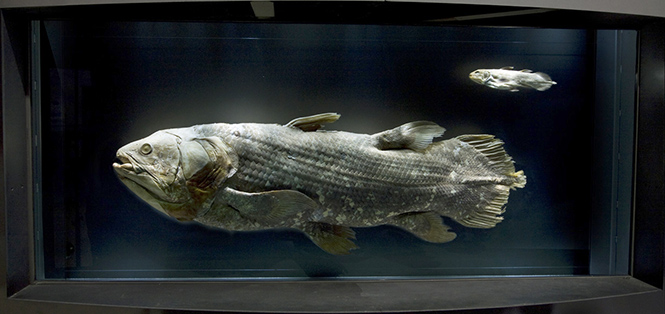
Coelacanth, 1938, Donald E. Hurlbert, Smithsonian's National Museum of Natural History

This Smithsonian Snapshot celebrates the June 8 World Oceans Day with this coelacanth, a prehistoric fish thought to have gone extinct 65 million years ago.

Coelacanths are primitive Sarcopterygians or lobed-finned fishes, a lineage of bony fishes that gave rise to land vertebrates, including humans. Their closest living relatives are lungfishes from the freshwaters of South Africa, Australia and South America. From an evolutionary standpoint, coelacanths are more closely related to reptiles and mammals than to the common ray-finned fishes.

Easily recognized by their distinctive shape and lobed fins, the first living coelacanth was discovered in 1938 off the coast of South Africa. Coelacanths are now known to live in temperate waters in the "twilight zone," generally 500-800 feet (152-243 meters), off steep rocky slopes of volcanic islands. 

The Smithsonian's Division of Fishes, which includes the world's largest research collection of preserved fish specimens, contains one adult coelacanth. A second specimen and its pup are on loan from the South African Institute of Aquatic Biodiversity which heads the African Coelacanth Ecosystem Programme. The fish are on display in the Sant Ocean Hall at the Smithsonian’s National Museum of Natural History.

arrow-up Back to top
Home
  • Facebook facebook
  • Instagram instagram
  • LinkedIn linkedin
  • YouTube youtube

  • Contact Us
  • Get Involved
  • Shop Online
  • Job Opportunities
  • Equal Opportunity
  • Inspector General
  • Records Requests
  • Accessibility
  • Host Your Event
  • Press Room
  • Privacy
  • Terms of Use