Gardens Take Flight
Smithsonian Gardens unveils two revitalized green spaces that educate and inspire
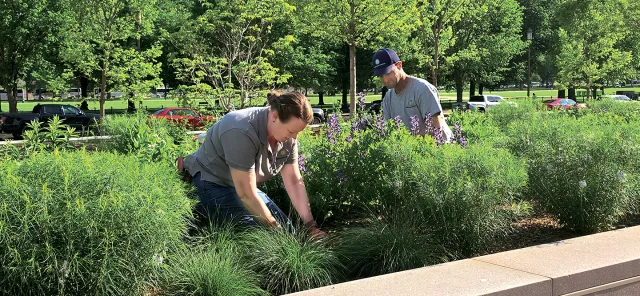
Smithsonian horticulturists Sarah Dickert (left) and Stephen Mann (right) tend to the Flight Garden on a spring morning.
PHOTO Jenna Park
Winged “helicopter seeds” are more than a beloved feature of maple trees. These airborne wonders—also known as samaras—twirl to the ground, mimicking the motion of helicopter blades, and are important to propagation of the species.
Visitors to the new Flight Garden, outside the National Air and Space Museum, will see these seeds in a new light. Here, they offer a lesson on the role of aerodynamics in tree reproduction: the farther the seeds travel, the better the odds of species survival.
Smithsonian Gardens designs and oversees this vibrant museum garden and 14 other public exhibition gardens, covering 180 acres in total across the Smithsonian campus in Washington, D.C.
The Gardens team includes expert horticulturists, landscape architects and volunteers whose mission is to engage visitors on the importance of plants and gardens in American culture and the role of gardens in creating thriving ecosystems.
“Just as flight expands our horizons, our gardens awaken curiosity— inviting visitors to see nature not only as beautiful but as ingenious, dynamic and vital to our shared future,” said Joy Columbus, director of Smithsonian Gardens.
Gardens that surround Smithsonian museums reflect themes found in each museum’s collections. Two recently revitalized gardens show how green spaces can enhance science education and improve America’s urban landscapes.
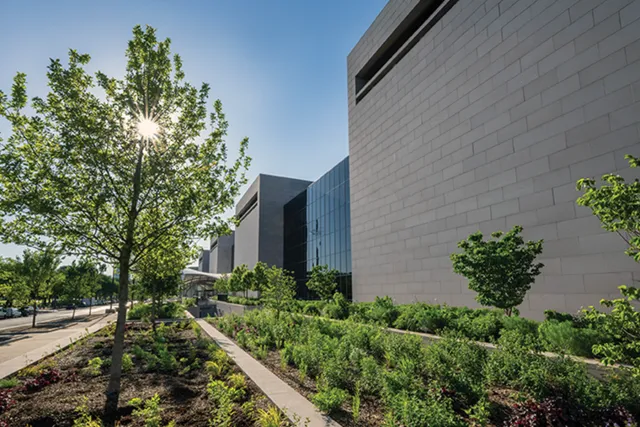
The newly replanted Flight Garden at the National Air and Space Museum comes alive on a spring morning.
PHOTO Mark Avino, National Air and Space Museum

Smithsonian horticulturalist Sylvia Schmeichel works in the tree beds outside the National Museum of Natural History.
PHOTO Marisa Scalera
Birds, Bees and Biodiversity
Alongside a multiyear renovation of the National Air and Space Museum on the National Mall, the museum’s new Flight Garden explores the wonder of flight through the lens of plants.
Two Flight Garden galleries highlight different themes: The Wind Garden shows how plants use wind to disperse seeds, pollen or spores, while the Habitat of Flight Garden focuses on the co-evolution of plants and creatures that fly.
New interpretive panels to be installed this fall will explain how seed dispersal aids plant reproduction and biodiversity, as well as how plants develop symbiotic relationships with birds, bees and flying insects. For example, coneflower petals emit ultraviolet light visible to bees, creating an attractive landing pad for bees to forage for nectar. The bees then carry coneflower pollen forward to different locations, helping the plant to reproduce and become more genetically diverse.
The garden also provides respite for museum visitors amid 14,000 newly planted perennials and 110 trees, all part of the Smithsonian’s living collections. It offers visual interest across seasons: Phlox, hellebores and blue stars bloom in spring, while salvia, coneflowers and wild quinine peak in summer.
“The museum’s renovation gave us an opportunity to reimagine the landscape, to make the garden more welcoming and engaging,” said Marisa Scalera, landscape architect, Smithsonian Gardens. “We want visitors to feel an appreciation for the natural world, understand its interconnections and develop a sense of stewardship.”
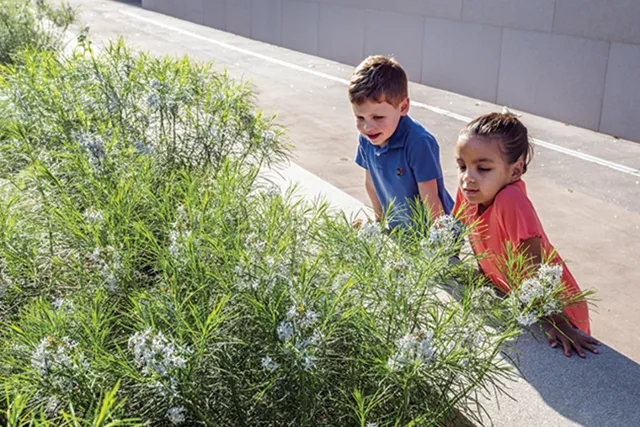
Young visitors Noah Berman (left) and Camille Boileau (right) explore a bed of blue star plants in the Flight Garden.
PHOTO Mark Avino, National Air and Space Museum

Phlox are among many plants in the Flight Garden that provide color across seasons.
PHOTOS Mark Avino, National Air and Space Museum
A Green Corridor
Across the National Mall, on the grounds of the National Museum of Natural History, Smithsonian horticulturists recently completed another critical project—to preserve and safeguard a line of stately American elms on a crowded urban street.
Running along Washington, D.C.’s congested Constitution Avenue, the elms had suffered years of damage due to heavy pedestrian traffic, which led to compacted soil in the trees’ planting beds. Such damage can make soil less porous, cutting off vital oxygen and water needed for a tree to thrive.
The multiyear preservation project included three components to restore a high-quality planting environment: street tree fencing (to keep pedestrians off the soil); soil remediation; and 15,000 native groundcover plantings.
The new plantings—including Eastern bee balm, golden columbine and Christmas fern—enhance soil aeration and drainage, provide resources to wildlife and beautify the Smithsonian’s streetscape.
New interpretive panels will be installed in the planting beds in 2026 to highlight the benefits of creating “green corridors” in American cities.
For more on how to support Smithsonian Gardens, contact Raven Bradburn at BradburnR@si.edu.
Published Summer 2025 in IMPACT Vol. 11. No 2
Your gift fuels innovation, inspiration and exploration for lifelong learners everywhere. Make a gift today.