Art of the Ancestors
Objects Up Close
At the age of six, artist Lauren Good Day (Arikara/Hidatsa/Blackfeet/Plains Cree) learned to bead and sew from her mother and grandmother. Sensing her daughter’s early artistic talent, Good Day’s mother soon purchased a ledger book and encouraged Good Day to continue the storytelling tradition of her people through illustration.
In the 1800s, Native artists across North America’s plains began to use pencils, crayons, canvas, muslin and the paper found in ledger books to draw and record communal events and successes in battle. That tradition continues today through the work of artists such as the North Dakota-based Good Day, who portrays contemporary Native life on antique ledger paper.
As a woman practicing what has traditionally been a male art form, Good Day said, “I try to show what I know. So, what I depict in my art is usually women, children, families and courtship.”
Good Day’s art is featured in the National Museum of the American Indian exhibition Unbound: Narrative Art of the Plains, which runs through Jan. 20, 2026, at the museum’s Washington, D.C., location.
Support for the exhibition is provided by the Terra Foundation for American Art and the Wyeth Foundation for American Art. Additional support is provided by Dr. Quincalee Brown and Dr. James P. Simsarian.
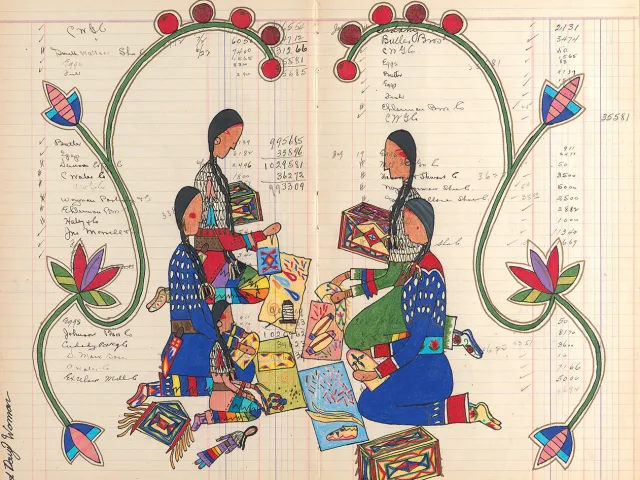
Lauren Good Day (Arikara/Hidatsa/Blackfeet/Plains Cree), Generations of Knowledge, 2012. National Museum of the American Indian
Here, artist Lauren Good Day depicts a scene from her own family, who have passed Native arts down through generations.
In the late 19th century, so many Native artists drew in accounting books that their style became known as ledger art.
Good Day is descended from 19th-century ledger artist Bloody Knife, whose drawings are in the Smithsonian’s collections.
Published Summer 2025 in IMPACT Vol. 11. No 2
Your gift fuels innovation, inspiration and exploration for lifelong learners everywhere. Make a gift today.