
James A. Garfield’s inaugural ball at the Smithsonian’s first museum
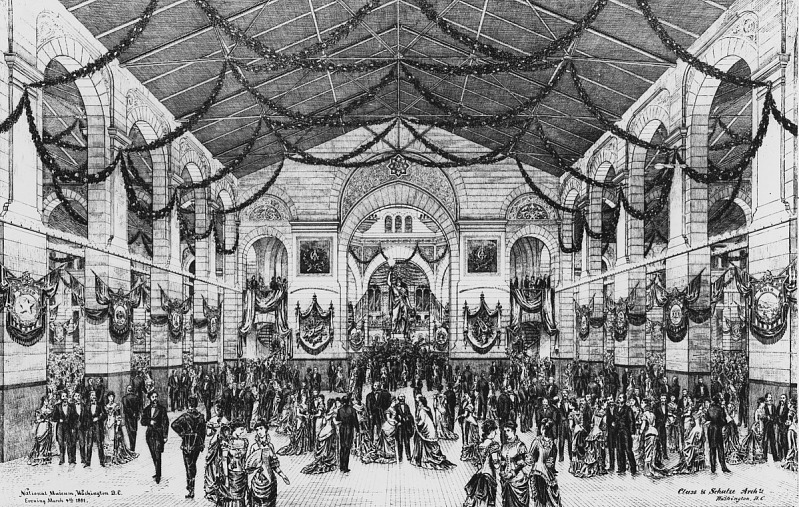
Engraving of the United States National Museum (now called the Arts and Industries Building) by Cluss & Schulze, Architects, depicting the interior of the building decorated for President James A. Garfield's and Chester A. Arthur's Inaugural Ball. 1881. Smithsonian Archives.
James A. Garfield was sworn in as the 20th president of the United States on March 4, 1881. He became president during a period when the Republican Party was split between two rival wings: the Stalwarts, who supported a system of nepotism and patronage, and the Half-Breeds, who supported merit-based civil service reforms. Garfield tried to unite the party by appointing members of both factions to important positions within his administration while staying true to his own reformist sympathies. His inaugural address included calls for national unity, racial equality, expanded suffrage, and governmental reform.

Inauguration of James A. Garfield. National Portrait Gallery, Smithsonian Institution; gift of Frank and Anne Goodyear.
Inauguration Day festivities continued into the evening at the Smithsonian’s second oldest building, the yet to be finished United States National Museum, now called the Arts and Industries Building. The Inaugural Ball was the first event held at the museum. A temporary wooden floor was laid for the event, garlands of electric lights were strung from the ceiling, 3,000 gas lights were installed, and festive buntings, state flags, and seals decorated the halls.

In the United States National Museum Building, now known as the Arts and Industries Building, a view of the North Hall looking towards the Rotunda. The hall is decorated for President James A. Garfield's and Chester A. Arthur's Inaugural Ball, March 4, 1881. Smithsonian Institution Archives.
A colossal "Statue of America" stood in the rotunda. Her uplifted hand grasped an electric light "indicative of the skill, genius, progress, and civilization" of America in the late 19th century. Around seven thousand well-dressed guests were in attendance. Among them was Lucretia Garfield, whose inaugural ball gown is in the First Ladies’ Gown Collection at the National Museum of American History.

"Statue of America" in the U.S. National Museum decorated for the Garfield Inaugural Ball. Smithsonian Institution Archives.
President Garfield would not live to see the official opening of the new National Museum in October 1881. Chester A. Arthur assumed the presidency on September 20, 1881, following Garfield's death. Garfield was assassinated by Charles J. Guiteau, an office-seeker and self-proclaimed Stalwart. Garfield’s assassination by a man seeking a government job intensified debates about the widespread practice of politicians appointing their supporters to powerful political posts. Though Arthur had long favored this “spoils system,” he endorsed the Pendleton Civil Service Act (1883), which created competitive examinations for some federal positions and offered protections from partisan discrimination.