
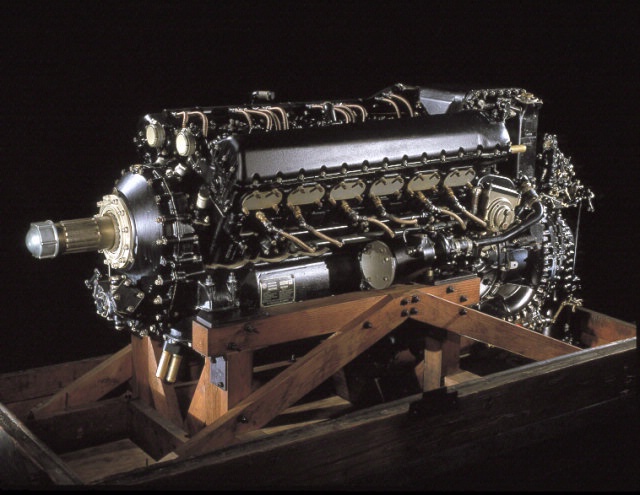
Object Details
Manufacturer
Wright Aeronautical
Physical Description
Type: Reciprocating, 12 cylinders, 2 rows, radial, liquid cooled
Power rating: 746 kW (1,000 hp) at 2,400 rpm
Displacement: 34.7 L (2,120 cu in.)
Bore and Stroke: Not available
Weight: 544 kg (1,200 lb)
Summary
In the early 1930s, the Navy supported Wright development of two new liquid-cooled engines, the XR-2120 (H-2120) and the V-1800. This was part of a "high-speed development program" undertaken by the Navy because of concern over the growing superiority of foreign airplanes in top speed, especially as demonstrated in the 1929 Schneider Trophy contest and again in 1931.
First of the two engines and derived from the Curtiss H-1640, it was anticipated that the XR-2120 design, with liquid cooling and enlarged cylinders, would make a good racing engine. The small diameter of the engine, considered important for drag reduction, proved to be difficult to develop due to excessive angularity of the connecting rods and other problems. The Navy withdrew support from the project, primarily because it decided to focus on the development of air-cooled engines. Convinced that the design was mechanically poor, Wright made little effort to persuade the Navy to change its decision and dropped the project.
Credit Line
Transferred from the U.S. Navy
Date
Circa 1933
Inventory Number
A19710896000
Restrictions & Rights
CC0
Type
PROPULSION-Reciprocating & Rotary
Materials
Steel, Aluminum, Rubber, Textile, Magnesium, Paint, Stainless Steel
Dimensions
Approximate: 160 × 167.6 × 147.3cm (63 × 66 × 58 in.)
Approximate (Weighed with Stand): 694kg (1530lb.)
Depth 160 cm (63 in.), Length 167.6 cm (66 in.), Width 147.3 cm (58 in.)
Country of Origin
United States of America
See more items in
National Air and Space Museum Collection
Data Source
National Air and Space Museum
Link to Original Record
Record ID
nasm_A19710896000