
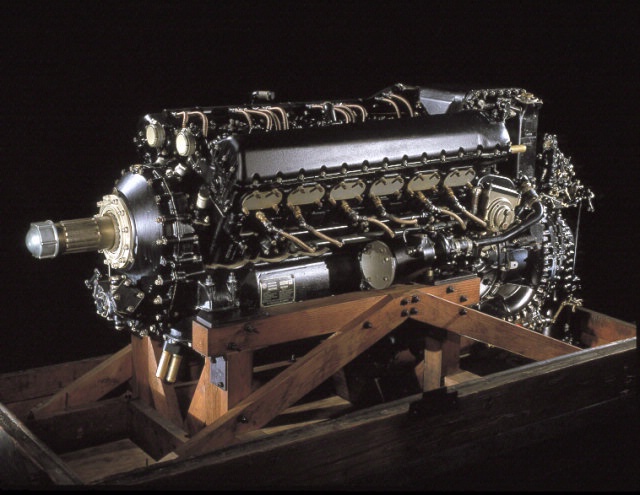
Object Details
Manufacturer
Wright Aeronautical
Physical Description
Type: Reciprocating, 9 cylinders, radial, air-cooled
Power rating: 168 kW (225 hp) at 2,000 rpm
Displacement: 12.9 L (788 cu in.)
Bore and Stroke: 114 mm ( 4.5 in.) x 140 mm ( 5.5 in.)
Weight: 231 kg (508 lb)
Summary
The J-5 Whirlwind was a cornerstone aviation technology of the 1920s and 1930s. Charles L. Lawrance began work on the J-series of compact, lightweight, air-cooled radials for the U.S. Navy in 1921. The Navy merged Lawrance's firm with Wright Aeronautical in 1923 to further develop and manufacture the new engines. The J-5 had such advanced features as sodium-cooled exhaust valves and aluminum cylinder heads designed by engine pioneer Sam D. Heron.
The Whirlwind became the engine of choice for America's long-distance and exploratory fliers, including Charles Lindbergh, who chose a J-5 for the Spirit of St. Louis. This artifact, a military R-790-A, was the center engine on the Army Air Corps Fokker C-2 tri-motor “Question Mark,” which pioneered aerial refueling by setting an endurance record of 150 hours and 40 minutes over Los Angeles in 1929.
Credit Line
Transferred from the War Department, Air Corps
Date
December 14, 1928
Inventory Number
A19290017000
Restrictions & Rights
CC0
Type
PROPULSION-Reciprocating & Rotary
Materials
Aluminum, Steel, Paint, Phenolic, Rubber, Copper, Preservative coating
Dimensions
3-D (Engine): 107.9 × 115.6 × 90.2cm (3 ft. 6 1/2 in. × 3 ft. 9 1/2 in. × 2 ft. 11 1/2 in.)
3-D (Overall with Stand): 113.3 × 132.1 × 147.3cm, 366.5kg (3 ft. 8 5/8 in. × 4 ft. 4 in. × 4 ft. 10 in., 808lb.)
3-D (Stand Base): 132.1 × 113.3 × 16.2cm (4 ft. 4 in. × 3 ft. 8 5/8 in. × 6 3/8 in.)
3-D (Prop Shaft Length): 24.4cm (9 5/8 in.)
Country of Origin
United States of America
See more items in
National Air and Space Museum Collection
Location
National Air and Space Museum in Washington, DC
Exhibition
Barron Hilton Pioneers of Flight
Data Source
National Air and Space Museum
Link to Original Record
Record ID
nasm_A19290017000