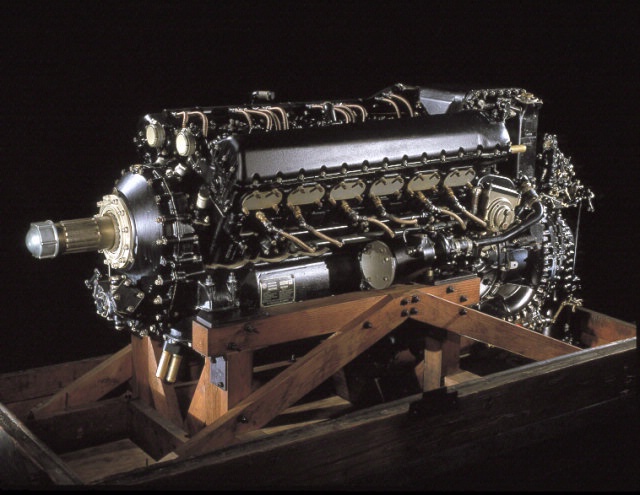
Object Details
Manufacturer
Wright Company (Dayton, Ohio)
Physical Description
Engine Type: Reciprocating, 4 cylinders, in-line, water cooled
Power rating: 31 kW (42 hp) at 1,325 - 1,500 rpm
Displacement: 3.9 L (240 cu in.)
Bore and Stroke: 111 mm (4.375 in.) x 102 mm (4 in.)
Weight: 81.6 kg (180 lb.)
Summary
The Wright vertical four-cylinder engine was designed by Orville Wright in 1906. These engines, of which more were built than any other Wright Brothers' engine model, were produced until approximately 1912. They were used during the U.S. Army and European demonstrations, which were crucial to the success of the Wright brothers and their airplanes. An engine of this type powered the Vin Fiz, the first U.S. transcontinental aircraft, and Wright Model B aircraft. A Wright B1 was the U.S. Navy’s second aircraft, which was first flown by Orville Wright on July 15, 1911, and later converted to a “hydroaeroplane.”
This particular engine was a keepsake of Orville Wright for many years. Wright gave the engine to his close and trusted friend, Jim Jacobs, who had been a mechanic with the original Wright Company. In 1948, the engine was donated to the Smithsonian Institution by Jacobs' wife, Ruth.
Credit Line
Gift of the Family of James M. H. Jacobs
Date
1906
Inventory Number
A19620037000
Restrictions & Rights
CC0
Type
PROPULSION-Reciprocating & Rotary
Materials
Metal
Plastic
Coating
Dimensions
Overall: 1 m 3.5cm × 45.7cm × 68.6cm, 81.6kg (3 ft. 4.8 in. × 1 ft. 6 in. × 2 ft. 3 in., 180lb.)
Overall (Support (Each block)): 47.3cm × 7cm × 11.4cm (1 ft. 6.6 in. × 2.8 in. × 4.5 in.)
Country of Origin
United States of America
See more items in
National Air and Space Museum Collection
Location
National Air and Space Museum in Washington, DC
Exhibition
Wright Brothers & The Invention of the Aerial Age
Data Source
National Air and Space Museum
Link to Original Record
Record ID
nasm_A19620037000