
Object Details
Designer
Orville Wright
Manufacturer
Wright Company (Dayton, Ohio)
Physical Description
Type: Reciprocating, in-line, 4 cylinders, liquid cooled
Power rating: Normal 22.4 kW (30 hp) at 1,200 rpm, Maximum 29.1 kW (39 hp) at 1,600 rpm
Displacement: 3.95 L (241 cu in)
Bore and Stroke: 111 mm (4.375 in.) x 102 mm (4.0 in.)
Weight: 81.7 kg (180 lb)
Summary
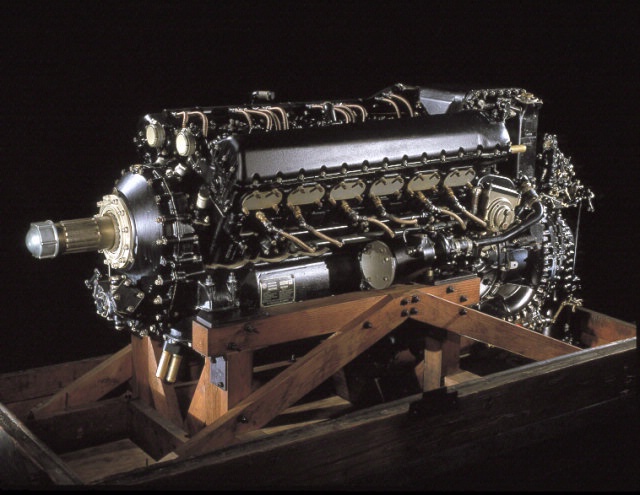
Because the Wright Brothers’ initial and primary objective was demonstration of heavier-than-air flight, their early engines, which they designed and manufactured themselves, were very similar and rudimentary. For example, they did not have carburetors. This Wright Vertical 4, the oldest existing U.S. Navy aircraft engine, powered the Navy's first Wright airplane, the B-1 hydro-aero plane. In 1912 the B-1 crashed in San Diego Bay during a training flight. Navy mechanics repaired the heavily damaged aircraft and its engine. However, attempts to solder and weld the aluminum fragments to the crankcase proved impossible, so an electrician fabricated a sheet metal patch and bolted it to the lower side of the crankcase.
This engine is the only known artifact to have survived from the Navy's first aviation training program, during which routine flights and accidents resulted in a cycle of repair and reconstruction of aircraft and overhaul of many engines.
Credit Line
Transferred from the Department of the Navy, Bureau of Aeronautics
Date
1911
Inventory Number
A19520108000
Restrictions & Rights
Usage conditions apply
Type
PROPULSION-Reciprocating & Rotary
Dimensions
Length 88.9 cm (35 in.), Height 63.5 cm (25 in.), Width 35.6 cm (14 in.)
Country of Origin
United States of America
See more items in
National Air and Space Museum Collection
Location
Steven F. Udvar-Hazy Center in Chantilly, VA
Hangar
Boeing Aviation Hangar
Data Source
National Air and Space Museum
Link to Original Record
Record ID
nasm_A19520108000